




This post may contain affiliate links. Please read our disclosure and privacy policy for more information.
A blown fuse can make simple things stop working. Your radio might go dead. Power windows might not move. Your horn might stop. In many cases, the fix is a small fuse that costs very little and takes a few minutes to replace at home.
This guide walks you through DIY fuse replacement in easy steps. You do not need special skills. You just need to be careful and use the correct fuse.
Tools and Items Needed
- Owner’s manual (or fuse box diagram on the cover)
- Replacement fuses (same type and same amp rating)
- Fuse puller (often inside the fuse box) or plastic tweezers
- Small flashlight
- Phone camera (for a quick photo of the fuse layout)
- Optional: Multimeter or 12V test light
- Optional: Needle-nose pliers (only if you are careful and gentle)
Safety or Legal Notes
Fuses protect wiring. If you put in the wrong fuse, you can damage the car or create a fire risk. Always replace a fuse with the same amp rating and the same style.
Turn the car off before you touch fuses. Remove the key. If your car has a push button start: Keep the key fob away from the car so it cannot wake up systems.
For under-hood fuse boxes: Let the engine bay cool down first. Hot parts can burn you.
If a fuse blows again right away, do not keep replacing it. That usually means there is a short or a failing part that needs diagnosis.
Numbered Fuse Replacement Steps
1) Confirm the Problem
Start with a simple check. What stopped working? Try one or two quick tests.
- If one power window does not work but the others do: It might be the window switch or motor, not a fuse.
- If all power windows stopped: A fuse or relay is more likely.
- If the radio is dead: Check if the screen is off and no buttons respond.
Do not guess. Your goal is to find the fuse that matches the exact circuit.
2) Find the Correct Fuse Box
Most cars have at least two fuse boxes:
- One inside the cabin (often under the dash, side of the dash, or near the glove box)
- One in the engine bay (often near the battery)
Use the owner’s manual to locate them. If the manual is missing, look for a fuse diagram on the fuse box cover.
3) Open the Fuse Box and Read the Diagram
Remove the cover. There is usually a diagram showing fuse positions and names. Use a flashlight. Take a photo before you pull anything. This helps you put everything back correctly.
Look for the circuit name that matches your issue. Common labels include RADIO, ACC, PWR OUTLET, CIG, HORN, WIPER, POWER WINDOW, ECU, or TAIL.
4) Identify the Fuse Type and Amps
Most modern cars use blade fuses. They are small and colorful. The amp rating is printed on the top, like 10, 15, 20, or 30.
Match two things:
- Same physical type (mini, low-profile mini, standard, or cartridge style)
- Same amp rating number
If you are new to DIY car work and want more simple projects like this, try DIY car phone mount installation for an easy win at home.
5) Pull the Suspected Fuse
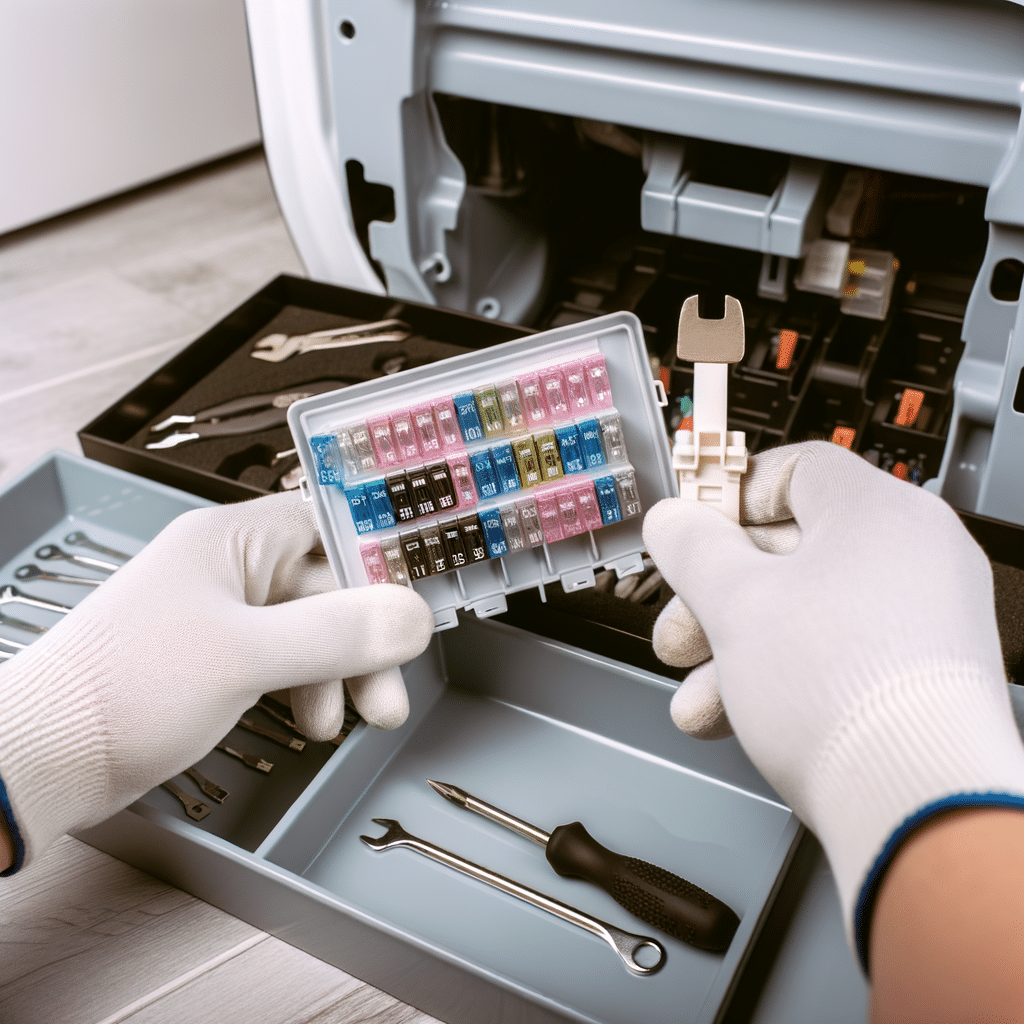
Use the fuse puller if your car has one. It is often clipped into the fuse box. Grip the fuse straight and pull up gently.
If you use tweezers or pliers: Use light pressure. Do not crush the plastic. Do not bend the fuse blades.
6) Check if the Fuse Is Blown
Hold the fuse up to the light. Inside the clear plastic, you will see a small metal strip.
- Good fuse: The metal strip is unbroken.
- Blown fuse: The metal strip is broken or looks burnt.
If you cannot tell by eye, use a multimeter on continuity mode. Touch one probe to each blade.
- Continuity or beep: Fuse is good.
- No continuity: Fuse is blown.
7) Replace With the Correct Fuse
Push the new fuse into the same slot. It should sit fully and evenly. Do not force it. If it does not fit, it is probably the wrong style.
Never install a higher amp fuse “just to get home.” That can let too much current flow and overheat wiring.
8) Test the System
Put the fuse box cover back on loosely, then test the item that failed. Turn the ignition to ACC or ON if needed.
- If it works: Turn the car off again and reinstall the cover properly.
- If it still does not work: You may have the wrong fuse, a relay issue, or a fault in the part or wiring.
- If the new fuse blows right away: Stop and troubleshoot the cause.
Sometimes electrical issues show up together with warning lights. If your dash light comes on but the car feels normal, this guide can help you think through it: check engine light on.
9) If the Fuse Blows Again, Do These Quick Checks
A repeated blown fuse is a clue. Here are beginner-friendly checks before you book a shop visit.
- Unplug recent add-ons: Phone chargers, dash cams, or anything in the 12V outlet.
- Look for a pinched wire: Around door hinges, trunk hinges, or under a seat.
- Check for water: Wet carpets or a damp fuse box area can cause issues.
- Try the circuit with the load disconnected: Example: If the “RADIO” fuse blows, unplug the radio if you know how and try again.
Common Mistakes
- Using the wrong amp fuse: This is the biggest mistake.
- Swapping fuses around “to test”: You can create new problems and confusion.
- Not reading the fuse box diagram: Many fuses look the same but protect different systems.
- Pulling fuses with metal tools carelessly: You can damage the fuse blades or short something.
- Forgetting the fuse box cover: Some covers help keep moisture out and prevent rattles.
Maintenance Tips
Fuse replacement is not regular maintenance, but a little prep helps.
- Keep a small spare fuse kit in the glove box: 10A, 15A, 20A, and 30A are common.
- Label your fuse kit: Match the types your car uses.
- Fix loose 12V outlet chargers: Poor-quality plugs can cause shorts.
- Do not overload accessories: Running too many devices on one outlet can blow fuses.
Small checks at home can prevent surprises later. This quick guide is a good habit to add: home tire pressure check.
Is It Worth It?
Yes, in most cases. Fuse replacement is one of the easiest DIY fixes. It is cheap, fast, and beginner friendly. It can save a trip to a shop for a small, simple problem.
That said, it is only worth it if you replace the fuse correctly. If the fuse keeps blowing, the real problem is somewhere else. At that point, diagnosis matters more than more fuses.
If you are working on an older vehicle, you may see more electrical quirks over time. This can help you set expectations: Basics of modding older cars.
Conclusion
Replacing a blown fuse at home is a simple skill that every beginner can learn. Find the right fuse box, match the fuse type and amp rating, swap it carefully, and test the system. If the new fuse blows again, stop and look for the cause. With a small spare fuse kit and a careful approach, you can fix many small electrical problems in minutes.


