




This post may contain affiliate links. Please read our disclosure and privacy policy for more information.
- The Origins
- Early Development: Series I (1948 to 1958)
- Series II and IIA: Making the Land Rover a Global Standard (1958 to 1971)
- Major Turning Points: Coil Springs and the Range Rover Effect
- Series III: Updating Without Losing the Formula (1971 to 1985)
- The 1980s Transition: From “Series” to Defender in All but Name
- Defender (1983 to 2016): A Working Icon Under Pressure
- Technology Evolution: From Utility Mechanics to Electronic Control
- Design Evolution: Practical Shapes, Then a Clean Break
- Modern Evolution: The New Defender (2020 to Present)
- Challenges and Competition Across the Decades
- Cultural Impact: From Tool to Symbol
- Legacy and Lasting Influence
The Land Rover story is really a story about changing needs. It began as a simple work tool for farms and remote areas, then grew into a symbol of exploration, government service, and hard use. Later it had to adapt to comfort expectations, emissions rules, safety standards, and global competition. From the Series I to today’s Defender, each major change happened because the world around the vehicle changed.
The Origins
Land Rover was born in postwar Britain, when materials were scarce and export sales mattered. Rover, best known for refined passenger cars, needed a product that could sell overseas and use available resources. The idea took inspiration from the Willys Jeep, which had proven the value of a light 4×4 during the war and then in civilian life.
The first Land Rover prototype appeared in 1947, and the production model arrived in 1948. It was built with practicality in mind: A steel chassis, simple body panels made from aluminum alloy, and a no-nonsense interior that could be hosed out. Aluminum was not chosen for style. It was chosen because steel was rationed and Rover already had experience working with alloy.
From the start, Land Rover aimed at buyers who needed traction and durability more than speed. Farms, utility companies, and colonial services were key markets. These customers wanted a vehicle that could do the job every day with basic tools and limited support, far from dealerships.
Early Development: Series I (1948 to 1958)
The original model, later known as the Series I, began with an 80-inch wheelbase and a 1.6-liter petrol engine. Four-wheel drive was selectable, and early vehicles were meant to spend most of their time in rear-wheel drive on roads. This reflected the era. Many rural users drove on mixed surfaces, and mechanical simplicity was prized.
As demand grew, the Land Rover expanded quickly. Wheelbases increased to 86 and 107 inches, and the engine grew to 2.0 liters in 1952. These changes were not about performance for its own sake. They were about load carrying, towing, and durability under heavier work. The Land Rover was already being used as an ambulance, pickup, station wagon, and general-purpose transport.
One of the most important additions arrived in 1957: A 2.0-liter diesel option. Diesel power suited the Land Rover’s real-world job better, with low-speed pulling strength and improved economy for high-mileage fleet users. When fuel cost and range could decide whether a vehicle was viable in remote regions, diesel mattered.
Series II and IIA: Making the Land Rover a Global Standard (1958 to 1971)
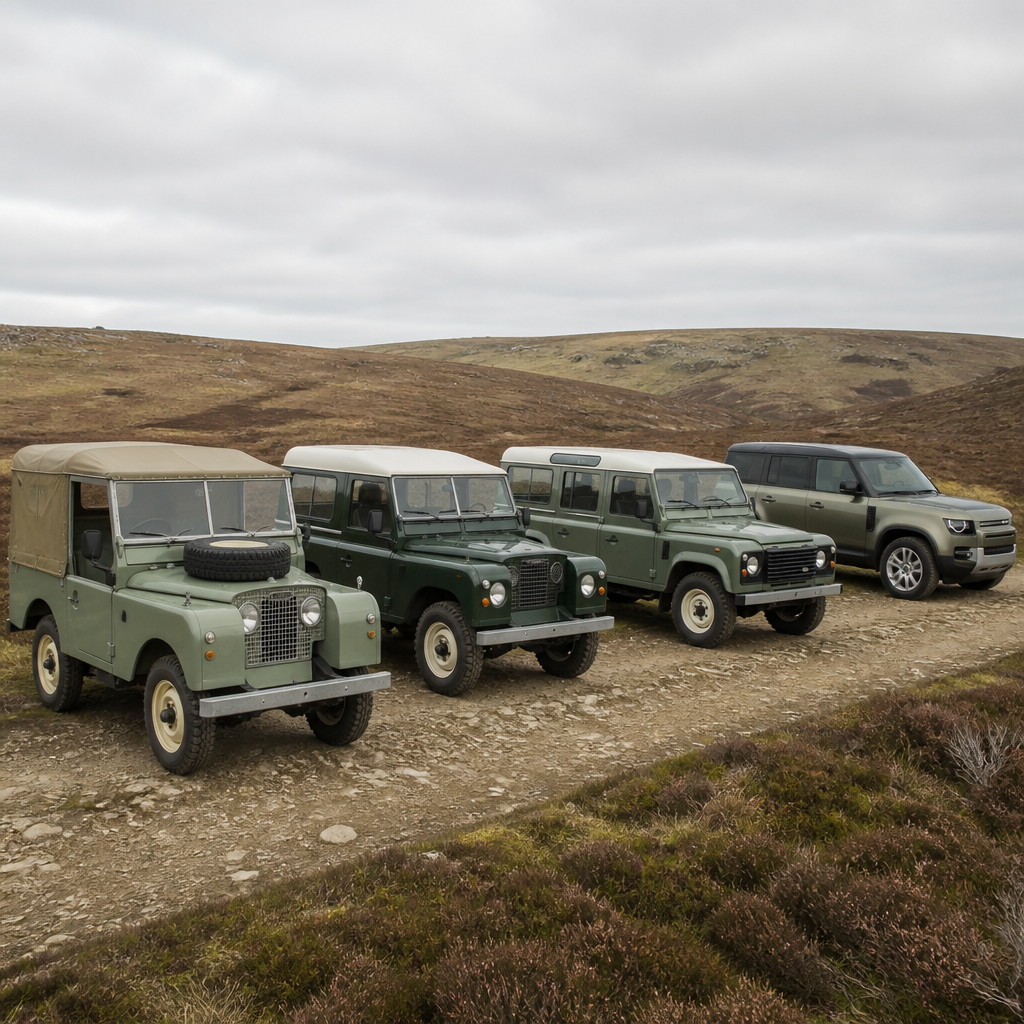
In 1958, Land Rover launched the Series II. The new model introduced a wider track and a more rounded body shape, which improved cabin space and stability. The design was still plainly functional, but this generation established what many people picture when they think “classic Land Rover.”
Land Rover also started to look more closely at how the vehicle behaved on the road, not just off it. Many Series trucks were now doing long trips between towns and job sites. Better comfort and a more settled ride made the vehicle easier to live with, which helped broaden its appeal beyond strictly agricultural users.
The Series IIA arrived in 1961 and is often seen as the definitive early Land Rover. It offered a 2.25-liter petrol engine, and a 2.25-liter diesel followed. The 2.25-liter units became known for durability and serviceability, which mattered as Land Rovers spread across Africa, Australia, and the Middle East.
Market conditions also helped. Many regions wanted rugged vehicles but had limited paved roads, limited service networks, and high demands from government and industry. Land Rover met those needs with a modular platform and a wide variety of body types. In some places, the Land Rover became a default choice for officials and aid organizations, partly because it was available and familiar.
Major Turning Points: Coil Springs and the Range Rover Effect
By the late 1960s and early 1970s, a new problem was becoming clear. The leaf-sprung Land Rover was capable off-road, but its on-road ride could be tiring, especially as buyers began to expect higher speed travel and more comfort. Meanwhile, global competitors were improving.
A key shift arrived not directly through the working Series models, but through the 1970 Range Rover. With coil springs and a more refined driving experience, the Range Rover proved Land Rover could blend comfort and off-road ability. That mattered because customer expectations were changing. Many buyers wanted one vehicle for work, family, and travel.
This was also the start of a long-running challenge for Land Rover: Keeping the tough, simple identity while meeting comfort, refinement, and regulatory demands. Once customers experience comfort, they tend to want it again.
Series III: Updating Without Losing the Formula (1971 to 1985)
The Series III launched in 1971. It looked familiar but included updates that reflected broader industry trends. A fully synchronized gearbox made driving easier, especially for drivers who were not used to agricultural vehicles. Interior trim improved, and dashboards became more car-like over time.
These changes happened because the Land Rover was no longer used only by specialists. It was being bought by families, small businesses, and drivers who wanted the image and capability without the daily inconvenience. Some markets also faced stricter rules on noise and safety, nudging manufacturers toward more civilized cabins.
Still, the Series III kept the core structure and leaf springs. That decision shows the tightrope Land Rover was walking. Making a clean break would have risked losing the vehicle’s working reputation and parts compatibility in global markets. But staying too static would leave it behind.
The 1980s Transition: From “Series” to Defender in All but Name
Land Rover’s next step was more than a facelift. In 1983, the Ninety (later 90) arrived, followed by the One Ten (later 110) in 1984. These models introduced coil-spring suspension to the utility line, bringing a clear improvement in ride and wheel articulation. This was a direct answer to the comfort problem and to competition from vehicles that were becoming easier to drive every day.
They also introduced a more modern chassis and driveline approach, including permanent four-wheel drive on many versions, influenced by Range Rover engineering. Permanently driven four wheels improved on-road stability and off-road control, but it added complexity. Land Rover accepted that trade because market expectations were shifting toward safer, more predictable handling at speed.
During this era, powertrain development accelerated. New diesel engines appeared, including the 2.5-liter naturally aspirated diesel and later turbo diesels. Internationally, diesel was becoming essential for utility 4x4s, both for running costs and torque delivery.
Defender (1983 to 2016): A Working Icon Under Pressure
The name “Defender” was officially introduced in 1990, largely to distinguish Land Rover’s utility models from the Discovery (launched in 1989) and the Range Rover. This naming change sounds simple, but it marked a new reality. Land Rover was now managing a family of vehicles aimed at different customers, from work to family to luxury.
Under the skin, the Defender continued to evolve in response to emissions rules, noise limits, and safety demands. The 200Tdi engine arrived in the early 1990s, followed by the 300Tdi in 1994. These engines improved refinement and efficiency while keeping the low-speed strength buyers depended on. Later, the five-cylinder Td5 arrived for 1998, bringing electronic engine management. That step was driven by emissions and drivability needs. Mechanical diesels were robust, but electronics provided cleaner running and smoother control.
In 2007, Defender gained the Ford Duratorq-based 2.4-liter diesel (often called “Puma”), paired with a six-speed gearbox. In 2012, it moved to a 2.2-liter version to meet updated emissions requirements. Each update was a compromise: More compliance and usability, but also more complexity and cost.
Consumers reacted in two different ways. Many traditional users appreciated incremental improvements, but some disliked the move away from simple mechanical systems. At the same time, a growing group of private owners embraced the Defender as a lifestyle vehicle. They accepted the driving position, the noise, and the slow steering as part of its character.
Competitors kept moving. Toyota’s Land Cruiser lines, Nissan’s Patrol, and later a wave of modern pickups offered strong durability with more comfort. Even within Land Rover’s own showroom, the Discovery catered to buyers who wanted space and refinement with serious off-road ability. The Defender’s place became narrower, and its old design faced mounting regulatory and safety barriers.
By the mid-2010s, it was becoming difficult to keep the classic Defender on sale in key markets without fundamental re-engineering. The vehicle’s basic architecture dated back decades. Side-impact standards, pedestrian protection rules, and modern crash structures were not easy to integrate into that shape without losing what made it the Defender. Production ended in 2016.
Technology Evolution: From Utility Mechanics to Electronic Control
Looking across generations, the biggest technological shift was not power. It was control. Early Land Rovers relied on mechanical grip, low gearing, and driver skill. As the brand expanded, electronic systems became essential for meeting regulations and improving user confidence.
Traction control, stability control, hill descent control, and electronically managed drivetrains helped everyday drivers access off-road capability without specialist technique. This also changed what “off-road” meant to customers. It was less about mechanical empathy and more about selecting the right mode and trusting the system.
Weight also became a more complicated issue. The earliest Land Rovers used aluminum bodywork and simple cabins partly because of material shortages, but the side effect was relatively low mass for a working 4×4. Over time, safety structures, sound deadening, emissions equipment, and comfort features increased curb weight across the industry. That has real consequences for performance, braking, and efficiency, which is why discussions around weight reduction and fuel use have become more common as modern vehicles grow heavier.
Design Evolution: Practical Shapes, Then a Clean Break
Classic Land Rover design followed function, with flat panels that were easy to replace and a cabin that prioritized visibility and utility over style. Even when the Series II added curvature, it remained a practical vehicle first.
The original Defender kept that philosophy. Its upright stance helped visibility on trails and in cities. Its boxy body allowed flexible cargo use. But those same traits became problems under modern safety rules, which favor crumple zones, controlled deformation, and pedestrian impact management. A tall, flat front and narrow structure are difficult to reconcile with those requirements.
By the time Land Rover prepared a modern replacement, it was clear that small tweaks would not be enough. A full redesign was the only realistic path if the Defender name was going to continue.
Modern Evolution: The New Defender (2020 to Present)
The modern Defender launched for 2020 (North American market timing varies slightly by model year and body style). It moved to a new platform with a unibody structure rather than the old body-on-frame approach. This was the most controversial change in Defender history, but it was rooted in practical constraints.
A modern crash structure, stronger torsional rigidity, and better packaging for safety systems are easier to accomplish with contemporary engineering approaches. The new Defender also needed to support multiple powertrains and advanced driver assistance systems. Meeting global emissions and safety standards, while also delivering refinement expected at its price point, pushed the design toward a modern premium SUV architecture.
Land Rover also had to consider who the Defender buyer had become. Many customers now wanted a daily vehicle that could manage winter roads, towing, and occasional off-road travel, rather than a truck that lived on a farm. The market for a bare-bones utility 4×4 had shrunk in many regions, partly because commercial buyers moved to capable pickups and vans.
Off-road capability did not disappear, but it changed character. The new Defender relies on electronics, sophisticated traction control, and chassis tuning to deliver ability with less driver effort. It also introduced more road comfort, quieter cabins, and more controlled handling. Buyers generally responded positively, especially those who never owned the older Defender. Long-time enthusiasts were split: Some saw it as a necessary evolution, others felt the name should have stayed with a simpler vehicle.
Industry competition shaped this shift as well. The Mercedes-Benz G-Class proved that an off-road silhouette could survive as a luxury product, but it also showed the cost of maintaining a tough image while meeting regulations. Jeep’s Wrangler remained closer to its roots, but even it adopted modern safety engineering and electronics over time. The Defender entered this landscape as a new kind of multipurpose SUV, carrying heritage while competing in a modern segment.
Challenges and Competition Across the Decades
Land Rover’s biggest challenge was always balancing extremes. Work users demanded simplicity, strong parts support, and rebuildable components. Private buyers wanted comfort, image, and reliable daily use. Regulators demanded safer and cleaner vehicles, which tend to add cost and complexity.
Economic conditions played a role throughout. Postwar austerity helped create the first Land Rover. Later, global expansion and changes in rural economies shaped demand. In more recent decades, the SUV boom provided opportunity, but it also raised expectations for refinement and reliability. When buyers pay more, tolerance for quirks drops.
That shift also affected the used market. Older Defenders became valuable, and that makes careful inspection important. When classic 4x4s become collectibles, buyers pay attention to history and documentation, which connects to broader used-car topics like Odometer fraud in used cars.
Cultural Impact: From Tool to Symbol
Land Rovers earned cultural weight because they were seen in hard places doing real work: On farms, at construction sites, with aid groups, and in remote travel. That visibility gave them authenticity that advertising could not manufacture. Over time, the vehicle’s image expanded. The Defender became associated with exploration, outdoors culture, and a certain functional design honesty.
In the 1990s and 2000s, as SUVs became everyday vehicles, the Defender’s utilitarian nature made it stand out. Its driving quirks became a feature for enthusiasts, a reminder that it came from a different era. That identity helped preserve demand even when the product was objectively outdated in comfort and safety terms.
Legacy and Lasting Influence
The Land Rover line shows how a vehicle can evolve from necessity into heritage, and then into a modern product shaped by rules and expectations its creators never imagined. The original Series models solved a postwar problem: Build something simple, exportable, and useful with limited resources. The Defender era tried to keep that utility spirit alive while adapting to emissions and customer demands. The modern Defender represents a different kind of solution: How to preserve a name and a mission in a world where safety engineering, electronics, and refinement are non-negotiable.
Whether someone prefers leaf springs and a hand-me-down toolbox approach or a modern cabin with driver aids, the through-line remains clear. Land Rover kept returning to the same question: How do you build a vehicle that can travel far from help and still feel at home on the road? That question is why the Land Rover evolution still matters, and why the Defender name continues to carry meaning.


