




This post may contain affiliate links. Please read our disclosure and privacy policy for more information.
- Scuderia Ferrari begins as a racing organization
- The first steps toward Ferrari road cars
- 1950s: Ferrari becomes a symbol, not just a team
- 1960s: expansion, icons, and a turning point with Fiat
- 1970s: mid-engine becomes the new Ferrari language
- 1980s: turbo era, supercar headlines, and the last Enzo-era statement
- 1990s: modernizing Ferrari without losing the soul
- 2000s: paddle shifts, carbon ceramics, and a new kind of speed
- 2010s to the present: hybrid power and a wider audience
- Why Ferrari’s milestones still matter
- Related Resources
In the early 1900s, racing in Italy was not a side show. It was a proving ground for engineering, pride, and reputation. Enzo Ferrari grew up in that world, shaped by the noise and danger of competition long before his name would sit on the hoods of some of the most famous cars ever made. When people talk about Ferrari’s origin, it helps to start with the person first, because for decades the company’s direction followed Enzo’s instincts more than any market research.
Enzo Ferrari was born in 1898 in Modena. As a young man, he chased motorsport work however he could find it, and after World War I he aimed for a place in the growing Italian car industry. By 1919 he was racing, and in 1920 he joined Alfa Romeo as a driver. It mattered that Ferrari entered the story through racing rather than road cars. That single fact explains so many later choices: the obsession with speed, the willingness to build specialized machines, and even the idea that a Ferrari road car could exist partly to fund the next race program.
Scuderia Ferrari begins as a racing organization
In 1929, Enzo founded Scuderia Ferrari in Modena. At that time, it was not an independent car manufacturer. Scuderia Ferrari operated primarily as a racing team and a kind of semi-official competition arm for Alfa Romeo, running cars for talented private drivers and managing race logistics. It was a smart move in an era when racing required deep organization, spare parts, and technical coordination that many drivers could not handle alone.
Through the early 1930s, Scuderia Ferrari became a serious presence on the grid. But the decade also pushed racing technology forward at an unforgiving pace. Engines grew more powerful, chassis design improved, and factory-backed programs became more professional. Enzo’s role shifted from simply participating to coordinating people, machines, and strategy. That management style would later define Ferrari as a company: small enough to feel personal, but intense enough to demand results.
In 1938, Alfa Romeo brought its racing efforts more directly under factory control. Enzo was placed in charge of their racing department, but the arrangement did not last. He left Alfa in 1939, and as part of the separation he agreed to a restriction that limited his ability to use the Ferrari name in racing and car manufacturing for a period of time. This detail is often skipped, but it explains why Ferrari’s next step did not immediately wear the famous badge.
The first steps toward Ferrari road cars
In late 1939, Enzo formed Auto Avio Costruzioni. During World War II the company focused on wartime work and machine tools, like many Italian firms trying to survive the conflict. Yet even then, the desire to build a proper car did not disappear. In 1940, Auto Avio Costruzioni produced the 815, a pair of cars built for the Mille Miglia. They were not called Ferraris, but they are often treated as the closest pre-history chapter to the brand, because they came from Enzo’s new organization and carried his racing intent.
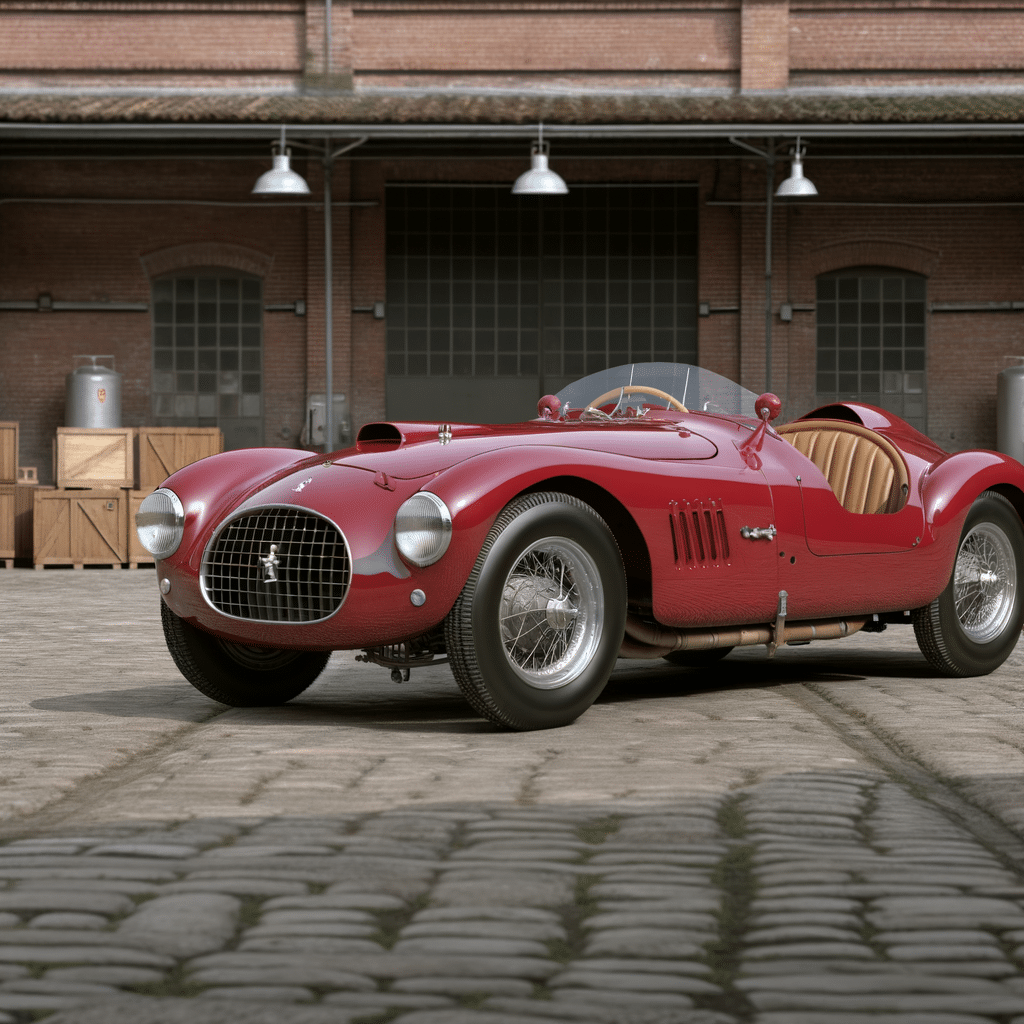
After the war, Italy was rebuilding, and so was Enzo’s operation. The company moved to Maranello, a location that would become inseparable from the Ferrari identity. In 1947, the first car officially wearing the Ferrari name appeared: the 125 S. It used a 1.5-liter V12 designed by Gioachino Colombo. Choosing a V12 for the first Ferrari was not a practical economy move. It was a statement. A V12 was smooth, prestigious, and capable of high-rev power, which suited Enzo’s belief that a car should feel special even before it won anything.
The 125 S raced the same year. Early reliability issues were part of the story, but Ferrari’s approach was clear: build, race, improve, repeat. The company’s reputation grew quickly because the cars were not created as luxury objects first. They were created as race machines that could be adapted into road-going forms for customers who wanted the closest thing to a competition car.
1950s: Ferrari becomes a symbol, not just a team
Ferrari entered Formula One in 1950, the first year of the official World Championship. That timing was important. Formula One became the public stage where the Ferrari name would build global meaning. In 1952 and 1953, Ferrari won the championship with Alberto Ascari. Those titles helped lock in the idea that Ferrari was not simply participating in the new era of racing, it was shaping it.
At the same time, Ferrari’s road cars began to develop a recognizable pattern. Small production numbers, hand-built bodies, and engines derived from racing knowledge made them expensive and rare. In the 1950s, Ferrari often relied on coachbuilders like Pinin Farina, whose work helped create the long-hood, short-deck proportions that became a visual signature. The beauty was not separate from function. High-speed stability and cooling needs influenced the shapes, but Italian design culture made them look effortless.
This decade also showed the darker side of motorsport’s intensity. Racing in the 1950s was extremely dangerous, and Ferrari’s competition program lived inside that reality. The pressure to win pushed technology forward fast, but it also came with tragedy across the sport. Ferrari’s identity, for better and worse, became tied to the idea that performance had a cost.
Key models from the era included the 250 series, particularly the 250 GT and later the 250 GTO in the early 1960s. These cars helped cement the blueprint: a V12 up front, light weight, and a balance of road usability with competition capability. Even today, the sound of a classic Ferrari V12 is a core part of its cultural image, and enthusiasts who love how engines communicate often start with Exhaust note basics to understand why certain layouts and firing orders feel so distinctive.
1960s: expansion, icons, and a turning point with Fiat
The 1960s brought both artistic high points and business strain. Ferrari’s racing success continued, but competition intensified and costs rose. The company was still relatively small, and the demands of developing new race cars while also producing road cars became harder to carry alone. Enzo Ferrari wanted racing independence, but he also needed financial stability.
During this time, the road car lineup produced some of the most legendary names in automotive history. The 250 GTO (1962) was built for homologation, shaped by racing rules and aerodynamic experimentation. Then came the mid-engine shift for Ferrari’s top sports cars, reflecting broader changes in race car design. Mid-engine layouts were proving superior for handling and balance at high speed. Ferrari tested the idea through models like the Dino prototypes, and the concept would soon reshape the brand’s performance image.
In 1968, Ferrari introduced the 365 GTB/4, better known as the Daytona. It kept a front-engine V12 layout, showing that Ferrari was not abandoning older formats overnight. Instead, Ferrari’s evolution often happened in parallel, with different layouts serving different roles in the range.
The major business milestone arrived in 1969 when Fiat acquired a 50% stake in Ferrari. This was not simply a corporate headline. It changed what Ferrari could afford to do. Fiat’s investment helped stabilize production and allowed Ferrari to keep racing without being as vulnerable to financial shocks. Enzo retained control of the racing operation, which was a central condition. The deal reflected Ferrari’s priorities: road cars mattered, but they were never supposed to replace racing as the heart of the company.
1970s: mid-engine becomes the new Ferrari language
The 1970s were a decade of change for every performance brand, shaped by emissions rules, safety standards, and fuel crises. Ferrari had to adapt without losing its identity. The answer was not to become practical. Instead, Ferrari refined how it delivered performance and drama under new constraints.
The Dino 246 GT, produced into the early 1970s, helped normalize the mid-engine layout for Ferrari customers, even though Dino was originally positioned as a sub-brand. The big turning point for Ferrari’s mainstream sports cars came with the 308 GTB in 1975. It brought a V8 mid-engine formula that would influence Ferrari’s core lineup for decades. The move to V8s was about more than cost. It offered packaging advantages, responsive handling, and a way to produce cars that were slightly more approachable than the flagship V12s while still feeling unmistakably Ferrari.
Ferrari’s Formula One story also swung dramatically in the 1970s. After a difficult period, the team returned to the top with Niki Lauda, winning championships in 1975 and 1977. Those wins mattered because Ferrari’s road cars were developing in a world where buyers increasingly cared about brand story. Racing success gave Ferrari legitimacy that marketing could not manufacture.
1980s: turbo era, supercar headlines, and the last Enzo-era statement
In the 1980s, performance culture went global. Posters, magazines, and television made supercars part of mass imagination. Ferrari became one of the defining symbols of that era, partly because its cars had both visual drama and racing credibility.
Turbocharging became a major theme, influenced by racing trends and the search for more power under regulatory pressure. Models like the 288 GTO (1984) and the F40 (1987) captured the decade’s obsession with speed and rawness. The F40, in particular, was shaped by a clear intent: minimal weight, high power, and a direct driving experience. It was introduced for Ferrari’s 40th anniversary and is widely understood as the last Ferrari developed under Enzo’s personal oversight. Enzo Ferrari died in 1988, and the company entered a new phase where leadership would continue, but the founder’s presence was gone.
Even when Ferrari embraced technology, it often did so in a way that kept the car feeling alive. That balance between sophistication and emotion is why debates about modifications, aesthetics, and performance can get intense around iconic brands, and why some enthusiasts think carefully about Balancing looks and performance mods when they personalize any sports car culture touchstone.
1990s: modernizing Ferrari without losing the soul
The 1990s forced Ferrari to become more consistent in quality and more modern in production. The world’s expectations had changed. Buyers still wanted excitement, but they also wanted cars that started reliably, handled heat and traffic better, and felt more refined at speed.
Cars like the 355 (1994) showed how Ferrari could blend high-revving character with improved aerodynamics and usability. The shift toward more advanced electronics began to take a bigger role, not to dull the experience but to help drivers use performance more confidently. This trend would accelerate in the next decade, especially as automated gearboxes and traction systems became normal in supercars.
Ferrari’s Formula One program also found a new long-term peak by the end of the decade. The arrival of Michael Schumacher and the rebuilding of the team set the stage for dominance in the early 2000s. That racing success mattered beyond trophies. It influenced road car technology, team morale, and Ferrari’s cultural visibility for a new generation watching highlights rather than reading racing newspapers.
2000s: paddle shifts, carbon ceramics, and a new kind of speed
In the 2000s, Ferrari’s road cars evolved into something faster and more electronically complex than ever before. Paddle-shift automated manuals, first controversial among purists, became a hallmark because they delivered quicker shifts and kept drivers focused on steering at high speed. It was a change driven by performance goals and by customer demand for speed without constant clutch work in traffic.
Models like the 360 Modena (1999) and F430 (2004) showed how aluminum construction, improved aerodynamics, and advanced stability systems could raise limits dramatically. Carbon-ceramic brakes became more common on higher trims and special models, reflecting supercar expectations for repeated hard stops without fade. For enthusiasts learning why a car’s behavior changes so much with hardware and tuning, suspension setup basics can make modern performance feel less mysterious.
Ferrari also kept its halo tradition alive with limited cars that acted as technology showcases. The Enzo (2002) referenced Formula One styling cues and pushed aerodynamics and materials forward, building a bridge between the brand’s race identity and its most extreme road execution.
2010s to the present: hybrid power and a wider audience
The 2010s brought the biggest philosophical shift since the move toward mid-engine layouts. Hybrid technology entered Ferrari’s top tier with the LaFerrari (2013). The reason was not environmental messaging first. It was performance. Hybrid systems could fill torque gaps, improve response, and add power in ways that made a car faster without relying only on displacement increases. Ferrari treated electrification as another tool for winning the same old argument: speed and control.
Turbocharging returned across much of the lineup, most notably with the 488 GTB (2015), replacing the naturally aspirated 458 Italia. The change happened because emissions and efficiency pressures were tightening, but Ferrari still needed huge power gains to stay competitive in the supercar world. Turbo engines delivered that, though Ferrari worked hard on throttle response and sound to preserve the emotional connection drivers expected.
Ferrari’s cultural footprint also widened. Social media compressed the distance between factory and fan, and a younger audience began to experience Ferrari through clips, games, and short-form content before ever seeing one in person. The brand’s image stayed aspirational, but its history remained rooted in a specific idea: racing creates the reason, road cars fund the continuation.
Modern Ferraris are now shaped by software as much as hardware. Stability logic, active aerodynamics, and drive modes can transform how the same car behaves in seconds. That does not mean the old Ferrari disappeared. It means the company adapted to a world where speed is easier to create than it is to control, and where the defining challenge is delivering confidence along with drama. For people who take performance driving seriously, the difference between a fast street car and something ready for repeated hard laps often comes down to details similar to a Weekend track car setup, even when the badge and budget are very different.
Why Ferrari’s milestones still matter
Ferrari’s story is not only a timeline of cars. It is a timeline of motivations. The early years were defined by a need to compete. The postwar era was defined by building machines that could win and also be sold. The Fiat partnership was shaped by survival and independence, not expansion for its own sake. The mid-engine shift followed racing physics, the turbo years followed both competition and regulation, and hybrid systems followed the modern reality that performance now comes from managing energy as much as burning fuel.
Across decades, Ferrari became a kind of shorthand for the idea that a car can be an event. That cultural impact did not appear overnight, and it did not come from design alone. It came because people watched the same name fight for wins year after year, then saw that same obsession translated into road cars with the look, sound, and feel of something built with a purpose beyond commuting. Even when Ferrari changes, it tends to change for reasons tied to the same core question it has asked since the 1940s: what will it take to be faster next time?
Ferrari’s place in car history also sits alongside other brands that shaped the modern world in different ways. Comparing its racing-first identity to companies built around mass mobility can put the contrast into focus, and seeing Ford’s key milestones nearby in the historical timeline helps show just how many different paths the automobile industry took through the 20th century.


