


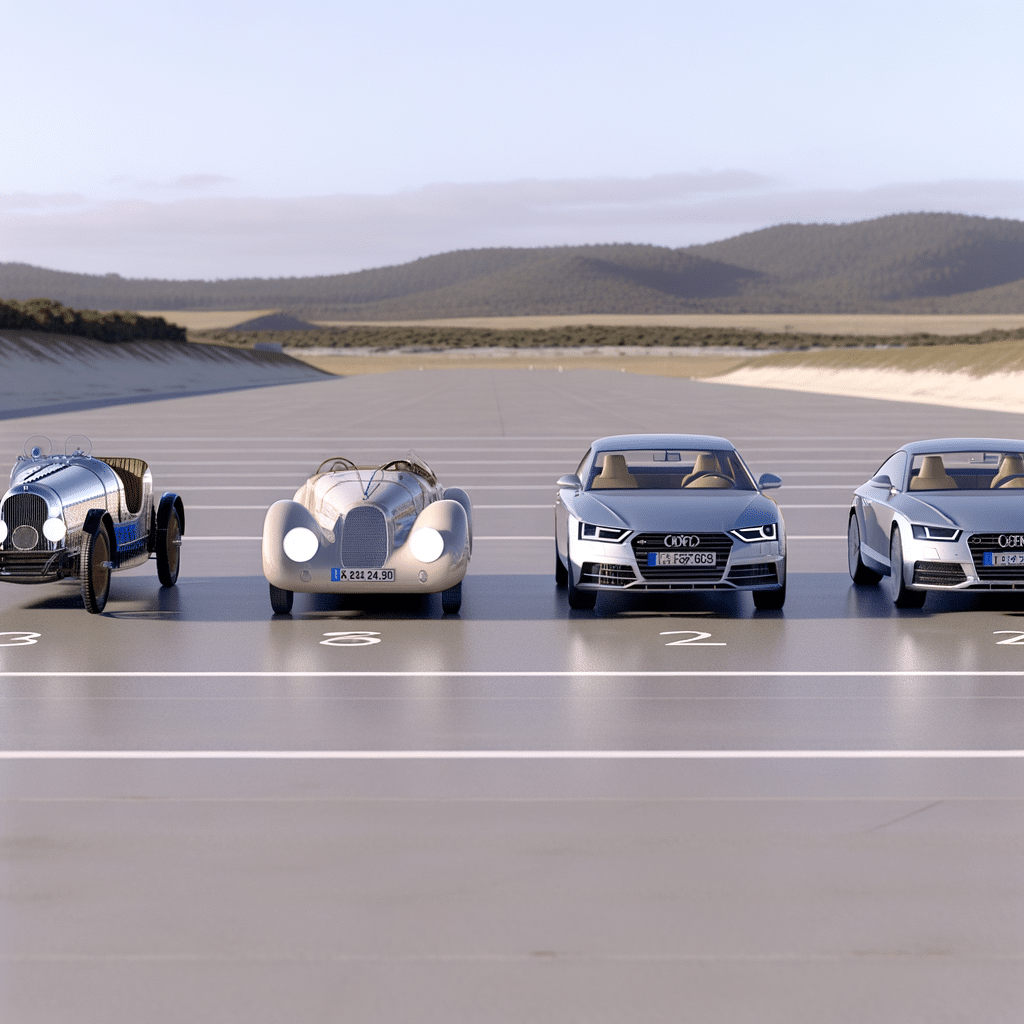
- The 1930s: Auto Union and the meaning of the four rings
- The 1940s and 1950s: War disruption and a slow restart
- The 1960s: Volkswagen ownership and the return of “Audi”
- The 1970s: Audi finds its shape, and the seeds of Quattro are planted
- The 1980s: Quattro changes the conversation
- The 1990s: Design discipline, quattro expansion, and the rise of S and RS
- The 2000s: Aluminum experiments, supercars, and LED identity
- The 2010s: Broader performance, digital cabins, and the first serious EV step
- The 2020s: Electric identity, software challenges, and a changing performance definition
Audi’s story moves like a long road with sharp turns: A small German manufacturer, a forced merger, a postwar restart, then a steady climb into modern performance and technology. The badge with four rings points back to the moment when several struggling brands had to become one, but it is the later decades that turned Audi into a name associated with clean design, all-wheel drive, and quietly confident speed.
To understand Audi through time, it helps to begin before “Audi” truly meant what it does today. In the early 1900s, engineer August Horch founded Horch, left after a dispute, and started a new company in 1909. He could not use his own surname again, so he translated “Horch” meaning “listen” into Latin: Audi. That small decision shaped a century of branding, but the company’s survival would soon depend on much bigger forces than a name.
The 1930s: Auto Union and the meaning of the four rings
In 1932, during the economic pressure of the Great Depression, Audi merged with Horch, DKW, and Wanderer to form Auto Union. The four-ring logo represented those four companies. This was not a marketing exercise as much as a financial necessity: Germany’s smaller manufacturers needed scale to develop cars and stay afloat.
Auto Union became famous in motorsport in the mid-1930s. The Grand Prix “Silver Arrow” racers, engineered under Ferdinand Porsche’s direction, used mid-engine layouts long before that idea became mainstream. While those race cars were far removed from everyday transport, their impact mattered later: Auto Union gained a reputation for technical ambition, the kind of reputation that would become central to Audi’s identity decades afterward.
The 1940s and 1950s: War disruption and a slow restart
World War II shattered German industry, and Auto Union’s factories in Saxony were largely lost or dismantled. After the war, the company re-established itself in West Germany, in Ingolstadt, a city that would become Audi’s long-term home. The postwar years were about basic mobility, not luxury or speed. DKW, one of the four Auto Union brands, leaned heavily into small cars and two-stroke engines, which were inexpensive and simple, fitting the era’s needs.
By the 1950s, that two-stroke identity became a problem. As West Germany’s economy improved, buyers expected smoother, quieter, more modern four-stroke engines. Auto Union needed investment and a new technical direction, and that set the stage for the next turning point: Volkswagen’s involvement.
The 1960s: Volkswagen ownership and the return of “Audi”
In 1964, Volkswagen acquired a majority stake in Auto Union from Daimler-Benz. The motivation was practical. Volkswagen was still heavily dependent on the Beetle and was looking for additional capacity and engineering depth. Auto Union, meanwhile, needed resources and a path away from aging two-stroke technology.
The breakthrough came with a new generation of four-stroke engines developed under engineer Ludwig Kraus, and in 1965 the company introduced the Audi F103 series. It was the first postwar car sold broadly under the Audi name, and it signaled a pivot: Audi would be about modern engineering rather than nostalgia. The models were labeled by power outputs like Audi 60 and Audi 75, a simple way to communicate progress in an era when the brand was still rebuilding recognition.
In 1969, Auto Union merged with NSU to form Audi NSU Auto Union AG. NSU brought advanced ideas, including the rotary engine experiment on the Ro 80, but also financial strain from warranty challenges. The merger mattered because it forced hard choices. Audi would pursue innovation, but it would do so with a more cautious focus on durability and repeatable production.
The 1970s: Audi finds its shape, and the seeds of Quattro are planted
The 1970s were when Audi began to feel like Audi. The Audi 100, introduced in 1968 and developed with an eye on aerodynamics and efficiency, grew into a core model line. It gave the brand a larger, more premium-feeling car without copying traditional luxury cues. Audi’s design started to look clean and modern, with a calm seriousness that appealed to buyers who wanted something different from the usual German choices.
In 1972, the Audi 80 arrived. It became important because it anchored Audi in the compact executive space and offered a platform for engineering improvements over time. The 1970s also brought the Oil Crisis, and that pushed European makers to think harder about weight, efficiency, and practical performance. Audi’s future signature was still coming, but the conditions that would make it famous were forming: Better traction, stability, and real-world speed became increasingly valuable as buyers drove more, in more varied weather, on faster roads.
For anyone interested in how German brands split into distinct identities during the same decades, Volkswagen history and origins provides useful background because Audi’s postwar path can’t be separated from Volkswagen’s corporate decisions.
The 1980s: Quattro changes the conversation
Audi’s defining milestone arrived in 1980 with the original Audi Quattro, revealed to the public and soon proven in rallying. The idea was simple but bold: Put a sophisticated all-wheel-drive system into a fast road car, not a truck. Engineers had noticed the capability of a military vehicle, the Volkswagen Iltis, in winter testing. The question became: What if that traction was applied to a performance coupe?
In the early 1980s, rallying was the perfect stage. The Quattro’s advantage on loose surfaces forced rivals to respond, and all-wheel drive shifted from being a niche concept into a new performance standard. Audi’s wins in the World Rally Championship made the technology feel real, not theoretical. Buyers who had never watched a rally still understood the benefit: More grip in rain and snow, and more confidence when the road turned ugly.
The cultural impact also mattered. Quattro was not only a system, it became a word people said out loud, almost like a promise. In the 1980s, when turbocharged power could be unpredictable, quattro traction helped make speed feel controlled. That combination is one reason Audi’s performance image grew so quickly in that decade.
Alongside Quattro, Audi shaped its modern executive lineup. The Audi 100 (C3 generation, launched in 1982) became a landmark for aerodynamics, with a notably low drag coefficient for the time. This was not about bragging rights alone. Better aerodynamics meant quieter cruising and improved fuel economy, both important for a brand building credibility in the premium market.
The decade was not without trouble. In the United States, sudden acceleration allegations in the mid-to-late 1980s damaged Audi’s reputation and sales. Later investigations connected much of the issue to pedal misapplication rather than a confirmed widespread mechanical defect, but the public impact had already landed. Audi had to rebuild trust slowly, and that influenced how carefully it presented safety, ergonomics, and quality in the years that followed.
The 1990s: Design discipline, quattro expansion, and the rise of S and RS
By the 1990s, Audi was focused on regaining momentum and sharpening its identity. The brand’s interiors became a signature: Clean layouts, solid materials, and switches that moved with precise resistance. This was not accidental. Audi needed to stand for something that could be felt every day, not only seen in racing clips.
The Audi A4 arrived in 1994, replacing the Audi 80 and bringing a new naming strategy that simplified the lineup. This was a strategic shift. Audi was no longer a half-remembered name from a merged past; it was building a family of clear, premium products that could compete in a global market.
Performance also became more systematic. Audi had offered fast versions before, but the 1990s shaped the “S” and “RS” idea into something buyers could follow. The 1994 Audi RS 2 Avant, developed with Porsche, was a milestone: A practical wagon with serious speed and credibility. It helped redefine what a family-shaped car could be, and it quietly previewed a future where performance did not need a flashy body style to feel special.
Technology moved forward too. Turbocharging, multi-valve engines, improved traction control systems, and increasingly sophisticated all-wheel-drive tuning made Audi’s cars easier to drive quickly, especially in poor weather. For drivers who like to personalize how a car feels underfoot, even small changes like pedal feel can shape the experience. Some owners start with simple touches such as Install pedal covers, especially on daily drivers where comfort and control matter.
The 2000s: Aluminum experiments, supercars, and LED identity
The 2000s opened with Audi pushing material science and design recognition. The Audi A8 had introduced the Aluminum Space Frame concept earlier, and Audi continued exploring lightweight construction as a way to improve both efficiency and handling. While aluminum bodies were expensive and complex to repair compared with steel, the effort showed Audi’s habit of trying engineering-first solutions even when the business case was not easy.
In 1998, the first Audi TT had already arrived, and its early-2000s popularity showed Audi could do more than sober sedans. The TT’s Bauhaus-inspired shape turned heads, especially among younger buyers who wanted a premium badge without traditional luxury cues.
The biggest statement, though, came in 2006 with the Audi R8. It put a mid-engine supercar into Audi showrooms, but it did not feel like a brand playing dress-up. The R8 was tied to Audi’s endurance racing success at Le Mans, where the company earned multiple overall wins across the 2000s. That motorsport connection shaped how the R8 was perceived: Not a toy, but a halo car rooted in real engineering programs.
This was also the era when Audi’s lighting became a signature. LED daytime running lights, first seen prominently on models like the 2008 A4 and especially the R8, made Audi instantly recognizable in traffic. The change happened because lighting technology improved, but it also served branding. A car’s face, seen in a mirror at night, became part of identity.
As cars added more electrical features in these years, owners also faced modern electrical quirks. Issues like headlights dimming while driving started to feel more common across many brands, partly because loads, sensors, and charging systems became more complex than older, simpler setups.
The 2010s: Broader performance, digital cabins, and the first serious EV step
In the 2010s, Audi expanded performance in a way that felt organized. The RS lineup grew in visibility, and models such as the RS 3 and RS 7 helped bring “everyday supercar pace” to normal streets. Audi’s use of turbocharged engines and advanced dual-clutch automatics in many models reflected the era’s push for efficiency and faster shifting, driven by emissions rules and consumer demand for responsive acceleration.
Interiors changed dramatically. Audi’s Virtual Cockpit, introduced on the 2014 TT and then rolled into larger models, signaled a new philosophy: The dashboard would become a screen-first environment. The change happened because digital displays became cheaper and better, but also because modern drivers expected navigation, media, and car data to live in a clean, customizable interface.
Audi also worked to balance sportiness with comfort as wheels grew larger and suspensions became more adjustable. That broader trend makes it easier to understand why conversations about Ride height basics matter to modern enthusiasts: Small changes can shift the feel from sharp to harsh, especially on rough city roads.
The decade’s biggest strategic shift was electrification. In 2018, Audi launched the e-tron SUV, its first high-volume modern battery-electric vehicle. It was a sign that Audi was moving beyond experiments and into a future where electric models would need to fit into the same premium expectations as gasoline cars: Quiet cabins, strong build quality, and confident high-speed stability. Audi was not first to the modern EV movement, but it arrived with the clear intention of competing seriously, not just participating.
The 2020s: Electric identity, software challenges, and a changing performance definition
The 2020s have been shaped by rapid shifts, including tighter emissions rules, supply chain disruptions, and the rising importance of software. Audi’s electric lineup broadened with vehicles like the e-tron GT, introduced in 2021, which blended Audi design with high-performance EV hardware. It showed how quattro could evolve in spirit, even when the driveline changes to dual motors and electronic torque control rather than a traditional mechanical setup.
Audi’s naming and model strategy has also been in motion. Publicly discussed plans around model names and electrification have shifted more than once in recent years, and some details have changed as market demand has moved. Where exact product timelines vary by region, the larger direction is clear: Audi has been trying to separate electric and combustion identities while still keeping the lineup understandable for everyday buyers. When future plans are revised, it usually reflects a mix of regulation, battery supply realities, and the fact that customer adoption does not always follow corporate forecasts.
Software has become part of the brand story, for better and worse. Modern Audis depend on complex infotainment, driver assistance calibration, and connected services. When it works, it makes the car feel up to date in a way that mechanical upgrades alone cannot. When it doesn’t, it can affect the ownership experience more than older enthusiasts expect, especially those raised on simpler cars of the 1990s and 2000s.
What remains consistent is Audi’s long-running theme: Technical credibility paired with restrained style. From Auto Union’s engineering ambition, to quattro’s real-world advantage, to the modern push into EVs, Audi’s milestones tend to come from problem-solving moments. The company has repeatedly responded to outside pressure, whether economic survival in the 1930s, postwar rebuilding, fuel crises, safety perception challenges, or today’s emissions and electrification demands. Through the decades, Audi did not just change cars. It changed the reasons those cars had to exist, and it made each era feel like the next step in an ongoing experiment with speed, stability, and modern identity.


