


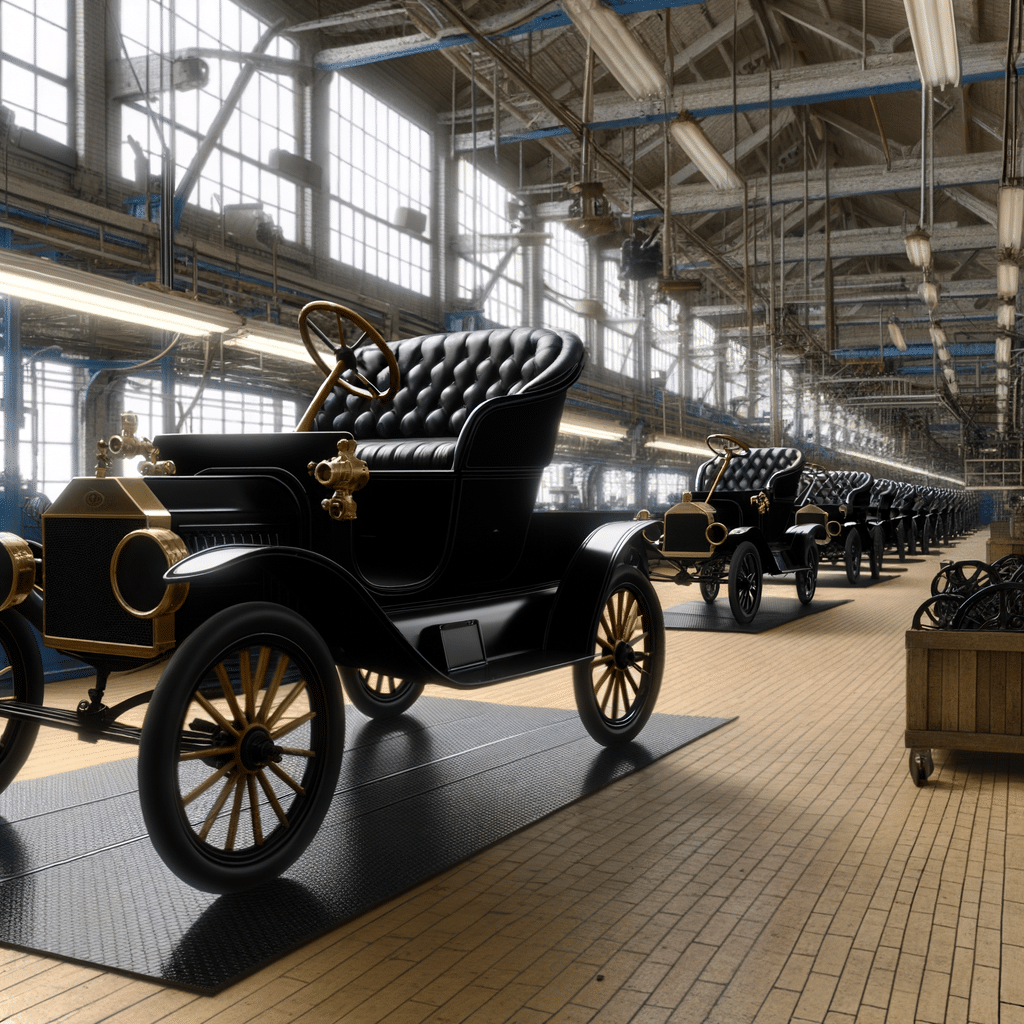
- The assembly line years and a new kind of industry
- From Model T to Model A and the rise of competition
- The flathead V8 and the sound of the 1930s
- War production and a postwar reset
- 1955 to 1957: Thunderbird and the image of personal style
- The 1960s: Mustang, racing image, and mass youth culture
- 1970s: Fuel shocks, downsizing, and a new kind of Ford
- 1980s: Modern manufacturing, front-wheel drive tools, and the Taurus moment
- 1990s: Trucks rise and the family vehicle changes
- 2000s: Safety, electronics, and the pressure of global competition
- 2010s: EcoBoost, aluminum trucks, and the new performance era
- 2020s: Electric Fords and a changing definition of “American Car”
In the summer of 1903, Henry Ford and a small group of backers formed the Ford Motor Company in Detroit. The United States was already experimenting with cars, but they were still expensive, fragile machines that felt closer to custom inventions than everyday transportation. Ford’s early years were a mix of ambition and survival. The company sold simple runabouts and touring cars, and it learned quickly that the American market wanted durability, easy repairs, and a price that could fit a working person’s budget.
That focus on the average buyer shaped Ford’s first major milestone. In 1908, the Model T arrived at a moment when rural roads were rough and service shops were rare. The Model T’s high ground clearance, tough chassis, and straightforward design made it usable in places where other cars struggled. Ford did not invent the car for the masses alone, but the Model T became the symbol of mass mobility because Ford kept refining how it was built and how cheaply it could be sold.
The assembly line years and a new kind of industry
By 1913, Ford’s Highland Park plant introduced a moving assembly line for key production steps. The idea had precedents in other industries, but Ford’s execution changed American manufacturing. Work was broken into repeatable tasks, and cars moved to workers instead of workers moving to cars. Production time dropped sharply, and costs followed. Ford’s milestone was not just speed, it was consistency. A Model T built today could be much like one built yesterday, and that predictability helped create a national car culture where parts, repairs, and expectations became standardized.
Another turning point came in 1914 with the famous five-dollar day. It was partly about reducing turnover in a demanding factory environment, and partly about building a stable workforce skilled in repetitive production. Higher wages also meant more workers could afford the products they made, tying the car business to the broader American economy in a highly visible way. Ford’s methods were debated even then, but the idea that a car company could influence labor, cities, and social mobility became a lasting theme in U.S. history.
Through the 1910s and 1920s, the Model T became more than transportation. It was a tool for farmers, a way for young people to travel, and a symbol of independence. As car ownership spread, the nation’s roads, fuel stations, and roadside businesses grew with it. Ford’s success helped prove that the automobile would not stay a luxury item. It would become infrastructure.
From Model T to Model A and the rise of competition
By the mid-1920s, the Model T was still selling, but the market had changed. Buyers began expecting more comfort, more style, and more choices. General Motors was building a ladder of brands and annual updates that made Ford seem stubbornly fixed in time. Ford finally ended Model T production in 1927 and introduced the Model A later that year. The Model A was not just a new car, it was a public admission that the era of one dominant, unchanging model was fading.
The Model A brought a more modern look, improved controls, and a broader body lineup. It restored momentum and showed Ford could update quickly when it had to. More importantly, it marked the start of a pattern Ford would repeat across decades: reacting to shifts in American taste, sometimes late, but often with a product that reset the conversation.
The flathead V8 and the sound of the 1930s
In 1932, Ford introduced a milestone that still echoes in American car culture: the affordable flathead V8. V8 engines existed before, but they were typically expensive and complicated for mass buyers. Ford’s flathead made eight-cylinder performance attainable at a time when the country was deep in the Great Depression. The result was not just better acceleration. It was a new emotional identity for the car in American life.
The flathead V8 helped shape early hot-rodding because it was plentiful and relatively easy to modify. It gave backyard builders a foundation for speed, and it also gave Ford a performance reputation that would be revived again and again. Even when later engines outclassed the flathead, the legend stayed strong because it was connected to an era when creativity and mechanical skill became a kind of currency.
War production and a postwar reset
World War II forced a major pivot. Like other automakers, Ford shifted to military production, contributing vehicles, engines, and components to the war effort. Civilian car production largely paused, and the factories that once fed personal mobility now fed national survival. When the war ended, the American car market returned quickly, but it returned older, too. Many people had postponed purchases, and demand for new cars surged.
Ford’s postwar challenge was to modernize and compete in a market that was moving toward bigger bodies and more comfort. The late 1940s and early 1950s were transitional. Ford rebuilt its lineup, refreshed styling, and pushed into the booming suburban future. The company’s milestones in this period were less about one model and more about scale: meeting massive demand, expanding dealer networks, and tying the automobile to family life, commuting, and postwar prosperity.
1955 to 1957: Thunderbird and the image of personal style
In 1955, Ford introduced the Thunderbird. It was not intended as a pure sports car, but as a “personal car,” a concept that mattered in the 1950s when buyers increasingly valued image alongside practicality. The early two-seat Thunderbird combined V8 power with comfort features, and it became a cultural marker of mid-century optimism.
The Thunderbird’s success also showed Ford could create desire, not just transportation. That mattered because the American market was becoming emotionally driven. Styling, identity, and lifestyle were now part of what a car sold. The company would build on that lesson soon.
The 1960s: Mustang, racing image, and mass youth culture
Few milestones sit as clearly in American memory as the Ford Mustang’s debut in 1964, marketed as a 1965 model. It arrived when Baby Boomers were coming of age and more people wanted a car that felt personal without being unattainable. Ford built the Mustang using existing components to keep costs down, but it wrapped that practicality in long-hood, short-deck proportions that looked expensive. The result was instant demand and an entire segment that became known as the pony car class.
The Mustang’s impact went beyond sales. It helped tie the car to youth identity in a way that felt mainstream. It also expanded the idea that customization could be factory-backed. Buyers could choose engines, trims, and options that shaped the car’s personality. That same impulse shows up today when enthusiasts debate the purpose of a build, whether it is a daily machine or something closer to a showpiece, a contrast that still feels familiar in conversations like Show car differences explained.
At the same time, Ford pushed its performance image through racing, with the GT40 program targeting endurance racing and the broader goal of winning prestige. The details of every negotiation and internal decision are complex, but the public outcome was clear: Ford used motorsport as a high-volume billboard, and American buyers noticed. That blend of mainstream reach and halo performance became a template the company would revisit.
1970s: Fuel shocks, downsizing, and a new kind of Ford
The 1970s tested every American automaker. Emissions rules tightened, safety expectations grew, and fuel crises changed how people shopped. Big engines and heavy bodies were no longer an automatic selling point. Ford’s milestones in this decade often came from adaptation rather than celebration.
The company downsized many models and leaned more heavily on smaller cars, including designs influenced by global operations. The Mustang itself changed character, becoming smaller and more fuel-focused in the mid-1970s. Some enthusiasts resisted the change, but the shift happened because the market demanded efficiency and because regulations made the old formulas harder to sustain. It was a period when Ford, like the rest of Detroit, learned that technology and policy could steer product direction as strongly as customer taste.
1980s: Modern manufacturing, front-wheel drive tools, and the Taurus moment
By the early 1980s, Ford faced strong competition from imports that had built reputations for efficiency and quality. The response was not a single magic fix, but a push toward more modern engineering and manufacturing discipline. This era saw more front-wheel-drive platforms and a stronger focus on aerodynamics, packaging, and interior space.
In 1986, the Ford Taurus arrived as a milestone that reset Ford’s mainstream design language. Its rounded shape looked dramatically different from the boxier cars many Americans had grown used to. The Taurus also reflected wider changes: wind tunnels were shaping bodies, fuel economy mattered to families, and comfort features were becoming common expectations rather than luxuries.
The Taurus mattered culturally because it made the idea of a “modern American sedan” feel credible again to buyers who had begun looking elsewhere. It also showed that bold design could be used in a practical car, not just in an expensive one.
1990s: Trucks rise and the family vehicle changes
In the 1990s, American preferences moved steadily toward trucks and sport-utility vehicles. Ford was positioned well because of the F-Series, which had already built a long-running reputation, and because SUVs were becoming family vehicles rather than niche tools. This shift happened for a few reasons that went beyond style: low fuel prices for much of the decade, a desire for a higher seating position, and the flexibility that trucks and SUVs offered for work and recreation.
The F-150 became not just a best-seller but a kind of cultural shorthand for American utility. Its evolution over the decade emphasized comfort, safety, and broader appeal, reflecting how buyers were using trucks in everyday life. Ford’s milestone here was understanding that the truck was no longer only for job sites. It was becoming a primary household vehicle.
2000s: Safety, electronics, and the pressure of global competition
As the 2000s progressed, cars gained more electronics, more complicated safety systems, and more refined cabin tech. Ford worked to modernize platforms and improve quality while facing a fiercely competitive global market. The decade also included a major industry shock with the 2008 financial crisis. Ford’s corporate decisions during this period are often discussed alongside other Detroit stories, but the key historical point is that the company had to balance investment in future products with a market that was suddenly uncertain.
Across these years, the phrase “technology evolution” became visible to everyday drivers. Features like stability control, better crash structures, and more advanced engine management systems quietly changed what it meant to drive and maintain a car. For owners keeping older vehicles on the road, basic maintenance stayed important even as cars got smarter, and simple tasks like Oil change for beginners remained part of car culture’s hands-on side.
2010s: EcoBoost, aluminum trucks, and the new performance era
The 2010s brought some of Ford’s most significant technical milestones in decades. EcoBoost turbocharged engines became a major strategy, pairing smaller displacement with forced induction and direct injection to balance power with fuel economy targets. This shift happened because regulations and consumer expectations pushed efficiency, but drivers still wanted strong acceleration and towing. EcoBoost became Ford’s way of keeping performance in the conversation while rewriting how that performance was delivered.
In 2015, Ford made a bold move with the F-150 by adopting an aluminum-intensive body. The decision was rooted in weight reduction. Lighter trucks can improve efficiency, handling, and payload flexibility, but the shift required new manufacturing processes and repair considerations. It was a major industrial step, not just a styling update, and it signaled that trucks would be a central battleground for advanced materials.
Ford also revived its performance reputation with modern interpretations of icons, including the Mustang’s continued development and the return of the Ford GT for a new era. Even when these halo cars were low in volume, they served as proof points for aerodynamics, lightweight thinking, and advanced powertrain development. They carried forward the old lesson from the 1960s: racing and engineering stories can shape brand identity far beyond the track.
2020s: Electric Fords and a changing definition of “American Car”
The early 2020s have been defined by electrification and software. Ford’s Mustang Mach-E, introduced for the 2021 model year, showed how the company interpreted EV demand through a familiar performance nameplate, a decision that sparked debate but also drew attention from buyers who might not have considered a Ford EV otherwise. The F-150 Lightning, launched for the 2022 model year, carried that shift into Ford’s most historically important vehicle line. It reframed the pickup as something that could be quick, quiet, and capable of powering tools and even homes under certain conditions.
These changes did not happen in a vacuum. They came from tightening emissions requirements, rapid improvements in battery technology, and a market that expects cars to behave like connected devices. The modern Ford story now includes range estimates, charging behavior, and software updates alongside horsepower and torque. For new buyers learning the basics of EV life, topics like EV ownership basics have become part of the same cultural learning curve that the Model T once created with hand cranks and rough roads.
At the same time, Ford’s milestones are increasingly shaped by how Americans use cars day to day. Charging at home versus public stations can influence what kind of EV fits a household, and that question has become as practical as fuel stops were a century ago, especially for people weighing Charging your EV at home or public stations.
Seen across more than a hundred years, Ford’s place in American car history is a sequence of pivots. It begins with making cars ordinary enough for ordinary people, then moves through performance identities, postwar expansion, regulatory adaptation, and the long rise of the truck as a cultural center. The newest chapter is still being written, but the pattern feels familiar. When American life changes, the company’s biggest milestones tend to arrive when it finds a way to build that change into a vehicle people can actually use.


