


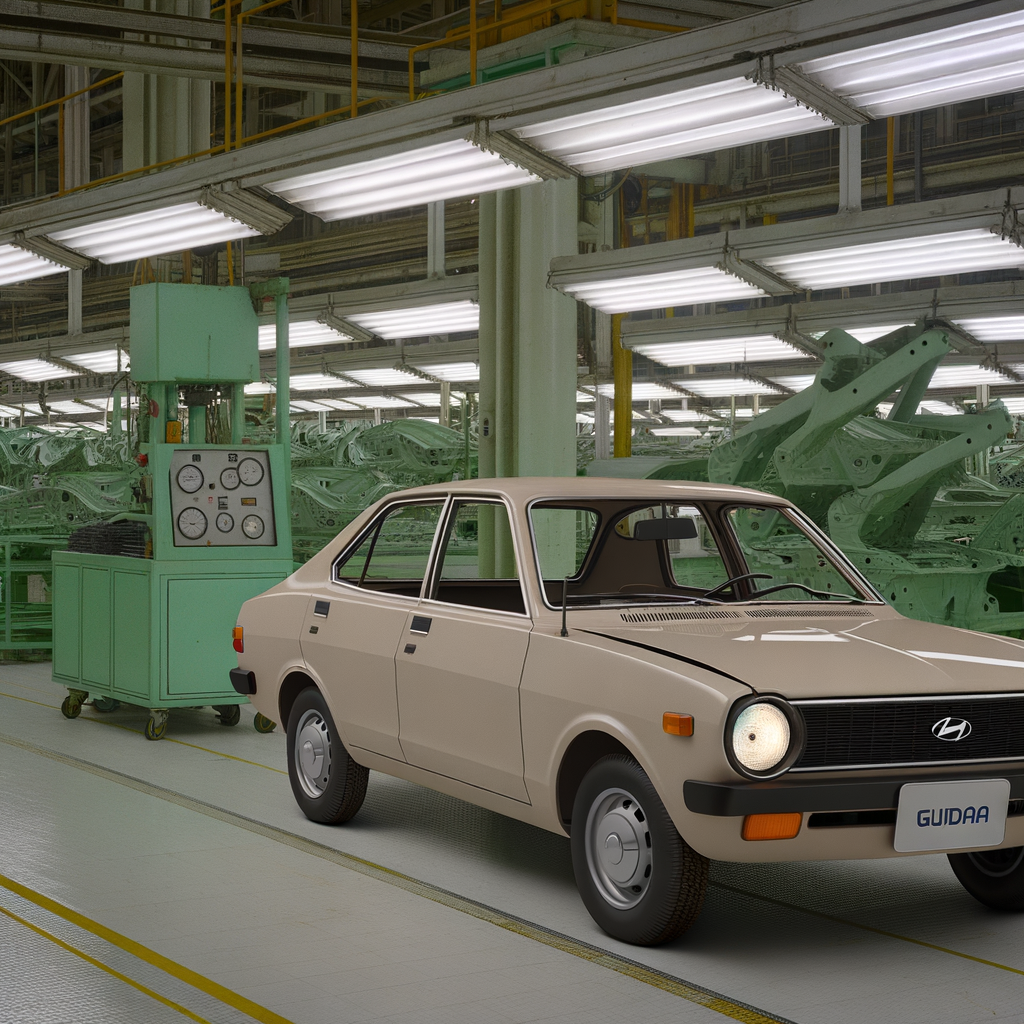
- 1967: A car company is born, before it has a car
- 1968 to the early 1970s: Learning through the Ford partnership
- 1974 to 1975: The Pony becomes Hyundai’s turning point
- Late 1970s: Export ambitions take shape
- Early 1980s: Expanding the lineup and improving capability
- 1985 to 1986: The Excel and entry into the United States
- Late 1980s: Building a stronger technical base
- 1991: The first in-house engine arrives
- Mid-1990s: Growing pains, global competition, and refinement
- 1997 to 1998: Crisis and consolidation in a changing Asia
- Technology evolution: From borrowed foundations to growing independence
- Cultural impact: What Hyundai represented in its early era
Hyundai’s story begins long before it had a badge on a car’s grille. In 1947, entrepreneur Chung Ju-yung founded the Hyundai Engineering and Construction Company in a Korea that was rebuilding and rapidly changing. The business started in construction, not cars, and that mattered. Heavy industry, logistics, and tight schedules shaped Hyundai’s DNA early, and those habits later carried into manufacturing: Build quickly, learn fast, and scale up when the moment is right.
By the 1960s, South Korea’s government pushed hard to modernize the economy through exports and industrial growth. Cars became part of that national plan. The country needed transportation, but it also needed industrial capability: Tooling, skilled labor, supplier networks, and the kind of precision work that could stand on its own in global markets. Hyundai saw an opening, but it still lacked the key ingredient: Automotive know-how.
1967: A car company is born, before it has a car
Hyundai Motor Company was established in 1967. At that point, Hyundai didn’t have its own engine family, platform, or even a local parts ecosystem built around its needs. The earliest years were about learning the craft. The fastest route was partnership, and Hyundai chose a practical path used by many emerging automakers: Assemble under license, absorb process knowledge, then begin local development step by step.
That approach fit the era. Building cars was not just about design. It was supply chains, metal stamping, welding quality, paint consistency, and the kind of repeatable production that separates a workshop from an automaker. Hyundai’s early leadership understood that credibility would be earned on factory floors as much as in showrooms.
1968 to the early 1970s: Learning through the Ford partnership
In 1968, Hyundai began assembling the Ford Cortina in Korea. The Cortina years are easy to overlook because the car was not truly “Hyundai” in engineering terms, but the milestone mattered. It taught production discipline and gave Hyundai experience dealing with global standards, parts quality, and the real-world compromises of building large volumes at acceptable cost.
Hyundai’s ambitions grew quickly. The company needed more than assembly work. It needed its own model, because a homegrown car would keep more value inside Korea, deepen the supplier base, and create export potential. But leaping from license assembly to a domestically developed car was a massive jump, especially for a company still building its manufacturing culture.
1974 to 1975: The Pony becomes Hyundai’s turning point
Hyundai’s first major leap arrived in the mid-1970s with the Hyundai Pony. The Pony concept was shown in 1974, and production began in 1975. It is often described as Korea’s first mass-produced car, and it became a symbol of national industrial progress. Hyundai did not create the Pony in isolation. Like many young automakers, it combined outside expertise with a clear internal goal: Create an affordable, simple, serviceable car that could be built in meaningful numbers.
Design work involved Italdesign and Giorgetto Giugiaro, giving the Pony a clean, modern look for the time. The car also relied on Mitsubishi components for key mechanicals, which helped Hyundai avoid the slow and expensive process of developing engines and gearboxes from scratch. The “why” behind this mix of partners was straightforward: Hyundai needed speed and reliability. A locally sourced but unproven drivetrain could have damaged the brand before it even started.
The Pony’s importance wasn’t only technical. It changed how Korean buyers saw Hyundai. Instead of a company assembling someone else’s product, it was building a car with its own name and identity. That shift laid the foundation for long-term loyalty inside Korea and helped create the confidence needed to try exporting.
Late 1970s: Export ambitions take shape
After the Pony proved itself at home, Hyundai looked outward. Exporting was about scale. A small market limits how much an automaker can invest in tooling, quality systems, and future models. Exports justify bigger factories and stronger supplier development. In the late 1970s, Hyundai began exporting the Pony to markets such as Ecuador and later parts of Europe. Those early export steps were not glamorous, but they were real-world tests. Different climates, driving styles, and customer expectations exposed weaknesses quickly.
Hyundai’s strategy in these years focused on pragmatic engineering. Cars needed to be durable, easy to repair, and affordable. The company’s reputation had to be built from scratch, and early buyers of emerging brands tend to be cost-conscious and unforgiving: If a cheap car becomes expensive to maintain, it stops being a bargain.
Early 1980s: Expanding the lineup and improving capability
As Hyundai entered the 1980s, it started broadening beyond a single defining model. The Pony evolved through updates and variants, and Hyundai expanded into vehicles that better matched how people actually used cars: Small family transport, taxi duty, and commercial roles. These were the miles that hardened Hyundai’s engineering priorities. Suspension durability, cooling performance, and corrosion resistance were not optional. They were survival traits.
It was also a period when Hyundai had to think about brand trust, not simply product availability. The company began investing more in testing and manufacturing consistency. For a young automaker, quality often improves in waves: A new process gets introduced, suppliers learn the tolerances, and the product becomes more consistent over time. Hyundai was experiencing that learning curve in public.
1985 to 1986: The Excel and entry into the United States
One of the biggest milestones in Hyundai’s early years came with the Hyundai Excel, introduced in the mid-1980s. The Excel’s significance is tightly tied to 1986, when Hyundai entered the United States market. This was not just another export destination. The U.S. market had higher expectations, stronger competition, and more visible media coverage. A brand could become famous quickly, but it could also be criticized just as fast.
Hyundai’s decision to target the U.S. was driven by opportunity. American buyers in the 1980s still wanted affordable, efficient small cars, and Hyundai aimed to offer a compelling price with a long warranty-like promise of value. Early sales success showed that the market was open to a new name if the deal looked right.
The harder part came after the initial wave. Rapid growth can expose weak points in quality control and supplier maturity. Hyundai’s early U.S. years became a lesson in what happens when production volume outruns process stability. Reports of reliability problems hurt the brand’s image, and Hyundai had to begin a long, expensive recovery that would reshape its priorities for the next decade. It was a painful phase, but it forced Hyundai to treat quality as a core engineering target, not a marketing phrase.
That pattern is familiar across automotive history. Other brands also went through early reputation swings as they scaled, similar to how different makers faced turning points in their global rise, such as in Mazda history timeline where rapid innovation and market pressure reshaped product direction.
Late 1980s: Building a stronger technical base
By the late 1980s, Hyundai was under real pressure to improve. The company expanded testing and upgraded manufacturing systems. It also continued pursuing more independence in engineering, even if partnerships still played a role. This era matters because it shows Hyundai’s shift from doing what it could to doing what it had to. Competing globally meant meeting increasingly strict standards for emissions, safety, and durability.
Culturally, Hyundai also started to become a recognizable global name. For many younger buyers and first-time owners, a Hyundai was a gateway car. It was the kind of purchase that came with hope: A new car, not a worn-out used one. That emotional role can be underestimated, but it shapes brand identity. A company that sells first cars becomes part of people’s broader relationship with mobility, independence, and adulthood.
1991: The first in-house engine arrives
A major technical milestone came in 1991 with Hyundai’s Alpha engine, widely recognized as the company’s first in-house developed engine family. This step carried real weight. Engines are among the most complex, capital-intensive parts of automotive engineering, and designing one is a statement of maturity. It meant Hyundai was no longer fully reliant on outside mechanical foundations for its mainstream cars.
The “why” behind developing an in-house engine went beyond pride. Control over engine design lets an automaker manage costs, improve fuel economy with targeted updates, meet changing emissions rules, and plan future model cycles more confidently. It also strengthens negotiating power with suppliers and partners. Hyundai was building the internal muscles needed to compete on its own terms.
Mid-1990s: Growing pains, global competition, and refinement
Through the mid-1990s, Hyundai worked to refine quality and expand its global footprint. This period included ongoing efforts to align manufacturing with international expectations. Better corrosion protection, tighter assembly tolerances, and improved supplier auditing were part of the slow, unglamorous work that turns a fast-growing automaker into a dependable one.
For enthusiasts, the mid-1990s Hyundai story is interesting because it shows the brand in transition. The company was still associated with affordability first, but it began laying the groundwork for products that would later be judged on more than price. The shift did not happen overnight, and Hyundai did not always get it right. When historical records are unclear on the exact timing of internal process changes at specific plants, it is safest to say this: Hyundai’s direction in the 1990s clearly moved toward stronger validation, stronger manufacturing discipline, and more self-reliant engineering.
1997 to 1998: Crisis and consolidation in a changing Asia
The Asian Financial Crisis of 1997 shook many automakers and suppliers across the region. Hyundai, like others, faced a market where financing tightened and consumer demand shifted quickly. The crisis years matter because they accelerated consolidation and forced companies to prioritize survival and long-term resilience.
In this era, Hyundai’s broader group strategy pushed the automaker to stabilize, protect production capacity, and prepare for a more competitive future. The late 1990s became a hinge point: Hyundai had the scale and global presence it wanted, but it still had to finish the hard work of improving long-term reliability and brand confidence.
The broader lesson echoes across the industry. When brands stretch into bigger markets, reputation becomes tied to ownership experience, not launch-day excitement. That same dynamic shows up in many manufacturer timelines, from Audi through the decades to legacy names that evolved under pressure to modernize.
Technology evolution: From borrowed foundations to growing independence
Hyundai’s early technology arc is easiest to understand as a gradual shift in control. In the beginning, Hyundai relied heavily on licensed assembly and outside mechanical parts because it needed speed and a proven base. The Pony and early exports showed the company could integrate design and manufacturing into a coherent product. The U.S. launch with the Excel proved Hyundai could compete on price and scale, but also exposed how much the company still needed to learn about consistency and long-term durability.
By developing its own engines in the early 1990s, Hyundai signaled a new phase: A move from assembling and adapting to engineering and owning core systems. That transition is not just an engineering story. It is a business story about control. When an automaker owns more of the critical technology, it gains the ability to set its own rhythm and to respond faster when markets change.
Car culture often focuses on performance numbers and styling, but everyday owners tend to care about the small realities. Strange noises, vibrations, and start-up behavior shape trust in a brand over time. Hyundai’s push for improved refinement in later years came from lived ownership feedback, the kind of concerns drivers describe when topics like car idle vibration causes start to matter more than brochure claims.
Cultural impact: What Hyundai represented in its early era
In Korea, Hyundai became connected to the country’s rapid modernization. The Pony was more than transportation. It was a sign that Korea could design, build, and export complex industrial products. For younger generations watching that transformation, Hyundai helped normalize the idea that a Korean brand could stand in the same conversation as long-established international makers.
Outside Korea, Hyundai’s cultural role started as practical: An affordable new-car option for buyers who wanted basic transport. Over time, that role produced a distinct identity. Hyundai was a brand of newcomers and first chances. Even when early reliability issues damaged the image, the company’s long-term response shaped a later reputation for taking improvement seriously.
That idea, that cars can be both personal expression and practical tools, is part of why enthusiasts later became interested in customizing even humble models. It is also why expectations matter when owners think about changing a car’s look or feel, especially for daily use, like the mindset behind Modified Daily Driver Basics.
By the end of its early era, Hyundai had already lived several lives: A construction-rooted industrial participant, a license assembler, a homegrown mass-market automaker, and a global exporter forced to mature quickly. The timeline from 1947 to the late 1990s shows a company moving from dependence to growing self-reliance, pushed forward by national ambition, global market pressures, and the hard feedback loop that only real customers can provide.


