


- From Rivalry to Union: The 1926 Mercedes-Benz Birth
- Rebuilding a Reputation: The Postwar Reset
- Safety Becomes a Mercedes-Benz Signature: 1960s Into 1970s
- Diesel Durability and Everyday Status: 1970s and 1980s
- The Modern Tech Era: 1990s Refinement and Electronics
- AMG Moves From Specialist to Core Identity
- Design Shifts of the 2000s: Tension, Curves, and a New Audience
- Hybrid Steps and the EV Turning Point: 2010s Into 2020s
- What Stayed Consistent Through All the Shifts
Mercedes-Benz history starts before the name even existed. In the 1880s, two separate German inventors were chasing the same idea: A self-propelled vehicle that did not rely on horses. In 1886, Karl Benz patented the Benz Patent-Motorwagen, widely credited as one of the first practical automobiles. Around the same time, Gottlieb Daimler and Wilhelm Maybach were developing compact, high-speed engines and fitting them to carriages and boats. The early cars were fragile and experimental, but the shape of the future was there: A small internal-combustion engine driving the wheels, with controls that ordinary people could learn.
By the 1890s, early motoring was already tied to competition and public spectacle. Racing and reliability trials were not just entertainment. They were proof that engines could run longer, climb hills, and survive poor roads. Those events pushed cooling, ignition, and lubrication forward faster than quiet laboratory work alone. Daimler-Motoren-Gesellschaft and Benz & Cie. became known for engineering credibility, even though the industry itself was still young and chaotic.
The “Mercedes” part of the story arrived in 1901, when DMG delivered the Mercedes 35 hp, a car associated with entrepreneur and dealer Emil Jellinek, who used the name Mercedes, after his daughter. The shift was more than branding. The 35 hp looked and behaved like a modern car compared to earlier carriage-like designs, with a longer wheelbase, lower center of gravity, and a purposeful stance. It mattered because it showed that speed and stability could be designed in from the start rather than fought for afterward.
From Rivalry to Union: The 1926 Mercedes-Benz Birth
World War I and the economic turmoil that followed changed Germany’s industrial landscape. In 1926, Benz & Cie. and DMG merged to form Daimler-Benz AG, and the combined products carried the Mercedes-Benz name. The merger was partly survival and partly strategy: Development costs were rising, the market was unstable, and a unified engineering organization could move faster. The famous three-pointed star, tied to Daimler’s ambition for engines on land, sea, and air, now sat alongside Benz’s legacy.
In the late 1920s and 1930s, Mercedes-Benz built everything from practical cars to imposing luxury machines and cutting-edge racers. The company’s engineering identity became clear: Conservative in appearance at times, but ambitious under the metal. Supercharged “Kompressor” models made performance a selling point, and Grand Prix racing became a high-profile stage where Germany’s “Silver Arrows” could demonstrate speed and technical confidence. Those race cars were not just for trophies. They shaped thinking on aerodynamics, materials, and high-output engines that would reappear in road car priorities later.
Rebuilding a Reputation: The Postwar Reset
After World War II, Mercedes-Benz faced a different kind of challenge. Factories were damaged, supply chains were broken, and the brand had to rebuild trust and output at the same time. In the early 1950s, the company returned to passenger cars with designs that balanced tradition with modern manufacturing. The 1951 W186 “Adenauer” limousine helped re-establish Mercedes as a symbol of official transport and prestige in West Germany. It was not flashy, but it was deliberate: Solid engineering, formal lines, and a focus on durability.
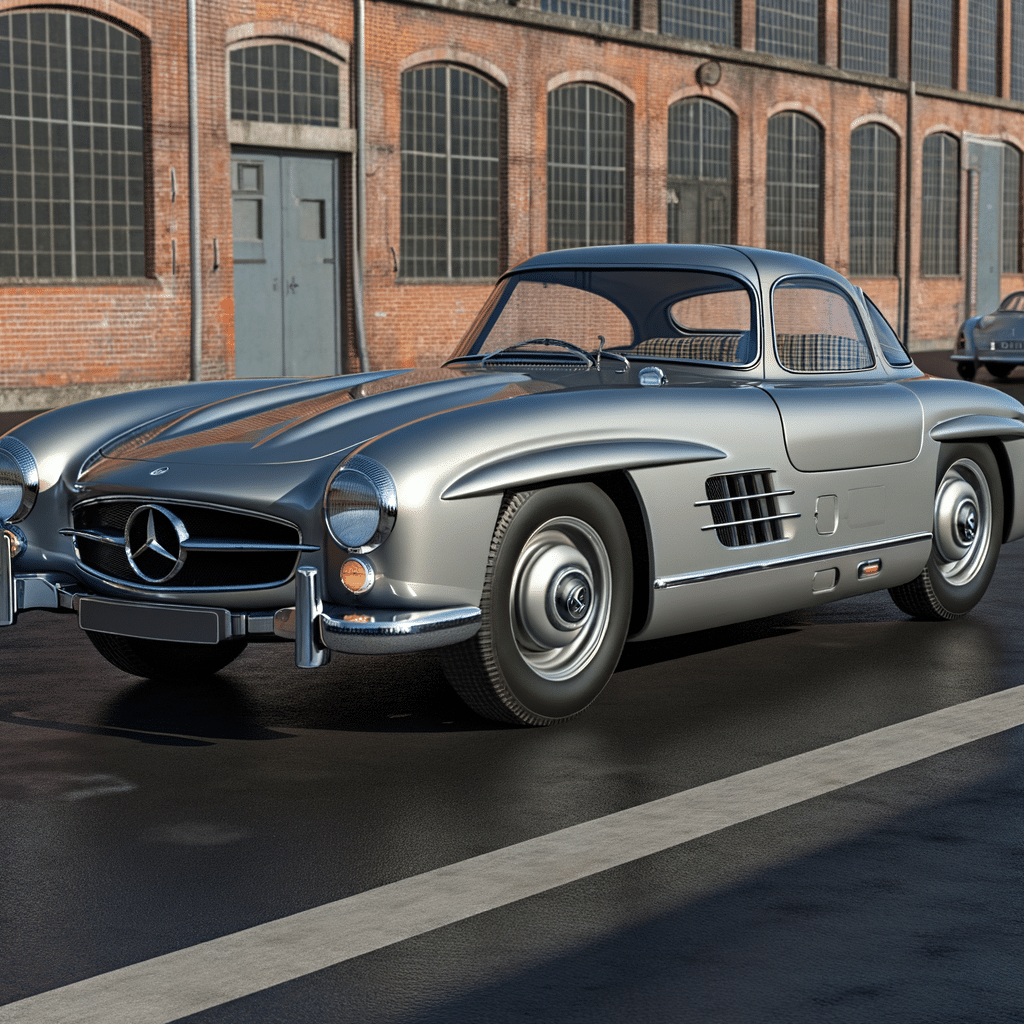
Then came a model that shifted the emotional side of the brand. In 1954, the 300 SL “Gullwing” arrived with fuel injection and dramatic upward-opening doors, built around a spaceframe that forced that door design. It connected Mercedes-Benz to high performance and advanced engineering in a way that even luxury limousines could not. The “why” behind it mattered: Mercedes wanted to translate racing success into road relevance, and the 300 SL proved it could do so with technology that felt futuristic.
At the same time, more attainable cars like the “Ponton” sedans showed a different design evolution. Their integrated fenders and unified body shapes signaled a move away from prewar styling habits. The brand was rebuilding not just factories, but a modern visual language.
Safety Becomes a Mercedes-Benz Signature: 1960s Into 1970s
In the 1960s, Mercedes-Benz began to define itself with a mission that went beyond comfort and prestige. Safety engineering moved toward the center of the brand. Engineer Béla Barényi’s ideas about crumple zones and a rigid passenger cell influenced Mercedes designs, and the company repeatedly treated safety as a system rather than a single feature. The emphasis grew because road speeds were rising, highways were expanding, and car ownership was spreading. Crashes were no longer rare events. They were a public issue.
By 1972, Mercedes-Benz introduced the S-Class name with the W116 generation. It was not the first top Mercedes sedan, but the moment gave a clear identity to the flagship. The W116 era also marked a more formal approach to advanced safety and equipment, including anti-lock braking system development that reached production later in the decade. The flagship was becoming a rolling statement of what Mercedes thought a modern car should be, especially for long-distance travel at high speed.
In 1978, Mercedes-Benz introduced ABS on the W116 S-Class. The timing was critical. As tire technology and engine performance improved, brakes and stability had to keep up. ABS did not just stop wheels from locking. It helped a driver steer while braking hard, which was a meaningful shift in real-world safety. Mercedes was building its reputation around the idea that new technology should serve control and confidence, not just novelty.
Diesel Durability and Everyday Status: 1970s and 1980s
While the S-Class carried the brand’s top image, other Mercedes models built the company’s everyday legend. The W123, launched in 1976, became one of the clearest symbols of Mercedes durability. In many parts of the world, it became a taxi hero and a family car that seemed to outlast expectations. Its success was not about fashion. It came from solid construction, conservative engineering margins, and a driving feel that communicated seriousness even at low speeds.
Diesel engines played a major role in that reputation. For some buyers, diesel meant fuel savings. For others, it meant longevity and a certain mechanical calm. Mercedes diesels became culturally significant in places where reliability mattered more than trend, and that long-term trust fed the brand’s premium positioning.
During the 1980s, Mercedes also refined its compact and mid-size offerings. The W201 “190” arrived in 1982 as a smaller Mercedes that still felt like a Mercedes. It mattered because it signaled that the brand could scale downward without losing identity. The “why” was simple: Markets were changing, competitors were improving, and Mercedes needed a car that could attract younger professionals without abandoning its engineering standards.
By the decade’s end, performance credibility gained a new edge through motorsport links. The 190E 2.3-16 and later 2.5-16 versions, developed with Cosworth involvement for the cylinder head, helped Mercedes speak to enthusiasts who wanted precision as well as status. For readers who like tracking how different brands use design to communicate identity, comparing Mercedes’ shifts with Nissan through the years can make the contrast in styling philosophies easier to spot.
The Modern Tech Era: 1990s Refinement and Electronics
In the 1990s, Mercedes-Benz stepped deeper into electronics and system-based engineering. The W140 S-Class, introduced in 1991, represented overengineering in both praise and criticism. It was large, heavy, and packed with features. It arrived in a world where luxury buyers wanted isolation, safety, and authority on the road. The W140 delivered that, but it also became a symbol of how complexity could grow faster than simplicity.
That complexity was not random. Regulations were tightening, customer expectations were rising, and Mercedes was competing in a high-stakes luxury arena. The brand’s design language also shifted toward cleaner, more geometric forms. It looked modern and serious, not delicate.
In 1995, the W210 E-Class introduced the four-headlamp face that became a recognizable Mercedes signature for years. It was a styling risk, meant to differentiate Mercedes in a market where rounded, aerodynamic shapes were becoming common. The company was trying to keep tradition while still looking contemporary, and those oval lamps became a quick visual identifier in traffic.
Safety and stability tech continued to expand. Electronic Stability Program, widely known as ESP, appeared in the 1990s and helped define modern luxury behavior. It was another step in Mercedes’ long pattern: Making the car feel calmer at the limit, even for drivers who never planned to explore that limit.
AMG Moves From Specialist to Core Identity
AMG began as an independent performance specialist in the 1960s, building a reputation through racing and tuned Mercedes road cars. Over time, the relationship formalized. By the late 1990s, AMG models were increasingly integrated into Mercedes-Benz’s product plan, moving from rare conversions toward official showroom offerings.
This mattered because performance was changing culturally. In previous decades, luxury and speed were sometimes separate worlds. In the late 1990s and 2000s, buyers increasingly wanted both in one car, with factory warranty and everyday manners. AMG helped Mercedes compete in the growing market for high-power sedans, wagons, and coupes that still behaved like refined commuters when asked.
As enthusiasts started thinking more about how modifications change a car’s feel, it also became common to compare factory performance divisions to personal build choices. Many newcomers who experiment with mild changes learn quickly that priorities matter, similar to the thinking behind a Car modding timeline where handling, braking, and comfort choices shape the result as much as horsepower does.
Design Shifts of the 2000s: Tension, Curves, and a New Audience
In the early 2000s, Mercedes design leaned into softer edges and more sculpted surfaces. The company was also expanding its lineup rapidly, including more SUVs and niche models that would have felt out of character in earlier decades. The change happened because the market changed. Luxury was no longer only formal sedans and coupes. Buyers wanted a premium badge in many shapes, including family crossovers and smaller city-friendly cars.
The 2000s also revealed the challenges of increasing complexity. Electronics were now central to nearly every feature, and ownership expectations were different. Drivers wanted convenience features that older Mercedes owners never imagined, but that also meant more systems that could fail. Mercedes’ mission did not move away from engineering. It shifted toward integrating many technologies at once, sometimes with mixed real-world results depending on model and era.
Even simple ownership habits began to matter more as cars became more dependent on electrical health. It is not unusual for modern drivers to run into everyday issues like a battery dead after sitting overnight, which feels far removed from 1950s motoring but is part of the same story of cars becoming rolling electronics platforms.
Hybrid Steps and the EV Turning Point: 2010s Into 2020s
By the 2010s, Mercedes-Benz was facing the biggest automotive transition since the switch from carriage shapes to modern car forms. Global emissions rules were tightening, cities were discussing restrictions, and electrification was moving from experiment to mainstream plan. Mercedes explored hybrids and improved efficiency across its gasoline and diesel engines, while also investing heavily in new platforms.
The EQ sub-brand signaled a more direct move into electric vehicles, with models like the EQC arriving as Mercedes began translating its comfort-focused identity into battery-electric form. The reason for the shift was not only regulation. It was also customer expectation. Smooth, quiet power delivery fits the traditional Mercedes luxury promise, even if the technology beneath it is very different from an inline-six of the 1960s or a diesel taxi icon of the 1980s.
Design also kept evolving. Aerodynamics became more visible in the silhouette of EVs, and interiors became more screen-centered as software took a larger role. That raised a new question Mercedes has been answering in real time: How to keep a human, tactile sense of luxury while dashboards become digital rooms.
For younger enthusiasts, personalization stays part of the culture regardless of powertrain. Some focus on comfort first, others on sound or stance, and those priorities shape how a car feels day to day. That same mindset shows up in topics like Balancing looks and performance mods, even when the car in question is more about quiet torque than exhaust tone.
What Stayed Consistent Through All the Shifts
Across more than a century, Mercedes-Benz has repeatedly changed its design language, expanded into new segments, and adopted new technologies earlier than many rivals. Yet the pattern stays recognizable. When the company makes a leap, it often does so to solve a real problem of its time: Stability in early high-speed cars, prestige and legitimacy in the postwar years, safety as speeds rose, electronics as luxury expectations expanded, and electrification as regulation and culture shifted.
The badge has meant different things in different decades. Sometimes it meant formal power, sometimes it meant quiet durability, sometimes it meant modern performance with AMG muscle. Through those phases, Mercedes-Benz kept returning to the same underlying goal: Building cars that feel engineered for the long run, even as the definition of “modern” keeps moving.
Looking across automotive history, Mercedes’ balance of tradition and reinvention has parallels and contrasts with other major brands. It can be interesting to place it alongside Ford’s key milestones to see how different markets and priorities shaped two very different ideas of what a car should be in the same decades.


