


- The Birth of Self-Propelled Vehicles (1770s-1880s)
- The Gasoline Revolution: Benz and the Modern Automobile (1885-1900)
- The Ford Revolution: Mass Production and Democratization (1908-1927)
- The Golden Age: Design, Comfort, and Power (1930s-1960s)
- The Safety Revolution (1950s-1990s)
- The Computer Age: From Mechanical to Digital (1968-Present)
- Aerodynamics and Efficiency: Form Follows Function (1970s-Present)
- Environmental Regulations: Driving Green Innovation (1970s-Present)
- Advanced Driver Assistance Systems (ADAS) (2000s-Present)
- The Electric Vehicle Renaissance (2000s-Present)
- The Autonomous Future (2010s-Present)
- Looking Ahead: The Road Forward
- Conclusion
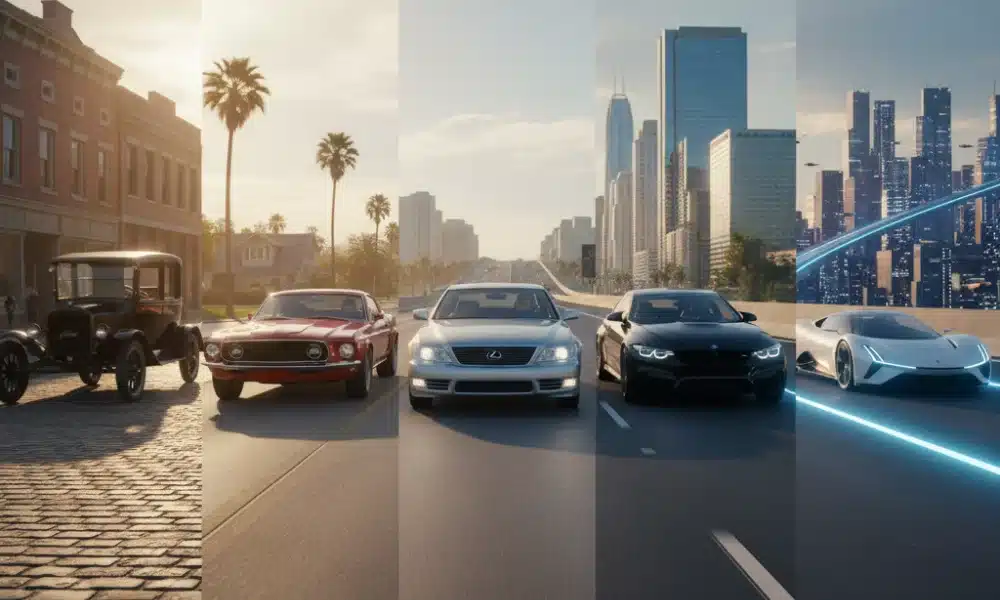
The car is one of the most important inventions in human history. It has completely changed how people live, work, and move. From early steam-powered machines to modern electric and self-driving vehicles, the story of the car is one of constant progress and creativity. It also shows how our needs and values around travel, safety, and the environment have evolved over time.
The Birth of Self-Propelled Vehicles (1770s-1880s)
The idea of a self-moving vehicle started long before the gasoline engine. In 1770, French engineer Nicolas-Joseph Cugnot built what is considered the first automobile, a steam-powered wagon designed to move heavy cannons for the military. It could carry about four tons and reach speeds of just 2.5 miles per hour, but it had to stop often to rebuild steam pressure.
During the early 1800s, inventors began exploring electric power. In 1828, Hungarian engineer Ányos Jedlik created a small electric motor that powered a model vehicle. Around the same time, Scottish inventor Robert Anderson made a simple electric carriage. These early versions didn’t get far because the batteries could not be recharged.
In 1859, the invention of the rechargeable battery changed everything. By the 1890s, electric cars became popular in cities, especially among the wealthy, because they were quiet, easy to use, and didn’t produce smoke. In 1897, electric taxis began operating in New York City, and models like the Detroit Electric could travel more than 380 kilometers on one charge.
The Gasoline Revolution: Benz and the Modern Automobile (1885-1900)
The invention that truly started the automotive age came in 1885. German engineer Karl Benz built the Benz Patent-Motorwagen, a three-wheeled vehicle powered by a small gasoline engine. It is widely seen as the first real, working car designed for public use. Benz received his patent in 1886 and started producing cars in 1888.
Benz’s wife, Bertha Benz, proved the car’s reliability by taking the first long road trip in history, driving more than 100 kilometers from Mannheim to Pforzheim and back. Her trip showed that the new “horseless carriage” could travel long distances safely.
At the same time, Gottlieb Daimler and Wilhelm Maybach were also building gasoline-powered vehicles in Stuttgart. Their work, combined with Benz’s, laid the foundation for the automotive industry. Later, in 1926, their companies merged to form Daimler-Benz, which became the famous Mercedes-Benz brand.
The Ford Revolution: Mass Production and Democratization (1908-1927)
At first, cars were handmade and expensive, only affordable for the rich. That changed when Henry Ford introduced the Model T on October 1, 1908. Ford wanted to build a simple, strong, and affordable car that ordinary people could buy.
The Model T was easy to drive, easy to fix, and tough enough for rough country roads. The biggest innovation, however, came from how it was built. In 1913, Ford introduced the moving assembly line, which reduced the time to build a car from more than 12 hours to just about 2.5 hours.
This huge boost in efficiency allowed Ford to make more cars at lower prices. The Model T’s price dropped from $825 in 1908 to just $260 by 1925, making car ownership possible for middle-class families.
Ford’s influence went beyond the car itself. To keep workers for his repetitive assembly line jobs, he introduced a $5-per-day wage in 1914, twice the average pay at that time. This helped build the modern middle class. By 1927, Ford had built more than 15 million Model Ts, and nearly half of all cars in America were Model Ts.
The Golden Age: Design, Comfort, and Power (1930s-1960s)
As cars became more common, manufacturers started focusing on design, comfort, and performance. The 1930s saw the rise of aerodynamic shapes to make cars smoother and faster. Cars like the Chrysler Airflow and Tatra T77 were early examples, even though they didn’t sell well.
After World War II, American car design entered its most colorful period. Cars had shiny chrome parts, large tail fins, and powerful V8 engines. They became symbols of freedom and success. However, this focus on looks and power often ignored fuel efficiency and safety. Cars were heavy, used a lot of gas, and lacked even basic safety features.
The Safety Revolution (1950s-1990s)
For many years, car safety wasn’t a priority. Early cars had no seatbelts and dangerous steering systems. In 1959, Volvo engineer Nils Bohlin changed that by inventing the three-point seatbelt, a design that became standard worldwide and saved millions of lives.
In the 1970s, airbags were introduced to protect passengers during crashes. Over time, more airbags were added, front, side, curtain, and knee airbags, creating full protection inside the vehicle.
The 1980s and 1990s brought electronic safety systems. Anti-lock Braking Systems (ABS) helped prevent skidding during hard braking, while Electronic Stability Control (ESC) improved balance on slippery roads. Today’s systems use sensors and smart software to detect danger and adjust in milliseconds. Some can even prepare for a crash before it happens, particularly in adverse conditions.
Today’s airbags have evolved into intelligent systems using advanced sensors and machine learning to optimize deployment based on crash severity, occupant size, and position. Some systems can even initiate pre-deployment protocols before impact through Vehicle-to-Everything (V2X) communication.
The Computer Age: From Mechanical to Digital (1968-Present)
The shift from mechanical to digital began in 1968, when the Volkswagen Type 3 became the first car with an electronic control system for fuel injection. This made engines more efficient and reduced emissions.
Today, cars are like computers on wheels. Most vehicles have 30 to 80 small computers called ECUs, each controlling specific functions like:
- Engine Control Unit: Manages fuel injection, ignition timing, and emissions
- Transmission Control Unit: Controls gear shifting and torque distribution
- Body Control Module: Operates lighting, windows, and door locks
- Safety Systems ECU: Monitors airbags, ABS, and stability control
- Infotainment System: Handles navigation, audio, and connectivity
These systems communicate through Controller Area Network (CAN) protocols at speeds up to 1 million bits per second, creating a sophisticated “nervous system” for the vehicle. When a check engine light illuminates, technicians can scan comprehensive fault codes from any linked ECU, identifying problems with surgical precision.
Aerodynamics and Efficiency: Form Follows Function (1970s-Present)
The 1973 oil crisis changed how car makers thought. Suddenly, fuel efficiency became more important than horsepower. Between 1975 and 1985, new rules in the U.S. forced cars to go farther on less fuel. The average mileage nearly doubled, from about 13.5 mpg to 27.5 mpg.
Engineers made cars lighter by using materials like aluminum and strong steel. Engines were redesigned for better mileage using new ideas like turbocharging, variable valve timing, and direct fuel injection. Designers also began shaping cars to cut through air more easily, a science called aerodynamics.
Over time, car design evolved in four steps, from basic boxy shapes to fully optimized, wind-tested bodies. Modern cars now have a drag coefficient as low as 0.24, compared to around 0.45 in the 1970s.
However, when fuel got cheaper in the 1980s, many companies focused again on power and big SUVs instead of efficiency. The focus on saving fuel returned in the 2000s as gas prices and environmental worries rose again.
Environmental Regulations: Driving Green Innovation (1970s-Present)
Governments also helped push the change. In the 1970s, new air pollution laws forced automakers to create catalytic converters and cleaner engines. The U.S. introduced fuel economy standards (CAFE), which made companies improve mileage year after year.
Europe went even further. By 2021, cars that emitted more than 95g of CO₂/km could no longer be sold. These strict rules encouraged brands to build hybrids and electric cars, while also improving gas engines.
These rules cost money to follow, but they also made automakers more competitive in a greener world.
Advanced Driver Assistance Systems (ADAS) (2000s-Present)
Modern cars don’t just protect you in a crash, they help prevent it. New systems, called ADAS (Advanced Driver Assistance Systems), use cameras, radar, and sensors to keep you safe. Some popular features include:
- Lane Departure Warning: Alerts you if you drift out of your lane
- Adaptive Cruise Control: Automatically adjusts speed to maintain safe following distances
- Automatic Emergency Braking: Stops the car if a crash seems likely
- Blind Spot Monitoring: Warns drivers of vehicles in adjacent lanes
- 360-Degree Camera Systems: Provide complete visibility around the vehicle
These features use artificial intelligence to process data instantly, helping drivers stay alert and safe.
The Electric Vehicle Renaissance (2000s-Present)
Electric cars actually came before gasoline cars, but they disappeared for most of the 20th century. In the 2000s, they made a big comeback. Concerns about pollution and climate change, along with better battery technology, changed everything.
Companies like Tesla showed that electric cars could be fast, stylish, and practical. Modern EVs use lithium-ion batteries that let them drive over 300 miles per charge. They also recover energy when braking, and charging networks are growing quickly.
Experts predict that by 2026, used electric cars will cost about the same as gasoline ones. Many car brands now plan to go fully electric in the coming decades.
The Autonomous Future (2010s-Present)
Self-driving cars are the next big leap. They could cut accidents (most caused by human error), reduce traffic jams, and help people who can’t drive.
Autonomous vehicles are classified into six levels:
- Level 0: No automation; complete human control
- Level 1: Basic driver assistance (cruise control)
- Level 2: Partial automation (vehicle controls steering and speed, but driver must remain attentive)
- Level 3: Conditional automation (vehicle handles most tasks, requires intervention in complex situations)
- Level 4: High automation (vehicle handles all tasks in specific conditions without human input)
- Level 5: Full automation (vehicle can drive in all conditions without any human involvement)
Most 2025 cars are Level 2 or 2+, meaning they help the driver but still need attention. Full Level 5 self-driving cars are still in testing because of weather, safety, and law challenges. Experts think we’ll see gradual progress, robotaxis and delivery vehicles first, followed by personal cars in the 2030s.
Looking Ahead: The Road Forward
The story of the car is still moving fast. Electric cars are improving every year, they go farther, charge faster, and are becoming more affordable. Self-driving technology is also getting better, even if progress is slower than many expected. Cars today are also becoming more connected, syncing with phones, smart homes, and even city systems, turning them into moving computers.
The need to protect our planet is shaping the future of cars. The auto industry produces about 23% of all energy-related CO₂ emissions, and road vehicles make up most of that. To meet climate goals, we’ll need not only cleaner cars but also smarter transportation systems, like shared rides, better public transport, and eco-friendly city planning.
New materials such as carbon fiber, strong lightweight steel, and 3D-printed parts are helping make cars lighter and more efficient. Artificial intelligence (AI) is playing a bigger role too, from designing cars and managing factories to improving driving safety and traffic flow.
Conclusion
From Nicolas-Joseph Cugnot’s steam-powered wagon to today’s intelligent electric vehicles, the automobile has undergone continuous transformation over 250 years. Each era has brought new priorities: early pioneers sought basic functionality; Henry Ford democratized mobility through mass production; post-war manufacturers emphasized style and power; the oil crises refocused attention on efficiency; modern times demand safety, environmental responsibility, and increasingly, autonomous capability.
The car has reshaped our cities, economies, and lifestyles more profoundly than perhaps any other invention. It enabled suburban sprawl, transformed courtship and dating, created entirely new industries, and fundamentally altered our concept of personal freedom. Yet this transformation has also brought challenges,traffic congestion, air pollution, sprawling development, and climate change.
As we look to the future, the automobile continues evolving to meet society’s changing needs. The vehicles of tomorrow will be cleaner, safer, and smarter than those of today. They may drive themselves, run on electricity or hydrogen, and communicate with each other to optimize traffic flow. Yet whatever form they take, automobiles will undoubtedly remain central to human mobility and progress, continuing the remarkable journey of innovation that began over two centuries ago.


