


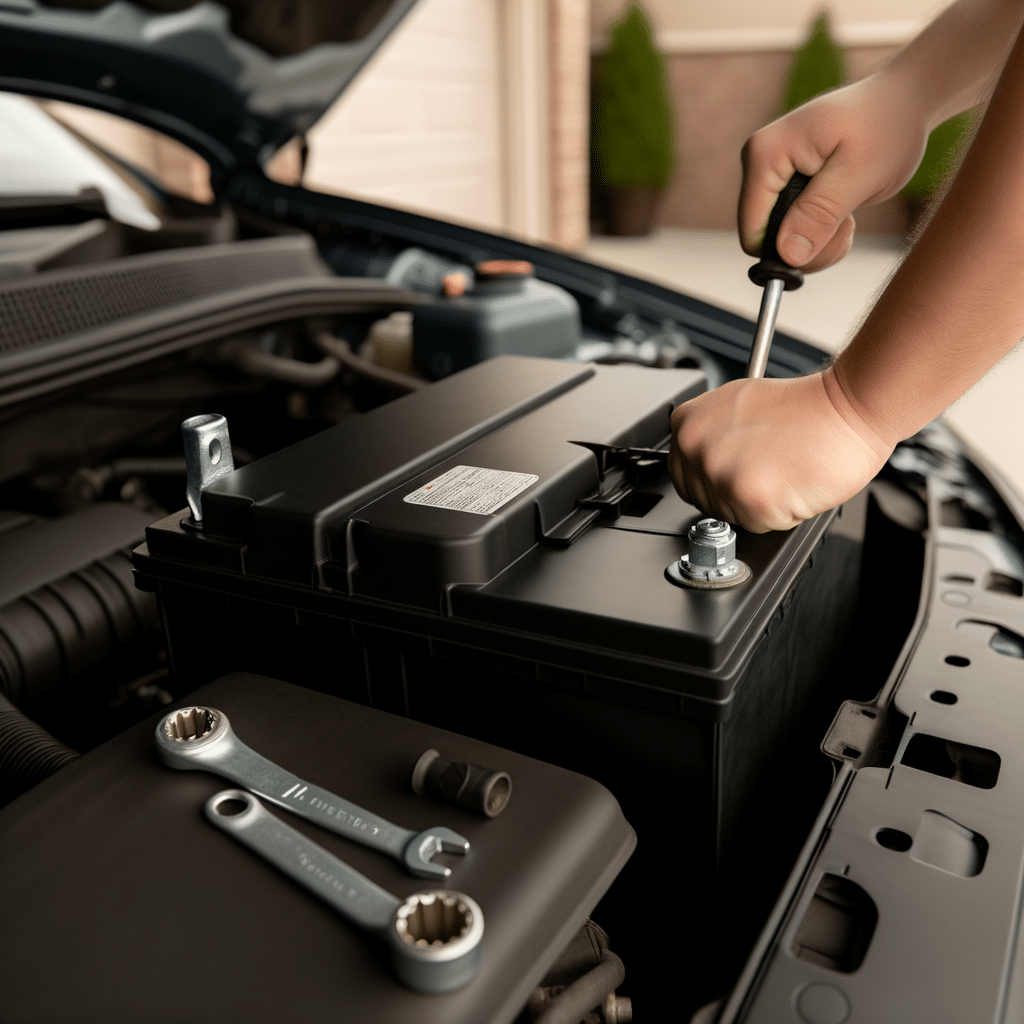
Replacing a car battery at home is a simple job if you take your time. Most batteries are heavy, and the terminals can spark if you touch the wrong things. The good news is: With basic tools and safe steps, you can do it in under an hour.
Tools and items needed
- New battery (correct size and terminal layout)
- Socket set or wrenches (often 10mm for terminals)
- Gloves (work gloves or mechanic gloves)
- Safety glasses
- Battery terminal brush (or small wire brush)
- Rag or paper towels
- Baking soda and water (for cleaning corrosion)
- Small cup or spray bottle for the baking soda mix
- Battery terminal protectant spray (optional)
- Memory saver (optional) or your radio code if your car needs it
How to pick the right replacement battery
Match the battery group size, the terminal position, and the type. Some cars use AGM batteries, and they must be replaced with AGM. Check your owner’s manual or the label on the old battery. Also check the cold cranking amps (CCA). You can go a little higher, but do not go lower than what your car calls for.
Safety and legal notes
- Work in an open area. Batteries can release gas, and you do not want sparks in a closed garage.
- Turn the engine off. Remove the key. Keep your keys in your pocket so nobody starts the car by mistake.
- No smoking, flames, or grinding near the battery.
- Wear eye protection. Battery corrosion can be irritating, and battery acid is dangerous.
- Keep metal tools away from both terminals at the same time. Touching both can short the battery fast.
- Recycle the old battery. Most parts stores take it back, and many areas require proper disposal.
If your battery keeps dying quickly, replacing it may not be the real fix. A drain, a weak alternator, or lights left on can do it. If that sounds like your issue, look at battery dead after sitting overnight before you buy another battery.
Numbered installation steps
1) Park and prep the car
Park on a flat surface and set the parking brake. Open the hood and support it safely. If your battery is in the trunk or under a seat, open that area and clear out anything that blocks access.
Turn off all accessories, including the headlights, cabin lights, and radio. If your car has an auto start-stop system, leave the car off and follow the manual for battery service mode if required.
2) Take a quick photo of the battery
Use your phone to take a clear photo of the terminals and hold-down bracket. This helps you put everything back in the same place.
3) Locate the negative and positive terminals
The negative terminal usually has a “-” symbol and a black cable. The positive terminal usually has a “+” symbol and a red cable, sometimes under a red cover.
4) Disconnect the negative terminal first
Use the correct wrench or socket. Loosen the clamp nut, then twist and lift the negative cable off the terminal. Move the cable aside so it cannot spring back and touch the battery.
Why this order matters: If your tool touches metal while you are on the negative side, it is less likely to create a short. If you start on the positive side and your tool hits grounded metal, you can get sparks.
5) Disconnect the positive terminal
Remove the positive cable next. Keep your tool away from nearby metal. If there is a red cover, open it first and fold it back after the cable is off.
6) Remove the battery hold-down
Most batteries are secured with a bracket or a small clamp at the base. Remove the bolt(s) and set them aside where you will not lose them.
7) Lift the old battery out
Batteries are heavy. Lift with both hands and keep it upright. If the battery has a handle, use it. Place the old battery on the ground, not on your seat or carpet.
8) Clean the battery tray and cable ends
If you see white or green crust on the terminals, mix baking soda and water. Dab it on the corrosion. It may fizz. Wipe it clean with a rag.
Use a terminal brush to clean the inside of the cable clamps. You want clean metal so the connection is tight and low resistance.
9) Install the new battery in the same direction
Set the new battery in the tray with the same orientation as the old one. Check that the terminals are on the correct sides. The cables should reach without stretching.
10) Reinstall the hold-down bracket
Tighten the bracket so the battery cannot move. A loose battery can cause starting problems and can damage cables over time.
11) Connect the positive terminal first
Push the positive cable clamp down fully on the terminal. Tighten the clamp nut until it does not rotate by hand. Close the red terminal cover if your car has one.
12) Connect the negative terminal last
Install the negative cable the same way. You might see a tiny spark when it touches. A small spark can be normal if the car has computers drawing a little power. A big spark is not normal, so stop and recheck that nothing is turned on and that you are on the correct terminal.
13) Final checks before you close the hood
- Try to move each cable by hand. It should not wiggle.
- Confirm the hold-down is tight and the battery is stable.
- Make sure no tools are left in the engine bay.
14) Start the car and check basics
Start the engine. It should crank strongly. Check that the headlights look steady at idle. If you notice electrical issues, this guide on headlights dimming fixes can help you narrow down if the charging system needs attention.
Reset the clock, radio presets, and auto window function if your car needs it. Some cars need a short relearn period for idle. If the idle is rough at first, drive a few short trips and see if it smooths out.
Common mistakes
- Removing the positive cable first: This can create sparks if your tool touches body metal.
- Installing the battery backwards: The cables will not reach correctly, and you can damage the electrical system.
- Loose terminals: A slightly loose clamp can cause no-start, flickering lights, or random warning lights.
- Skipping the hold-down: The battery can shift and short against metal parts.
- Not cleaning corrosion: Dirty terminals cause resistance and weak starting even with a new battery.
- Replacing the battery when the real issue is a drain: If your battery dies often, diagnose the cause first.
Maintenance tips
- Check the terminals every few months. If you see new corrosion, clean it early.
- Keep the battery tight in its tray. Vibration shortens battery life.
- If you do short trips only, take one longer drive sometimes. Short trips may not fully recharge the battery.
- Turn off accessories before shutting the car off. This reduces load at the next start.
- In very cold weather, a weak battery shows up fast. If cranking gets slow, test the battery soon.
If you are doing other easy jobs and want to keep momentum, a simple follow-up project like replace cabin air filter can also improve day-to-day comfort.
Is it worth it?
For most drivers, yes. Replacing a battery at home saves labor cost and time waiting at a shop. It also helps you learn basic under-hood safety and tool control.
It may not be worth it if your battery is hard to access, like under a seat, behind panels, or tied into a complex sensor system. Some modern cars need a battery registration step with a scan tool. If your car requires that and you do not have the tool, a shop is the safer choice.
Conclusion
Replacing your car battery at home is a beginner-friendly DIY job when you follow safe steps. Disconnect the negative first, connect it last, and keep your tools away from both terminals at the same time. Clean the terminals, lock the battery down, and confirm the car starts and charges normally. If the new battery still goes flat, the problem is likely somewhere else and needs diagnosis before you replace parts again.


