


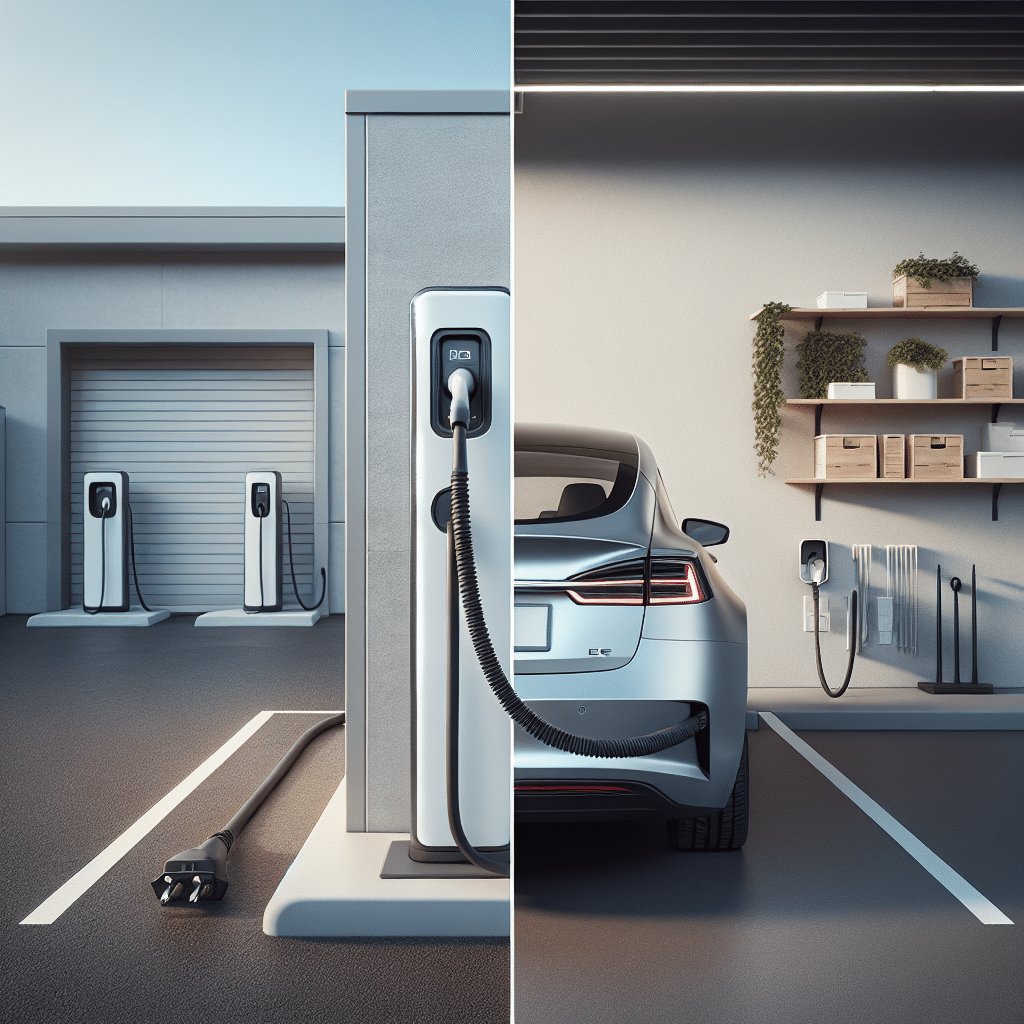
Charging an EV can feel confusing at first because there are two main places to do it: at home and in public. Both work well, but they fit different daily routines. Once you understand the power levels, connection types, and charging speed, it gets much easier to plan your driving.
What the concept is
EV charging means sending electricity from a power source into your car’s battery through a charging cable. The main difference between home and public charging is how much power is available and how the charging equipment is installed.
Charging is usually talked about in “levels”:
- Level 1 (slow AC): Uses a regular household outlet. Often 120V in North America. Very slow but simple.
- Level 2 (faster AC): Uses a higher power circuit, often 240V in North America. Common for home wall boxes and many public chargers.
- DC fast charging (very fast): Found in public locations. Sends DC power straight to the battery. Fast, but not always best for daily charging.
Home charging is usually Level 1 or Level 2. Public charging can be Level 2 or DC fast charging, depending on the station.
Why people do it
Most EV owners use a mix of home and public charging for practical reasons:
- Convenience: Home charging can happen while you sleep. Public charging helps during errands or longer trips.
- Time: DC fast charging can add a lot of range quickly when you need it.
- Flexibility: Apartment living, street parking, or shared driveways may make home charging tough, so public charging becomes the main option.
- Battery habits: Many people prefer slower charging day-to-day and save fast charging for travel.
Things to know before starting
Your daily driving matters more than your battery size
Think about how many miles you drive on a normal day, not your longest yearly road trip. If your daily driving is low, even slow charging may cover it.
Charging speed depends on the car and the charger
The charger can only give power up to its own limit, and the car can only accept power up to its limit. The slower of the two wins. Cold weather and a very full battery can also slow charging.
AC charging “speed” is about kilowatts (kW)
Level 2 charging might be 6 kW, 7 kW, 9 kW, 11 kW, or higher. More kW usually means more miles added per hour, but your car must support it.
DC fast charging is not one single speed
Some stations are “fast” and some are “very fast.” Also, charging usually starts faster and then slows down as the battery gets fuller. This is normal. Many EVs charge fastest from about 10% to 60% or 80%.
Connector types must match
Not all plugs are the same. Your EV has a charge port type, and public stations have certain connectors. Some cars can use adapters for some stations, but not all. Always check your car’s manual and the station connector before you park.
Home electrical capacity can limit Level 2 charging
A Level 2 home charger needs a dedicated circuit. Some homes have room for it easily, while others may need an electrical panel upgrade. A qualified electrician helps confirm what is possible.
Step-by-step explanation
1) Decide what “home charging” means for your situation
- If you can park near an outlet: Level 1 might work for light daily driving.
- If you want faster, reliable home charging: Look into a Level 2 setup.
- If you cannot charge at home: Plan a routine around public Level 2 stations near work, shopping, or a regular stop.
2) Understand how a home setup works
- Level 1 at home: Plug the portable cable into a standard outlet. It is simple but slow. Use a good outlet and avoid long extension cords.
- Level 2 at home: A wall box or a 240V outlet on a dedicated circuit. Some units are hardwired, some plug in. Your electrician will choose what fits your home wiring and local code.
- Daily habit: Many drivers plug in each night and set a charge limit (often 70% to 90% for daily use, depending on the car maker’s advice).
Some owners treat home charging like other simple car upgrades you can do: do the prep work once, then daily use is easy.
3) Understand how public Level 2 charging works
- Find a station: These are common at workplaces, parking garages, malls, and some street parking areas.
- Park and check the connector: Make sure the plug matches your car or your approved adapter.
- Start the session: Some stations start from an app, a card, or a screen. Others start when you plug in.
- Expect moderate speed: Public Level 2 is great for adding range while you are already parked for a while.
4) Understand how DC fast charging works
- Use it when time matters: DC fast charging is mainly for road trips or a quick top-up.
- Arrive with a lower battery when possible: Many EVs charge faster at lower state of charge.
- Stop earlier, not later: Often it is faster overall to do two shorter fast-charge stops than one long stop to 100%.
- Plan for slower charging near full: The last 20% can take a long time at a fast charger.
5) Balance home and public charging for battery health and time
- Use AC charging for daily needs: Level 1 or Level 2 is usually gentler and more predictable.
- Save DC fast charging for travel: It is useful, but it is not always the best daily habit if you have other options.
- Follow the car’s recommendations: Some EVs have built-in guidance for charge limits and preconditioning before fast charging.
Common mistakes to avoid
- Buying a home charger before checking your electrical panel: A unit might be too powerful for your available capacity.
- Using a worn or loose outlet for Level 1: Heat can build up at weak connections. If the plug feels hot or the outlet is loose, stop and get it checked.
- Relying on DC fast charging to reach 100% regularly: It can be slow near full and is often unnecessary for daily driving.
- Not checking station status before arriving: Public chargers can be in use or offline. A quick check can save time.
- Parking in a spot where the cable barely reaches: Strain on the cable and connector can cause damage over time.
- Ignoring your charge port area: Dirt, ice, or damage around the port can cause slow or failed connections, like any other car interface you use often.
Safety and legal considerations
Charging is generally safe when the equipment is used correctly, but the power involved is serious.
- Use a qualified electrician for Level 2 installs: Proper wiring, breaker sizing, and grounding matter. Local electrical code rules apply.
- Avoid extension cords for Level 1: Many are not rated for long, continuous loads. If you must use one in a special case, it needs to be heavy-duty and correctly rated, but it is still not ideal.
- Protect the cable: Do not run it where it can be crushed by a garage door or driven over.
- Follow parking rules at public chargers: Some locations have time limits, towing rules, or EV-only rules, and these can be enforced.
- Weather awareness: Charging in rain is normal with proper equipment, but do not use damaged plugs, cracked handles, or frayed cables.
Final practical advice
If you can charge at home, start simple. Level 1 is a good test for the first weeks because it shows how your real driving fits your real charging time. If it is too slow, move to Level 2 and get the electrical side checked first.
If home charging is not possible, build a routine around public Level 2 locations where you already spend time. Use DC fast charging mainly when you need a quick refill on a longer drive. Keep your charge plan flexible, the same way you might follow a beginner car modification tips approach: small, smart changes that match your daily use.
Keep a clean charging cable, learn your car’s best charging range, and practice one fast-charge stop before a big trip. Once charging becomes part of your normal schedule, EV ownership feels straightforward.


