




This post may contain affiliate links. Please read our disclosure and privacy policy for more information.
- A small car era begins: 1960 and the push into passenger markets
- The rotary gamble: 1960s engineering identity
- 1970s reality check: Emissions rules and the fuel crisis
- 1980s growth and a broader personality
- 1990s highs and pressures: Racing glory and market shifts
- 2000s: Zoom-Zoom and the push to feel different
- 2010s: Skyactiv engineering and Kodo design
- The rotary as an idea: From engines to an engineering symbol
- Late 2010s into the 2020s: Crossovers, premium ambition, and new platforms
- How Mazda’s design and culture stayed connected to drivers
- Related Resources
Mazda’s story starts long before it became a familiar badge on sporty coupes and practical crossovers. In 1920, a company in Hiroshima named Toyo Cork Kogyo was founded to make cork products. Japan was industrializing fast, and cork alone could not carry a young manufacturer through the swings of the economy. By the late 1920s and early 1930s, the company shifted into machine tools, then found a clearer identity in 1931 with a compact three-wheeled truck called the Mazda-Go. It was a working vehicle for a working country, and it mattered because it gave the business a reliable purpose: Building transport that could survive tough roads and tighter budgets.
The “Mazda” name itself began appearing in these years, tied to both the founder’s name, Matsuda, and the idea of a bright guiding light. It fit a company that was trying to move beyond raw materials and into mechanical craft. Hiroshima’s later devastation during World War II would scar the region, but Toyo Kogyo, as it was often known, rebuilt and expanded in the postwar boom. Three-wheeled trucks remained important through the 1950s, and they funded a bigger ambition: Passenger cars.
A small car era begins: 1960 and the push into passenger markets
In 1960, Mazda introduced its first passenger car, the R360 Coupe. It arrived in a Japan that was reshaping itself around personal mobility, and it sat in the tiny “kei” category, which rewarded small dimensions and modest engines with tax and insurance benefits. The R360 was light, simple, and aimed at new buyers who wanted a roof over their heads without the cost of a full-size sedan. This was not yet the Mazda known for performance. It was Mazda learning how to package cars efficiently and build the kind of everyday quality that keeps a young brand alive.
The early 1960s brought more small models, including the Carol in 1962, and Mazda began to look outward. Competing at home was one thing, but exporting was how a Japanese company could secure scale. The challenge was that Mazda was not the biggest player, and it needed a technical identity that could separate it from rivals with deeper pockets.
The rotary gamble: 1960s engineering identity
That identity arrived through one of the boldest bets in modern automotive history. In the early 1960s, Mazda licensed the Wankel rotary engine concept from Germany’s NSU. Many companies studied rotary power, but few were willing to live with its problems. The rotary was compact and smooth, and it promised strong output for its size. It also carried real drawbacks, especially apex seal wear, emissions challenges, and fuel economy that could look outdated as soon as fuel prices or standards changed.
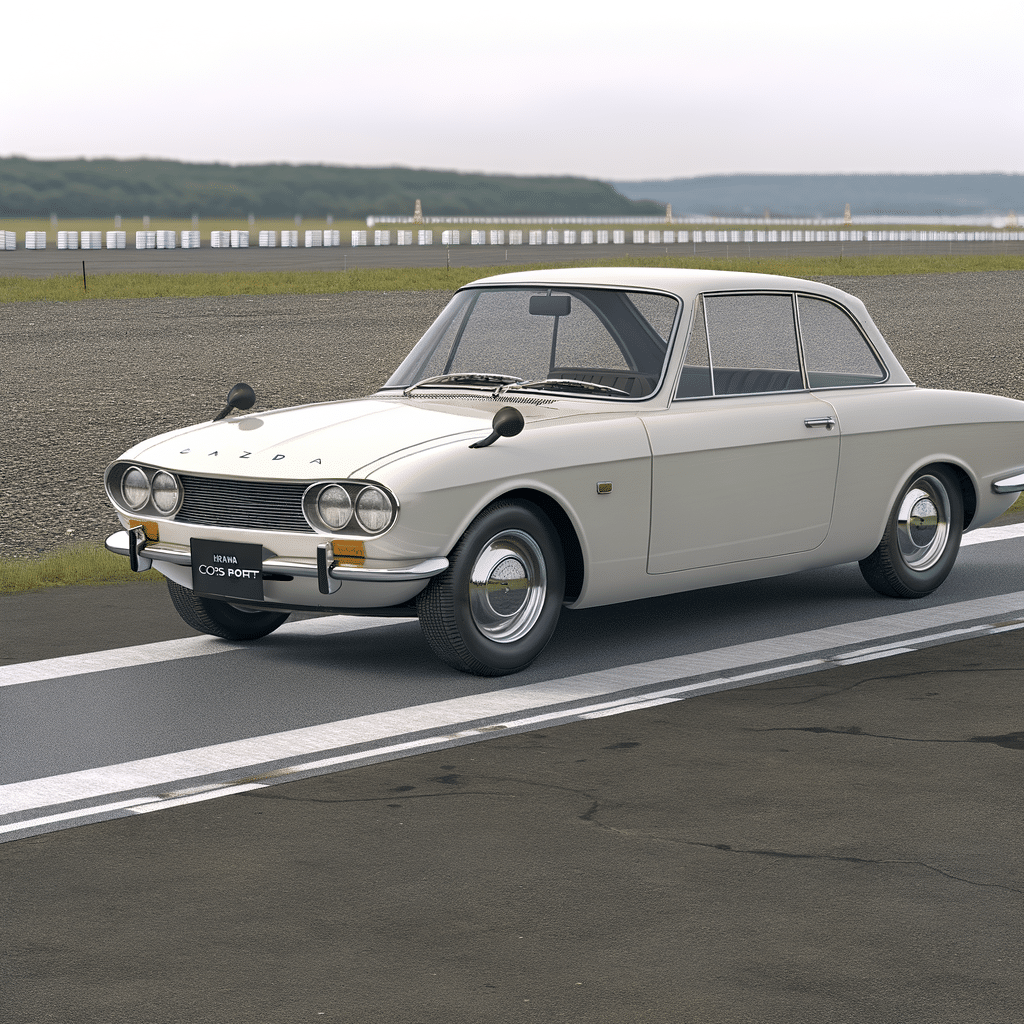
Mazda chose to push through anyway, largely because it needed something distinctive. The company built a specialized engineering group and spent years improving durability. The breakthrough moment came in 1967 with the Cosmo Sport 110S, Mazda’s first rotary-powered production car. It was sleek, futuristic, and it signaled that Mazda was not content to be a maker of small budget cars. The Cosmo did not become a mass-market hit, but it did something more valuable: It proved Mazda could commercialize a difficult technology and turn it into a brand signature.
From there, rotary power flowed into more attainable models. The late 1960s and early 1970s saw rotary versions of the Familia, Capella, and other lines, with export markets slowly noticing. Mazda’s engineering personality was forming as an underdog that tried unconventional solutions, not because it was trendy, but because the company needed differentiation to compete on a global stage.
1970s reality check: Emissions rules and the fuel crisis
The 1970s tested that rotary identity. Emissions regulations tightened in major markets, and the 1973 oil crisis changed what customers valued almost overnight. A rotary’s smooth, high-revving character could be exciting, but drivers started paying more attention to miles per gallon. Mazda did not abandon the rotary, yet it learned a key lesson: A signature technology cannot be the only plan.
During this decade, Mazda expanded its conventional piston-engine offerings and refined its lineups for different regions. The company’s rotary cars still created a performance halo, but the business needed staples that could sell in volume. This is where Mazda’s approach began to resemble what enthusiasts recognize today: Fun cars exist, but they sit alongside practical vehicles that keep the lights on.
Among the most culturally important rotary products to emerge from this era was the RX-7, introduced in 1978 for the 1979 model year in many markets. The RX-7’s timing was clever. It delivered the lightness and compact packaging that suited the rotary, wrapped in a sports car shape that felt attainable. As emissions and fuel worries reshaped the market, Mazda positioned the RX-7 not as a thirsty exotic, but as a relatively simple, balanced coupe with a unique engine note and smoothness that no piston four could quite mimic.
1980s growth and a broader personality
By the 1980s, Mazda was growing into a more complete global automaker. The company’s relationship with Ford deepened during this period, influencing manufacturing scale and product sharing in certain segments. Mazda also sharpened its understanding of what different markets wanted. North America appreciated reliability and value, Europe leaned into handling and efficiency, and Japan continued to shape design and technology expectations at home.
The second-generation RX-7 (FC), launched in 1985, moved the rotary sports car formula closer to the mainstream of the era with a more modern shape and available turbocharging in some markets. It helped keep Mazda’s rotary identity alive while competitors leaned hard into conventional power. Yet the 1980s also gave Mazda something even more widely influential than a rotary coupe.
In 1989, Mazda introduced the MX-5 Miata. It arrived after the classic British roadster had mostly disappeared under the weight of cost, reliability problems, and changing crash standards. Mazda did not invent the lightweight roadster idea, but it revived it with Japanese reliability and a simple, honest design. The Miata’s impact was immediate and long-lasting because it made low-speed fun feel legitimate again. It reminded a new generation that steering feel, weight, and balance could matter as much as horsepower.
Enthusiast culture grew around cars like the Miata and RX-7, and that culture often overlaps with the choices people make when they start personalizing their vehicles. The line between preserving a car’s character and going too far can get thin, which is why ideas like Avoid over-modding your car resonate with owners who want upgrades without losing what made the original platform special.
1990s highs and pressures: Racing glory and market shifts
The early 1990s brought one of Mazda’s proudest motorsport moments. In 1991, the rotary-powered Mazda 787B won the 24 Hours of Le Mans. It remains famous not only because it was a Mazda victory, but because it was the only win for a rotary engine at Le Mans. The achievement mattered symbolically: Mazda’s unusual engineering path could succeed on the world’s toughest endurance stage.
On the road, Mazda’s third-generation RX-7 (FD), introduced in 1991, became an icon. It was lighter and more focused than many rivals, and twin-turbo rotary power gave it a distinct blend of response and high-rev character. But the same forces that challenged rotaries in the 1970s never fully went away. Emissions compliance, rising complexity, and the cost of meeting modern standards made it harder to sell rotary sports cars widely and profitably.
Meanwhile, the broader market was changing. SUVs were gaining popularity, and buyers wanted more space and perceived safety. Mazda responded with products like the MPV and later compact SUVs, while still trying to keep a driver-focused edge in its sedans and hatchbacks. The company’s design language in the 1990s could look less unified than later decades because Mazda was juggling many demands at once: Exports, partnerships, regulations, and shifting tastes.
2000s: Zoom-Zoom and the push to feel different
In the early 2000s, Mazda leaned into a simple idea: Even everyday cars should feel alive. The “Zoom-Zoom” era was more than a marketing phrase. It aligned with product decisions that emphasized steering response, chassis balance, and a sense of connection, even in family-oriented models. The first-generation Mazda6 arrived in 2002, and the Mazda3 followed in 2003. Both helped Mazda build a reputation for cars that could be practical without feeling numb.
Mazda also returned to the rotary conversation with the RX-8 in 2003. Its Renesis rotary engine was engineered to improve emissions and packaging, and the car’s rear-hinged “freestyle” doors offered sports-car style with better access to the rear seats. The RX-8’s existence showed Mazda still believed the rotary belonged in its story, even if the business case was always harder than with piston engines.
As these cars aged into the used market, owners who cared about handling often started with fundamentals, especially wheels and tires. Small changes can reshape how a Mazda feels on a back road, and topics like Car wheel fitment explained tend to come up when enthusiasts try to preserve that factory balance while improving grip or stance.
2010s: Skyactiv engineering and Kodo design
The 2010s marked a turning point where Mazda tightened its identity again. Rather than chasing hybridization early or relying heavily on large partnerships, Mazda invested in making internal combustion more efficient through a holistic approach called Skyactiv. Starting around 2011 and rolling through the decade, Skyactiv meant engines, transmissions, body structures, and chassis designs were treated as one system. High compression gasoline engines, lighter platforms, and refined automatics and manuals were part of a strategy to improve fuel economy and emissions without sacrificing the responsive feel Mazda wanted.
At the same time, Mazda’s design language moved into a more coherent, mature phase with Kodo, often described as “Soul of Motion.” Lines became cleaner, surfaces more sculpted, and proportions more premium. This mattered because Mazda was gradually moving upmarket in feel, even if prices stayed closer to mainstream rivals. Interiors grew quieter, materials improved, and the cars began to feel intentionally minimal rather than simply budget-conscious.
The fourth-generation MX-5 (ND) arrived for 2015 and fit perfectly into this philosophy. It became lighter than its predecessor, an uncommon move in an era when most cars gained weight. Mazda’s choice reflected a consistent belief: A car does not need big power to be engaging if the fundamentals are right. That mindset also shaped the Mazda2, Mazda3, and Mazda6 updates through the decade, where refinement went up without abandoning the company’s handling priorities.
The rotary as an idea: From engines to an engineering symbol
Even when rotary-powered sports cars were no longer in showrooms, the rotary never fully disappeared from Mazda’s identity. It remained a symbol of the company’s willingness to take technical risks. Over time, Mazda began discussing the rotary less as a mainstream propulsion answer and more as a specialized tool. Public statements and concept work over the years pointed toward rotaries potentially serving as range extenders rather than primary performance engines, a role that plays to the rotary’s compact size and smooth running at steady speeds. Specific rollout timing and market availability have varied by region and model year, and some plans have shifted as regulations and EV strategies evolved, so it is safer to treat rotary revival talk as a recurring theme rather than a single straightforward return.
Late 2010s into the 2020s: Crossovers, premium ambition, and new platforms
As the market continued moving toward crossovers, Mazda expanded its lineup with vehicles like the CX-5, introduced for 2013 in many markets, and later the CX-30. These models mattered because they brought Mazda’s driving feel and design discipline into the segments where most buyers were now shopping. Instead of treating crossovers as purely practical appliances, Mazda tried to make them quieter, more responsive, and more carefully styled than the typical mainstream choice.
Then came a notable strategic shift in the early 2020s. Mazda introduced a new line of larger SUVs, including the CX-60 and CX-90, built around longitudinal engine layouts and rear-biased all-wheel drive architectures in certain configurations. This was a major engineering and brand statement. Mazda was building vehicles that could compete on refinement and driving character nearer the premium space, not by copying luxury brands directly, but by emphasizing balance, restraint in design, and a more structured platform approach.
At the same time, Mazda began stepping into electrification with models like the MX-30, which reflected an experimental, cautious entry rather than an all-in pivot. The company’s pace has often looked deliberate. Mazda historically prefers engineering solutions that fit its scale and identity, and the EV transition is no exception. That caution can be frustrating for fans waiting for big announcements, but it fits a company shaped by hard lessons from the rotary era: Distinctive technology is only valuable when it can be supported, refined, and sold in real-world conditions.
Real-world conditions also shape ownership experiences, especially as cars add tech and sit unused for longer stretches. Modern Mazdas are generally dependable, but any vehicle can have problems if it sits, and topics like car won’t start after sitting have become more common as commuting patterns change and weekend cars become a bigger part of enthusiast life.
How Mazda’s design and culture stayed connected to drivers
Across its decades, Mazda’s cultural impact has often come from making “driver’s car” values accessible. The RX-7 and RX-8 made rotary performance a recognizable subculture, especially in the 1990s and 2000s tuning scenes. The Miata became almost universal shorthand for lightweight fun, spawning track-day communities and grassroots motorsport participation that continues today.
Even Mazda’s mainstream cars carried that identity. A Mazda3 hatchback became, for many younger enthusiasts, a first taste of a car that felt responsive without being expensive. That matters for Gen Z and Millennials because the path into car culture is often through attainable, practical vehicles. The modifications tend to start small and personal, and conversations about Driving enjoyment car mods often reflect the same core belief Mazda has sold for decades: The point is to feel connected, not just to go faster.
From cork to three-wheeled trucks, from the Cosmo’s rotary promise to the Miata’s minimalist joy, Mazda’s history reads like a long attempt to answer one question: How does a smaller company stay memorable in a crowded industry? Sometimes the answer was a daring engine that no one else could make work at scale. Other times it was a simple roadster, or a family car with steering that felt just a little more alive. The details changed with each decade, but the thread remained recognizable: Mazda kept trying to make motion feel like something worth paying attention to.


