




This post may contain affiliate links. Please read our disclosure and privacy policy for more information.
- From Prototype to People’s Car: The 1950s
- Finding a Technical Identity: 1960s Boxer Power and Front-Drive
- The 1970s: The Leone, Early AWD Thinking, and Export Reality
- The 1980s: From Practical 4WD to a Broader Lineup
- The 1990s: Legacy, Impreza, and the Rally Image
- The 2000s: Turbo Era Peaks, Mainstream Growth, and New Priorities
- The Late 2000s into the 2010s: A New Engine Philosophy and Global Consistency
- The BRZ Moment: Subaru’s Sports Car Returns in a Different Form
- Design Shifts: From Quirky Utility to Modern Familiarity
- Culture and Community: Why Subaru Lands Differently
- Related Resources
Subaru’s story begins long before anyone outside Japan had heard the name. The company behind it, Fuji Heavy Industries, grew out of the wreckage and restructuring of Japan’s aircraft industry after World War II. Nakajima Aircraft, once a major airplane builder, was broken up under postwar rules. In the early 1950s, several successor companies regrouped, and in 1953 they merged into Fuji Heavy Industries. The new firm still carried an aviation mindset: It was engineering-led, weight-conscious, and interested in mechanical solutions that felt “right” rather than merely fashionable.
Even the brand name pointed to this rebirth. “Subaru” is the Japanese name for the Pleiades, a cluster of stars that can be seen as a small group in the night sky. It fit the idea of separate companies coming together into one. For a generation of buyers, though, what mattered more was that Subaru entered an era when Japan needed mobility that was small, affordable, and efficient, and the government was actively shaping what that first wave of cars should look like.
From Prototype to People’s Car: The 1950s
Fuji Heavy Industries showed its first passenger-car prototype, the Subaru 1500, in 1954. It was a serious attempt, but limited production and supplier realities meant it did not turn into a mass-market breakthrough. Still, it taught the company a crucial lesson: Subaru could not win by copying bigger manufacturers. It needed a niche where smart packaging and light weight mattered most.
That niche arrived in 1958 with the Subaru 360. Japan’s kei car regulations rewarded tiny dimensions and small engines, which made cars cheaper to buy and run. Subaru designed the 360 around those rules, creating a friendly, rounded microcar with a rear-mounted, two-stroke 356 cc engine. It was not fast, but it was attainable. The 360 earned a cultural role as a starter car for families and young drivers, a symbol of a country moving from bicycles and scooters to four wheels.
Just as important, the 360 forced Subaru to learn high-volume manufacturing and cost discipline. Those skills would matter later when the company made engineering choices that were more complex than the average economy car.
Finding a Technical Identity: 1960s Boxer Power and Front-Drive
During the 1960s, Subaru started building the identity enthusiasts now recognize. The big step came in 1966 with the Subaru 1000, the company’s first modern compact car and the debut of Subaru’s horizontally opposed “boxer” engine in a production passenger vehicle. A boxer layout places the cylinders flat, opposing each other across the crankshaft. The design is naturally low and balanced, which helps stability and packaging, even if it can be wider and sometimes trickier to service than an inline engine.
The Subaru 1000 also used front-wheel drive, which was still a forward-thinking choice for Japanese family vehicles at the time. It helped interior space and traction compared to traditional rear-drive layouts. Subaru’s reasoning was practical: A compact, low engine paired well with a drivetrain meant to keep the cabin roomy without making the car bigger. The 1000 did not instantly dominate the market, but it set a pattern. Subaru was willing to go its own way if the engineering logic was strong.
The 1970s: The Leone, Early AWD Thinking, and Export Reality
In 1971, Subaru introduced the Leone, a model that became the backbone of the brand through the decade. It arrived as Japan and many export markets were shifting toward compact cars for commuting and daily life. The Leone also arrived at a perfect time for Subaru’s export growth, including the United States, where buyers were becoming more open to smaller imports.
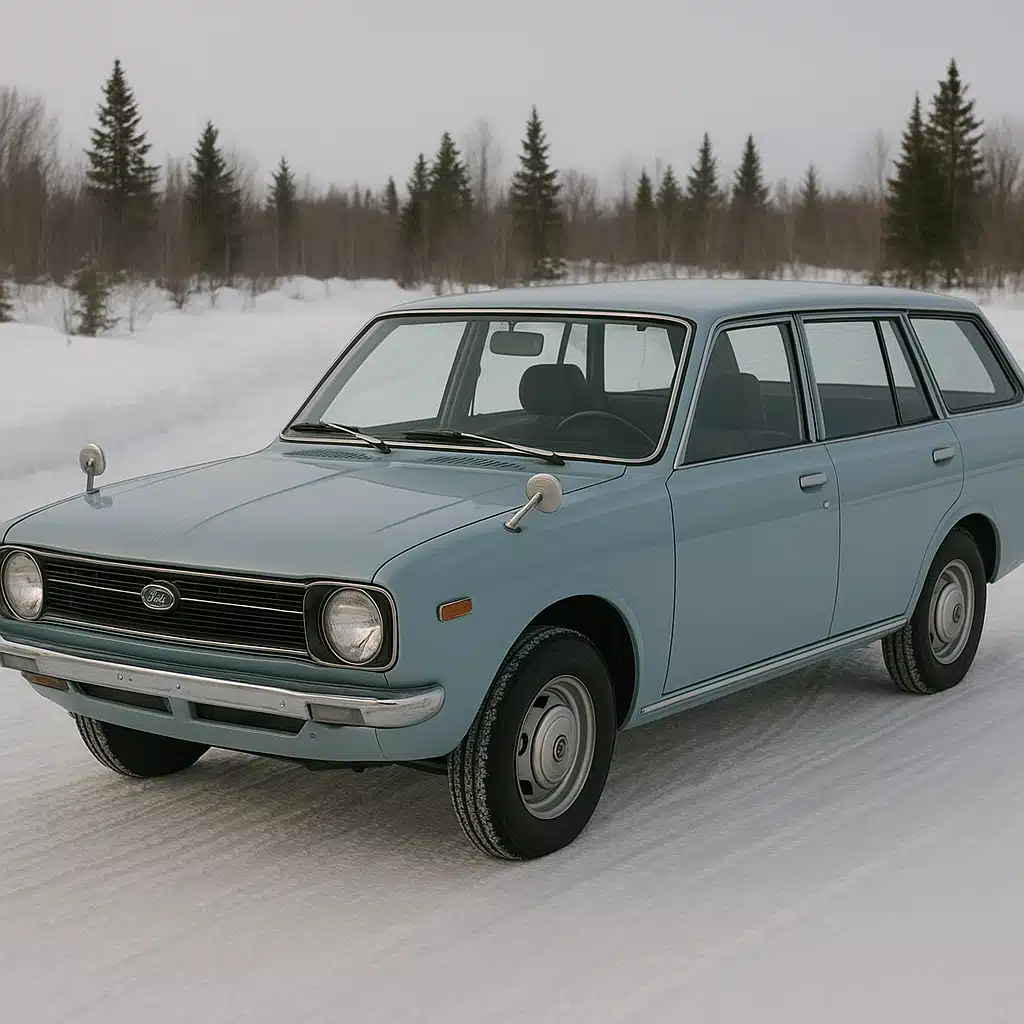
The most important Subaru milestone of the 1970s came in 1972: Subaru released a four-wheel-drive version of the Leone wagon. It was not the full-time, sporty all-wheel drive people associate with modern Subarus. Instead, it was a part-time 4WD system aimed at rough roads, snow, and rural use. In other words, it was built for utility and reliability, not rally glory.
Why did Subaru go there so early? The company was smaller than domestic giants, so it benefited from owning a specialty. For drivers in mountainous regions of Japan, or in snowy parts of North America, extra traction was not a luxury feature. It was the difference between getting home and getting stuck. Subaru realized that capability could become a brand signature.
In the background, the decade also brought emissions laws and fuel-economy pressure. Like other automakers, Subaru had to adapt engines and fueling systems to meet changing regulations. These constraints pushed engineering teams to prioritize efficiency and drivability, sometimes at the cost of raw simplicity.
When people compare brand identities across decades, it helps to remember that “signature choices” can be as much about survival as passion. Exotic brands often shaped themselves through performance statements, as seen in Lamborghini origins and milestones, while Subaru built its image through practical traction and everyday usability.
The 1980s: From Practical 4WD to a Broader Lineup
By the 1980s, Subaru was leaning harder into 4WD and refining the idea. The Leone evolved, and Subaru expanded globally with increasingly recognizable products. In 1983, the Subaru Domingo (known in some markets as the Libero) appeared as a compact van, showing Subaru’s interest in packaging efficiency. In 1984, Subaru launched the Justy, notable for offering an electronically controlled continuously variable transmission in some versions, an early sign that Subaru was open to unconventional solutions when they suited the mission.
In 1985, the Subaru Alcyone arrived, sold in many markets as the XT. Low, futuristic, and wedge-shaped, it was a design swing at a time when digital dashboards and sharp angles felt like the future. It also signaled that Subaru did not want to be seen only as the brand for wagons and winter roads. Even so, the company’s strongest reputation still formed around traction and durability rather than pure speed.
Subaru’s 4WD systems continued to evolve through this era, varying by transmission and market. The company was moving toward a more seamless, more passenger-car-friendly form of all-wheel drive, but details diverged across models. What is consistent is the direction: Subaru saw AWD as something regular people could benefit from every day, not just an off-road tool.
The 1990s: Legacy, Impreza, and the Rally Image
The 1990s are where Subaru’s modern identity comes into focus. In 1989, Subaru launched the Legacy, and it quickly became a central platform through the early 1990s. The Legacy was larger, more mature, and aimed at buyers who wanted a family car that still felt engineered with purpose. In 1992, Subaru followed with the Impreza, a more compact model that would become the brand’s youth magnet.
Subaru’s turning point in public image came through motorsport, especially rallying. Subaru competed in the World Rally Championship with increasing success through the 1990s, culminating in memorable achievements such as the 1995 manufacturers’ championship and the rise of driver icons like Colin McRae. Rallying mattered because it matched Subaru’s technical strengths. Turbocharged boxer power and all-wheel drive were not just marketing ideas. They were proven tools on loose surfaces and bad weather stages.
The showroom effect was real. Buyers who lived nowhere near a rally stage started associating Subaru with confident traction and a slightly rebellious, outdoors-ready personality. The Impreza WRX and later WRX STI variants became symbols for a generation that wanted speed but also wanted a car that could handle rain, snow, or rough commutes without drama. For newcomers trying to decode drivetrain layouts, the difference in feel between traction-focused systems is easier to grasp with an AWD vs FWD guide in mind, because Subaru’s whole strategy depended on the advantages being noticeable in daily life.
Design also shifted in this decade. Subaru styling moved from boxy and utilitarian toward smoother, more aerodynamic shapes. It was partly driven by safety standards, fuel economy, and mainstream taste. Subaru had to look less quirky to grow, especially outside Japan, but it still needed to keep a recognizable mechanical personality under the skin.
The 2000s: Turbo Era Peaks, Mainstream Growth, and New Priorities
The early 2000s marked the high point of Subaru’s turbocharged performance era in the public imagination. The second-generation Impreza (introduced in 2000 in Japan, reaching many markets soon after) and its WRX and STI versions became global favorites. The “bug-eye” 2002 model in the United States sparked debate, and that reaction itself revealed a new reality: Subaru now had enough fans that styling changes could feel personal.
At the same time, Subaru’s mainstream lineup gained momentum. The Outback, introduced in the mid-1990s as a raised, ruggedized wagon concept, grew into a defining product in North America. That shift happened because buyers were moving toward SUVs and crossovers, but many still wanted car-like driving manners. Subaru’s approach was to create vehicles that sat between categories: More ground clearance and toughness than a typical wagon, without becoming a truck-based SUV.
Safety and reliability also became central to Subaru’s identity in these years. The brand leaned into all-weather confidence and family use, expanding beyond the tuner and rally crowd. Engineering focus turned toward refinement and emissions compliance, and that gradually changed what enthusiasts expected from Subaru powertrains.
The Late 2000s into the 2010s: A New Engine Philosophy and Global Consistency
In the late 2000s, Subaru introduced the FB-series boxer engines, beginning around 2010 in key models. The goal was better fuel efficiency, lower emissions, and improved everyday torque compared with older EJ-series engines. This was not a change made for excitement. It was made because global regulations and consumer expectations were changing, and Subaru’s future depended on meeting those demands without losing the boxer layout that defined the brand.
Another major shift was Subaru’s broader adoption of continuously variable transmissions. CVTs helped fuel economy targets and made power delivery smoother for commuting. Some drivers missed the sharper feel of traditional automatics or manuals, but from Subaru’s perspective, the trade made sense: Most buyers were choosing comfort and efficiency, and Subaru needed to stay competitive.
Subaru also worked to standardize AWD availability across its lineup, especially in markets where that feature had become the brand’s calling card. Over time, “Symmetrical All-Wheel Drive” became a consistent marketing and engineering theme, even though the exact hardware still varied by model and transmission type.
Chassis tuning grew more sophisticated too. Better body control, quieter cabins, and improved crash performance reshaped how Subarus felt. Drivers who wanted to understand why modern cars corner and ride the way they do often start with Car suspension basics, because Subaru’s shift from rally-bred rawness to daily refinement was as much about suspension and structure as engines.
The BRZ Moment: Subaru’s Sports Car Returns in a Different Form
In 2012, Subaru launched the BRZ, developed with Toyota. For longtime fans, it was a fascinating pivot. Subaru had been known for turbocharged AWD performance icons, yet the BRZ was rear-wheel drive and naturally aspirated. It still used a Subaru boxer engine, but the mission was different: Light weight, balance, and driver feel over raw traction.
This happened for practical reasons. Regulations and costs made niche performance cars harder to justify alone, and partnerships helped spread development expense. It also reflected a broader enthusiast truth: Not everyone wants speed through grip. Some want a car that communicates clearly at lower speeds, with predictable handling and simple feedback.
The BRZ did not replace the WRX in spirit, but it showed Subaru could still play in enthusiast spaces without relying on the same old formula.
Design Shifts: From Quirky Utility to Modern Familiarity
Over decades, Subaru design moved in waves. Early models were small and purpose-built, shaped by regulations and tight budgets. The 1970s and 1980s leaned practical and boxy, made for visibility and easy packaging. The 1990s smoothed things out as aerodynamics and global taste took over. By the 2000s and 2010s, Subaru styling became more mainstream, with strong fender shapes and bolder faces that were easier to recognize in crowded segments.
That mainstream look sometimes disappointed fans who loved Subaru’s oddball charm, but it aligned with Subaru’s reality as a growing global manufacturer. When a brand sells to more families, safety tech, cabin comfort, and predictable styling tend to matter more than eccentricity.
Culture and Community: Why Subaru Lands Differently
Subaru’s cultural impact has always been tied to what its cars allow people to do. In snow states and mountain towns, a Subaru often reads like a practical tool, chosen for traction and durability rather than status. In cities and college towns, older Imprezas and WRXs became a form of identity, shaped by rally imagery, tuner culture, and the appeal of a car that felt fast in bad weather.
There is also a long-running modification scene around Subarus, from lifted Outbacks built for dirt roads to WRXs tuned for track days. That community is not unique to Subaru, but Subaru’s consistent mechanics made knowledge transferable across years. People learned what worked, what broke, and what to upgrade first. At the same time, the brand’s shift toward modern complexity means ownership today can include more attention to diagnostics and maintenance habits, the same way drivers of any modern vehicle sometimes end up chasing issues like a coolant level keeps dropping symptom when age, heat cycles, or small leaks start to add up.
Subaru’s story, decade by decade, is not just about a list of models. It is about a company that kept choosing a clear technical identity, then adapting it to whatever the era demanded. From postwar rebirth to kei-car necessity, from boxer engines to everyday all-wheel drive, and from rally fame to mainstream crossovers, the brand kept moving forward without fully letting go of what made it distinct in the first place.


