




This post may contain affiliate links. Please read our disclosure and privacy policy for more information.
- What “Vehicle Weight” Really Means
- How Weight Affects Acceleration
- How Weight Affects Braking
- How Weight Affects Fuel Use
- Weight Reduction That Helps, and Weight Reduction That Hurts
- Performance Impact: What You Usually Feel First
- Safety Considerations
- What the Research Shows in Real-World Terms
- Common Misconceptions
- Things to Consider Before Making Changes
- Practical Guidance for Drivers
Vehicle weight is not just a spec on a window sticker. It changes how fast a car accelerates, how hard the brakes have to work, and how much fuel the engine needs to move the car down the road.
Weight reduction sounds simple, but the effects are connected. Drop mass and you often improve acceleration, braking consistency, tire life, and fuel use at the same time. The trade-off is that not all weight is “safe” to remove, and some changes can create new problems like higher noise, harsher ride, or weaker crash performance.
What “Vehicle Weight” Really Means
When people say “weight,” they usually mean curb weight: The car with fluids and standard equipment, but without passengers or cargo. That number matters because it represents what the powertrain and brakes always have to move and control.
Two other weight ideas help explain real-world results:
- Total moving weight: Curb weight plus passengers, cargo, and fuel. If you carry tools, a stroller, or heavy work gear every day, your “daily curb weight” is higher than the brochure number.
- Rotational and unsprung weight: Wheels, tires, brake rotors, and some suspension parts. This weight can have a bigger feel than the same amount removed from the trunk because it affects both rotation and suspension response.
How Weight Affects Acceleration
Acceleration is about how quickly a car can increase speed. The simplest way to understand the weight effect is Newton’s Second Law: F = ma. If the available force (engine torque through the drivetrain) stays the same, a lighter car accelerates more than a heavier one.
What it means in normal driving
Most daily acceleration happens at part throttle, not full throttle. That is where weight reduction can feel surprisingly noticeable:
- The car needs less throttle to pull away from a stop.
- It holds speed more easily on hills.
- It feels more responsive in short merges and lane changes.
Why wheels and tires can feel like “more than their weight”
Weight at the wheels is both rotating and moving up and down over bumps. A lighter wheel usually improves response because the drivetrain has less rotational inertia to spin up, and the suspension has less mass to control. The downside is that very light wheels can be easier to damage, and the wrong wheel size or design can create fitment or handling issues. If you change wheels, understanding wheel offset and backspacing matters as much as the weight.
How Weight Affects Braking
Brakes turn motion into heat. The heavier the vehicle, the more kinetic energy it carries at a given speed, and the more energy the brakes must dissipate to stop.
That relationship matters for two reasons:
- Stopping distance: All else equal, less mass means the tires and brakes have an easier job. On real roads, tire grip, brake condition, and ABS control matter a lot, but reducing weight generally helps.
- Brake temperature and fade: Even if a heavier car can stop once in a similar distance, repeated stops create more heat. Heat is what causes long pedals, reduced friction, and “fade.” Lower mass reduces how quickly temperatures climb.
Practical implication: Consistency can improve more than the first stop
Drivers often focus on 60 to 0 mph stopping distance, but repeated braking is where weight really shows. Descending a long hill, towing, or driving aggressively on back roads builds heat. A lighter car often keeps a more consistent pedal feel and braking response because it generates less heat for each stop.
If the goal is better braking without major weight changes, hardware and friction choices also matter. A sensible Brake upgrade path can improve pedal feel and fade resistance, but it cannot change physics. Weight still sets the baseline workload for the brake system.
How Weight Affects Fuel Use
Fuel economy is influenced by many things, but government research consistently shows mass is a major driver. The reason is simple: It takes energy to accelerate mass, and in stop-and-go driving you keep paying that cost over and over.
What the research shows
The U.S. Department of Energy reports a clear benchmark: A 10% reduction in vehicle weight typically improves fuel economy by about 6–8%. In smaller steps, a 100 lb (45 kg) reduction is often worth about a 1–2% improvement in fuel economy.
What it means: Weight reduction does not create “free MPG,” but it can produce a measurable change, especially in city driving.
Why it matters: Many drivers chase fuel economy with minor tweaks while ignoring the biggest repeated energy cost in traffic: accelerating mass.
Practical implication: If most of your driving is highway cruising at steady speed, weight reduction helps less than in city driving. At highway speed, aerodynamic drag becomes the main load. Weight still matters for hills, passing, and rolling resistance, but the MPG change is usually smaller than it is in stop-and-go use.
Mass is also tied to emissions
EPA fleet analysis also identifies mass as one of the dominant factors affecting fuel economy, alongside aerodynamic drag and rolling resistance. In simple terms: When vehicle mass goes down, fuel use and CO₂ generally go down too, even before you change the engine.
Weight Reduction That Helps, and Weight Reduction That Hurts
Not all pounds are equal. Some weight makes a car quieter, smoother, and safer. Some weight is just unused cargo, heavy wheels, or oversized components that do not match your driving needs.
| Change | Likely Benefit | Common Trade-Off |
|---|---|---|
| Removing unnecessary cargo (tools, boxes, unused racks) | Better fuel economy in stop-and-go driving, slightly better acceleration | None, as long as you keep required safety gear |
| Lighter wheels and tires (correct size and load rating) | Improved response, potentially shorter braking distances, better ride control over bumps | Cost, possible durability loss, fitment and alignment sensitivity |
| Switching to lighter exhaust components | Small weight savings, sometimes better packaging | More noise, drone, possible emissions compliance issues depending on parts |
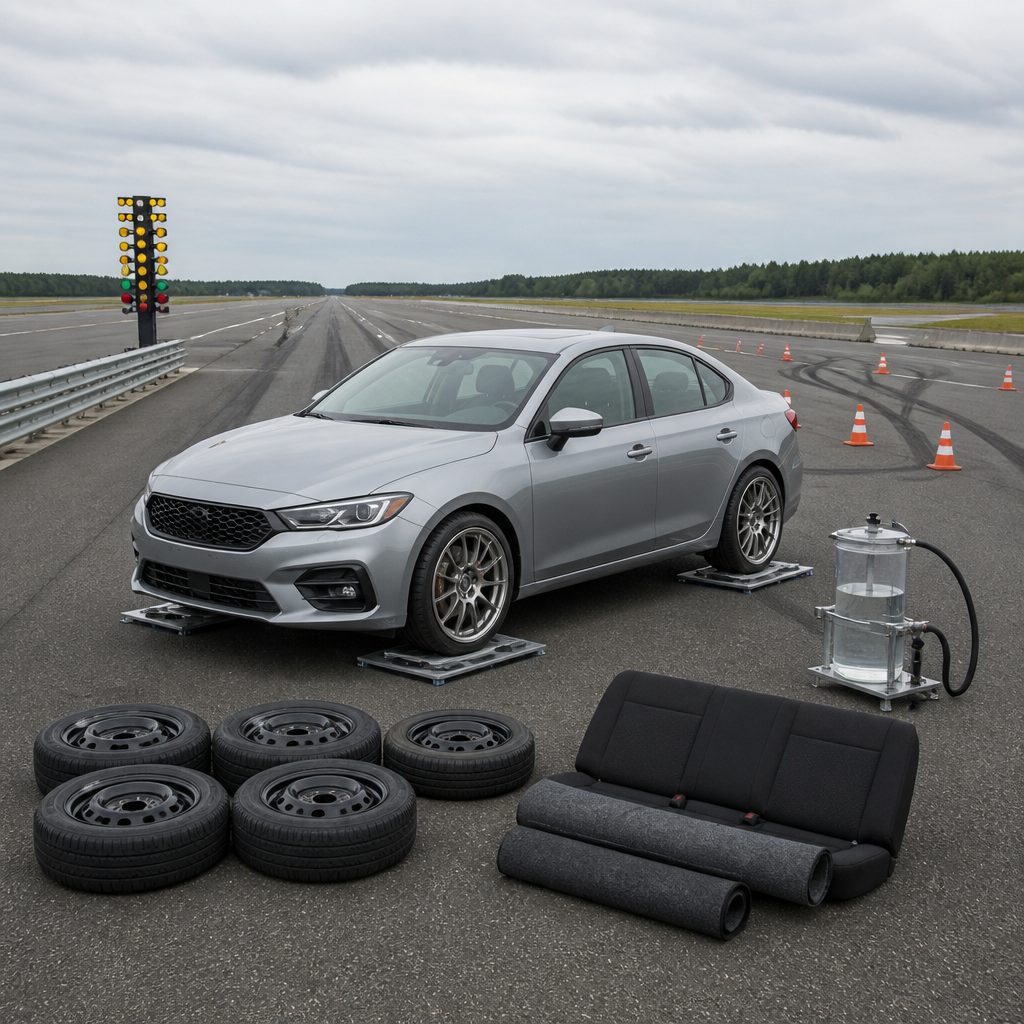
| Removing rear seats, spare tire, interior trim | Noticeable weight loss for track or autocross use | Higher cabin noise, reduced comfort and practicality, safety concerns in a crash |
| Replacing structural parts with weaker aftermarket pieces | None worth the risk | Crash performance risk, poor repairability, potential legality and insurance issues |
Performance Impact: What You Usually Feel First
In most street cars, you feel weight changes in three places before you notice top-speed differences.
1) Launch and low-speed pull
Less mass means the powertrain has less work to do at low speeds. This is the range where many cars feel “heavy,” especially smaller-engine vehicles or cars with tall gearing.
2) Brake feel during repeated stops
If you reduce weight and keep the same brake hardware, the brakes usually run cooler in the same driving. That can improve consistency and reduce the “hot brake” smell and soft pedal people sometimes notice after mountain driving.
3) Steering and ride response
Reducing unsprung weight can make the front end feel sharper and can help the suspension follow bumps with more control. This is not about grip alone. It is about how quickly the tire can stay in contact with rough pavement.
Safety Considerations
Weight reduction and safety sit in the same conversation for a reason. Mass can help in certain crash scenarios, but structure, restraint systems, and crash design matter more than “heavier is safer” thinking.
Crash compatibility is a real issue
In multi-vehicle crashes, a very light vehicle can be at a disadvantage when hitting a much heavier one. That said, modern crash performance depends heavily on:
- How the front structure manages energy (crumple zones and load paths)
- How the passenger cell maintains survival space
- Airbags, seat belts, and pretensioners working as designed
This is why serious lightweighting from automakers involves materials engineering, crash testing, and redesign. It is not just removing parts.
Do not remove safety systems for weight savings
A few common weight-saving ideas can create big risk on the street:
- Deleting airbags or seat belt components
- Removing impact beams or structural braces
- Using seats that do not fit correctly or do not lock firmly
If a change could affect safe control of the vehicle, treat it as a safety decision first, not a performance decision. When a car starts showing scary symptoms on the road, it helps to think in terms of “can I keep driving or do I need to stop and inspect?” The decision framework in Safe to Keep Driving can help you think clearly under pressure.
What the Research Shows in Real-World Terms
Government research gives a useful baseline for what weight reduction does to fuel economy.
Key finding: The U.S. Department of Energy reports about a 6–8% fuel economy improvement from a 10% weight reduction.
What it means: Dropping weight is one of the few changes that can improve fuel use without changing how the engine is tuned or how the transmission shifts.
Why it matters: It also tends to improve acceleration and braking at the same time. Many modifications improve one area while hurting another. Weight reduction often improves several areas together, as long as you avoid removing parts that help safety, comfort, and durability.
Practical implication: The most noticeable fuel economy gains from weight reduction usually show up in city conditions, short trips, and routes with lots of stops. If your driving is mostly steady highway speed, focus first on tire pressure, maintenance, and aero drag sources like external racks when not needed.
Common Misconceptions
“Any weight reduction is good weight reduction”
Some weight is there for a reason. Sound deadening, structural reinforcements, and proper seats add mass but also add comfort and crash protection. Treat weight reduction like a system change, not a single-number goal.
“A lighter car always stops shorter”
It usually helps, but tires and road grip set the maximum braking force. If you remove weight but switch to harder tires, old tires, or poor alignment, stopping distances can get worse. Brake condition also matters. If the pedal is inconsistent or the steering shakes under braking, fix the basics first. Problems like steering wheel shakes can be a sign of tire, wheel, rotor, or suspension issues that no weight change will solve.
“Lightweight parts are automatically higher performance”
Some light parts are excellent. Some are light because material strength, thickness, or heat capacity was reduced too far. That matters for parts like wheels, brake rotors, and suspension arms that see impact loads and heat cycles.
Things to Consider Before Making Changes
If you want the benefits of a lighter vehicle without creating new problems, start with decisions that do not compromise the car’s design limits.
Focus on “free” weight first
- Clear out cargo you do not use weekly.
- Remove unused external racks when you are not carrying anything.
- Keep the trunk organized so weight does not creep back over time.
Be careful with wheel and tire choices
Wheel and tire changes can improve response and efficiency, but they can also harm ride quality, braking, and durability if you pick the wrong size, load rating, or offset. Avoid extreme upsizing. Larger wheels often add weight and can increase rolling resistance with wider tires.
Understand the trade between strength and mass
Automakers use high-strength steel, aluminum, and composites to reduce weight while keeping crash protection. Aftermarket lightweight parts do not always follow the same testing standards. If a part is structural, treat strength, fit, and corrosion resistance as non-negotiable.
Do not chase weight reduction to fix a fuel economy problem
If fuel economy suddenly drops, weight is rarely the cause. A mechanical issue, tire problem, or fuel system problem is more likely. Symptoms like fuel mileage suddenly dropped often point to maintenance needs, tire pressure, or a bad fill-up, not a sudden change in vehicle mass.
Practical Guidance for Drivers
If you want a lighter, more efficient car for daily driving, use this priority order:
- Keep the car empty of unnecessary cargo: It is the safest and cheapest way to reduce moving mass.
- Maintain tires and alignment: Rolling resistance and tire grip strongly influence both fuel use and braking.
- Choose lighter wheels only if you can keep correct fitment and load rating: You can gain responsiveness, but durability and geometry matter.
- Avoid removing safety, structural, or restraint components: Street cars need crash protection more than they need a small performance gain.
- Match weight changes to your driving: City drivers benefit most in fuel use. Drivers who brake repeatedly benefit most in brake temperature and consistency.
Weight reduction works because it changes the basic physics of how a car moves and stops. Done thoughtfully, it can make a car feel more responsive, brake with less stress, and use less fuel. Done carelessly, it can make the car louder, harsher, and less safe. The best results come from small, smart reductions that respect how the whole vehicle system works.


