


This post may contain affiliate links. Please read our disclosure and privacy policy for more information.
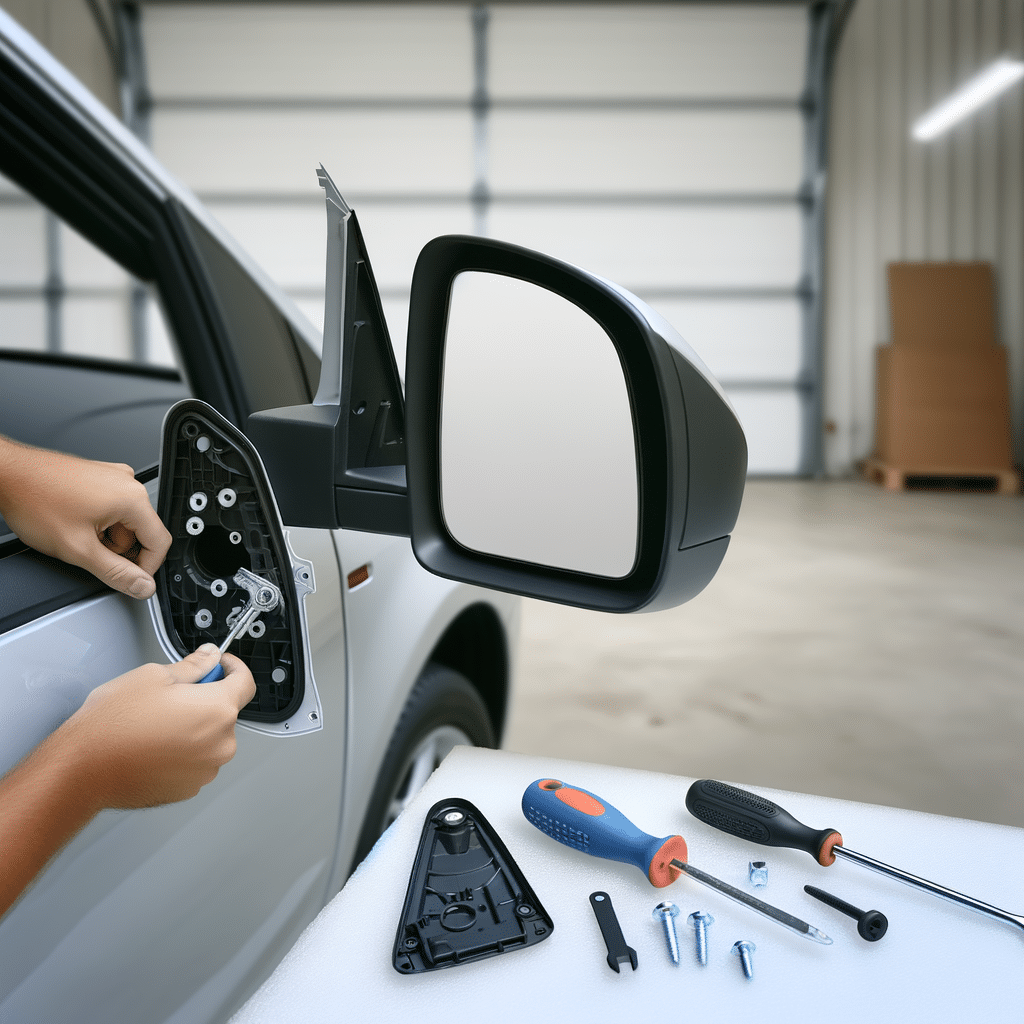
If your side mirror is cracked, loose, or missing, you can replace it at home. This job is usually simple. Most cars only need basic hand tools. You just need the correct mirror for your exact car.
This guide covers the common bolt-on door mirror. It also works for many power mirrors with wiring. If your mirror is glued to the glass only, that is a different repair.
Tools and items needed
- Replacement side mirror that matches your car (left or right side, and the same options)
- Socket set (common sizes: 8mm, 10mm, 12mm)
- Ratchet and short extension
- Trim removal tool or plastic pry tool
- Phillips and flat screwdriver
- Torx bits (some cars use Torx for door trim)
- Needle-nose pliers (helpful for clips)
- Painter’s tape or masking tape
- Shop light or flashlight
- Gloves and safety glasses
- Small container for screws and clips
How to pick the correct mirror
Before you start, match these details:
- Manual or power adjustment
- Heated glass or not
- Turn signal in mirror or not
- Blind spot indicator or not
- Painted cap vs black textured cover
Use your VIN when buying if possible. If you get the wrong mirror, it may bolt on but the plug may not match.
Safety or legal notes
Park on flat ground. Set the parking brake. Turn the key off. If your mirror has wiring, disconnect the negative battery cable before unplugging connectors. If you are not comfortable with that, follow Replace car battery safely for the basics.
Be careful with side curtain airbags. Some cars have airbag parts behind the door panel or near the A-pillar. Do not probe yellow connectors. Do not turn the key on while airbag plugs are disconnected.
In many places, you must have at least one working mirror. Some areas require both side mirrors. If your mirror is missing, fix it soon and avoid driving at highway speed until it is replaced.
Numbered installation steps
1) Protect the paint and glass
Put painter’s tape on the door near the mirror base. If the old mirror is loose, tape it to the door so it cannot fall.
2) Remove the inner mirror trim
Open the door. Look at the small plastic trim panel at the front top corner of the door, right behind the mirror. This is often called the sail panel.
- Use a plastic pry tool.
- Pull gently and evenly.
- If there is a tweeter speaker in the trim, unplug it.
Some cars hide a screw behind a small cap. If the panel will not move, look for a screw and remove it first.
3) If needed: Remove the door panel (only when required)
Many cars let you remove the mirror without taking off the whole door panel. If you can reach the mirror bolts and wiring plug from the sail panel area, skip this step.
If the plug is deeper inside the door, remove the door panel:
- Remove screws in the armrest, behind the handle, and along the bottom edge.
- Pry around the edges to release the clips.
- Lift the panel up and off the window ledge.
- Unplug window switch connectors and the door handle cable.
Work slow. Door panel clips break easily when pulled at the wrong angle.
4) Unplug the mirror wiring (power mirrors)
Find the mirror connector. Press the locking tab and pull the connector apart. If it is tight, use your fingers first. Use needle-nose pliers only on the connector body, not on the wires.
5) Remove the mirror mounting nuts or bolts
Most mirrors use three nuts on studs. Hold the mirror with one hand while you remove the last nut. This stops it from dropping and chipping paint.
- Use the correct socket size.
- Keep the nuts in a container.
- Pull the mirror straight away from the door.
If the mirror is stuck, wiggle it gently. There is usually a foam gasket that can grip the paint.
6) Clean the mounting area
Wipe the door surface where the mirror sits. Remove dirt and old foam pieces. Do not scrape the paint with metal tools.
7) Install the new mirror
Feed the wiring through the hole first (if equipped). Line up the studs or bolt holes. Press the mirror base flush against the door.
Start the nuts by hand. Do not cross-thread. Tighten them evenly.
- Snug is usually enough.
- Do not over-tighten. The mirror base can crack.
8) Reconnect wiring and test before reassembly
Plug the connector in until it clicks. Reconnect the battery negative cable if you disconnected it.
Test these items before you put panels back:
- Mirror adjustment (left, right, up, down)
- Mirror heater (if equipped, it may take a minute to feel warm)
- Turn signal in the mirror (if equipped)
- Blind spot indicator (if equipped)
If the mirror does not move and the connector looks fine, check the fuse. Electrical issues can also show up as dimming headlights causes, so it is worth paying attention to battery and charging health.
9) Reinstall the trim or door panel
Put the door panel back in reverse order:
- Reconnect switch plugs and the handle cable.
- Hang the panel on the top edge first.
- Press clips in around the perimeter.
- Reinstall every screw and cap.
Snap the sail panel back on. If you unplugged a tweeter, reconnect it first.
10) Set the mirror position
Sit in the driver seat. Adjust the mirror so you can see a small part of your car and a wide view of the lane next to you. Many drivers aim the mirror too far inward. That increases blind spots.
Common mistakes
- Buying the wrong mirror version. A plug mismatch is common on heated or signal mirrors.
- Breaking sail panel clips by pulling one corner too hard.
- Letting the mirror fall when removing the last nut.
- Over-tightening nuts and cracking the mirror base or deforming the gasket.
- Pinching the wiring harness so the mirror stops working later.
- Skipping the test step and reassembling the door, then finding the mirror does not work.
Maintenance tips
A new mirror will last longer with small habits:
- Hand wash around the mirror base. High-pressure spray can push water into the seal.
- Do not push on the mirror glass when scraping ice. Scrape around it first.
- If the mirror vibrates, recheck the mounting nuts after a week.
- If the car was hit, look for other problems like checks for car pulling right. Alignment issues matter for safety.
Is it worth it?
For most cars, yes. The work is simple and takes about 30 to 90 minutes. You save labor cost, and you learn how your door trim comes apart. The only time it may not be worth it is when:
- Your car has complex cameras or sensors in the mirror that must be calibrated.
- The door was damaged and the mirror mount area is bent.
- You are not comfortable removing the door panel and handling clips.
If your mirror is intact but the car feels shaky at speed, the problem may be elsewhere. A rough-running engine can even feel like vibration at idle. If that sounds familiar, see Idle RPM fluctuation fixes and rule out simple causes.
Conclusion
Replacing a side mirror at home is a solid beginner DIY job. Get the correct mirror, protect the paint, unplug the wiring carefully, and tighten the mounting nuts evenly. Test the mirror functions before you put the trim back. Once it is set and stable, you are ready to drive with a clear view again.


