


This post may contain affiliate links. Please read our disclosure and privacy policy for more information.
A bad ignition coil can make your engine run rough, shake, and lose power. The good news: Replacing one coil is usually a simple at-home job. Most cars with coil-on-plug ignition have one coil per cylinder, right on top of the spark plug. You remove the old coil, install the new one, and plug it back in.
This guide walks you through a safe, beginner-friendly coil replacement. It also helps you avoid common mistakes that can turn a quick job into a long day.
Tools And Items Needed
- New ignition coil (match your exact year, make, engine)
- Basic ratchet and socket set (often 8 mm, 10 mm, or 12 mm)
- Socket extension (helps reach coil bolts)
- Small flat screwdriver or pick (for electrical connector tab)
- Torque wrench (nice to have, not required)
- Dielectric grease (optional, for inside the coil boot)
- Shop towel or clean rag
- OBD2 scanner (optional, for checking misfire codes)
- Gloves and eye protection
Safety Or Legal Notes
Work on a cool engine. Coils sit near hot parts, and you can burn your hands fast. Also, the ignition system can produce high voltage. You will not touch that voltage during coil replacement, but you still want the key off and the battery disconnected for safety.
- Park on level ground. Set the parking brake.
- Turn the engine off. Remove the key or keep the fob far from the car.
- Disconnect the negative battery cable if you will unplug coils.
- If your car has a plastic engine cover, remove it gently to avoid breaking clips.
If your engine is shaking and you suspect a misfire, a scan tool can point you to the cylinder. For example, P0300 engine misfire fixes can help you understand what the code means before you start swapping parts.
Numbered Installation Steps
1) Confirm The Coil Location
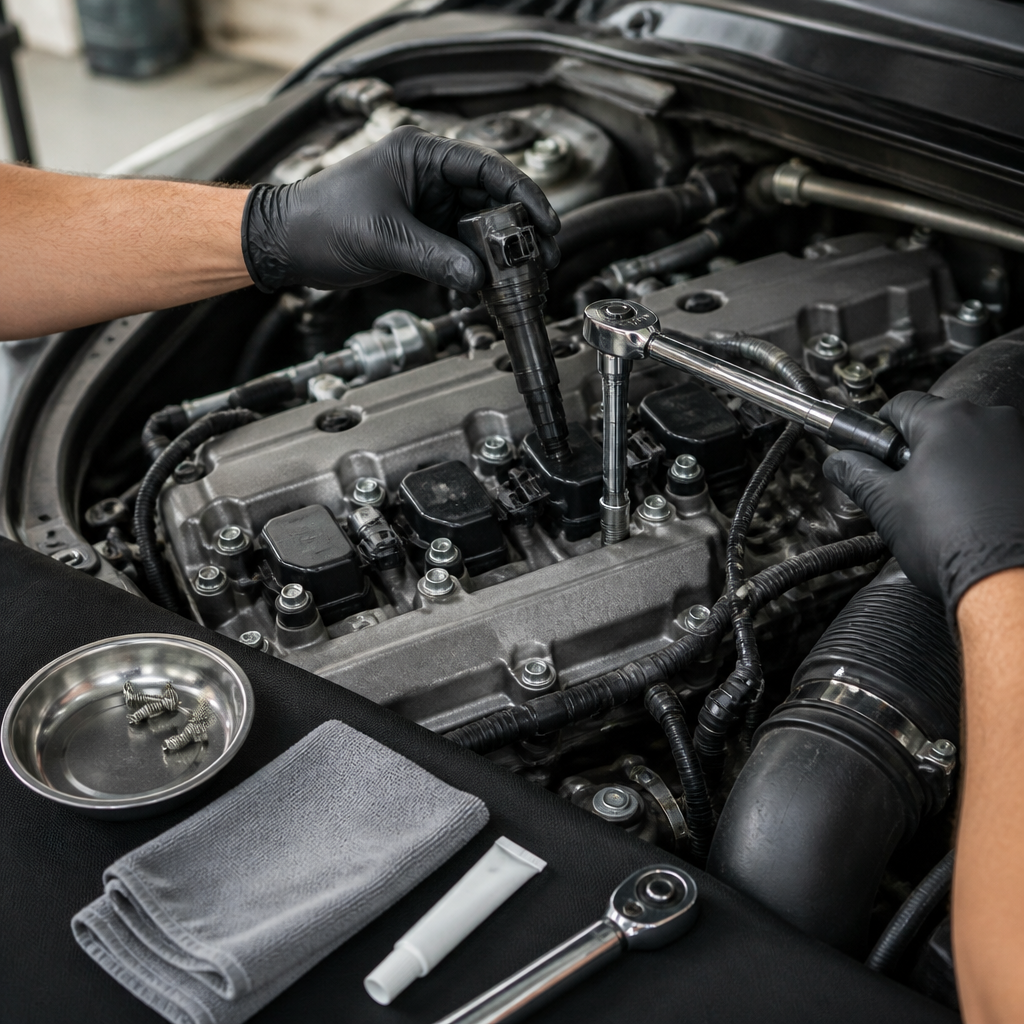
Open the hood and find the ignition coils. On many 4-cylinder engines, you will see four small coils lined up on top of the valve cover. On many V6 and V8 engines, some coils are easy to see, and others may be under an intake cover.
If you are not sure, look for electrical connectors going into small modules sitting over thick rubber boots. That is usually the coil.
2) Identify The Bad Coil (If You Can)
If you have a check engine light and a rough idle, the code may tell you the cylinder number. For a specific cylinder code like P0301, P0302, P0303, or P0304, the last digit usually points to the cylinder that is misfiring. Rough running at idle is a common symptom, like P0301 cylinder 1 misfire.
No scanner: You can still replace one coil you suspect, or you can do a simple coil swap test. Move the coil from the suspected cylinder to another cylinder and see if the misfire code follows the coil. If it does, the coil is very likely the problem.
3) Disconnect The Battery (Recommended)
Use a wrench to loosen the negative battery terminal, then remove it and tuck it safely to the side. This lowers the risk of shorts and protects sensitive electronics.
4) Remove The Engine Cover (If Needed)
Many cars have a plastic cover held by bolts or rubber grommets. Remove bolts or pull straight up. Put fasteners in a small tray so they do not get lost.
5) Unplug The Coil Electrical Connector
Press the locking tab and pull the connector straight off. If the tab is stubborn, use a small screwdriver carefully. Do not pry hard. The plastic gets brittle with age.
6) Remove The Coil Hold-Down Bolt(s)
Most coils have one small bolt. Some have two. Use the correct socket and remove the bolt(s). Keep them safe.
7) Pull The Coil Out
Twist the coil gently left and right, then pull up. The rubber boot seals to the spark plug and can feel stuck. Slow and steady is best. Do not yank on the wiring.
Look down the spark plug tube with a flashlight. If you see oil or coolant down there, stop and investigate. Oil can point to a leaking valve cover gasket. Coolant can point to a bigger issue. A new coil will not fix those problems for long.
8) Compare The New Coil To The Old One
Check that the connector, mounting tab, boot length, and overall shape match. If anything looks different, double-check the part number before you install it.
9) Add A Tiny Amount Of Dielectric Grease (Optional)
Put a small dab inside the new coil boot. Do not coat the spark plug. A little grease can help with moisture and make the coil easier to remove next time.
10) Install The New Coil
Lower the coil straight down into the spark plug tube. You should feel it seat on the spark plug. Reinstall the bolt(s) by hand first, then snug them down. If you have torque specs, use them. If not, tighten until snug, then stop. Small bolts strip easily.
11) Reconnect The Electrical Connector
Push the connector on until it clicks. Give it a small tug to confirm it is locked.
12) Reinstall Covers And Reconnect The Battery
Put the engine cover back on. Reconnect the negative battery terminal and tighten it.
13) Start The Engine And Check Your Work
Start the car and let it idle. A good repair often makes the idle smooth right away. If you had a misfire code, clear it with a scanner and see if it returns.
If the car still shakes, the issue may be a spark plug, fuel injector, vacuum leak, or sensor problem. For example, air metering issues can cause rough running, and Clean mass airflow sensor is another simple DIY that sometimes helps when symptoms match.
Common Mistakes
- Replacing the coil but ignoring the spark plug: Worn plugs can overload a coil and make it fail early. If plugs are due, replace them.
- Breaking the connector tab: Do not force it. Release the lock the right way, and work slowly.
- Overtightening the coil bolt: These bolts are small. Stripped threads can turn into a costly repair.
- Mixing up coils during a swap test: Label them with tape so you do not lose track.
- Not checking for oil in the plug tube: Oil can cause repeated coil failure and misfires.
Maintenance Tips
- Replace spark plugs on schedule: This is one of the best ways to help coils live longer.
- Keep water out of the engine bay: Avoid spraying high-pressure water around coils and connectors.
- Fix oil leaks early: Oil in plug tubes breaks down boots and causes misfires.
- Watch for early symptoms: If your engine shakes at idle, do not ignore it. A small misfire can damage the catalytic converter over time.
Is It Worth It?
For most drivers, yes. Ignition coil replacement is usually quick and low risk. It often needs only basic hand tools, and there is no fluid mess. If your coil is easy to reach, you can often finish in under an hour.
It may not be worth it if your coils are buried under an intake manifold, or if you find oil or coolant in the spark plug tubes. In those cases, you may be dealing with extra parts and extra diagnosis.
Conclusion
Replacing an ignition coil at home is a solid beginner DIY. Work on a cool engine, disconnect the battery, and handle connectors gently. Install the new coil carefully, tighten bolts lightly, and confirm the engine runs smooth after the repair. If the misfire stays, move on to checks like spark plugs, air leaks, and sensor issues.


