




This post may contain affiliate links. Please read our disclosure and privacy policy for more information.
Wheel fitment can feel confusing because two different measurements can describe where a wheel sits: Backspacing and offset. They are related, but they are not the same thing. If you understand both, you can pick wheels that clear your brakes and suspension and sit where you want in the fender.
What the modification or concept is
Backspacing and offset are ways to describe the wheel’s mounting pad position.
Offset is the distance from the wheel’s centerline to the mounting pad. It is usually shown in millimeters (mm).
- Positive offset (+): The mounting pad is closer to the outside face of the wheel. The wheel sits more “inboard” toward the suspension.
- Negative offset (-): The mounting pad is closer to the inside of the wheel. The wheel sticks out more.
- Zero offset (0): The mounting pad is on the centerline.
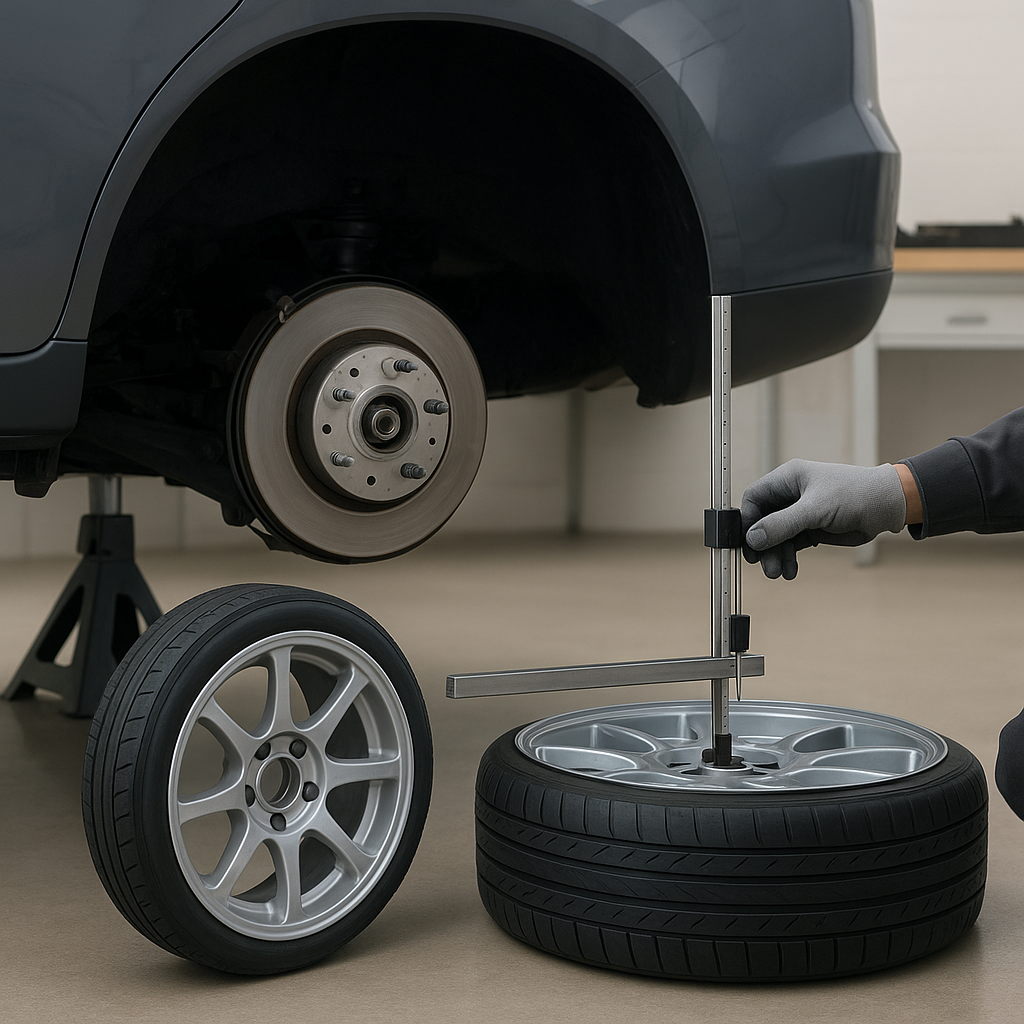
Backspacing is the distance from the mounting pad to the inner edge of the wheel. It is usually shown in inches. It tells you how close the inner barrel and inner lip may get to the strut, control arm, and inner fender.
Offset is centered around the wheel’s middle. Backspacing is measured from the mounting surface to the inside edge. Both describe the same wheel, just from different reference points.
Why people do it
Most people care about backspacing and offset when they change wheel width, diameter, or overall stance. Common reasons include:
- Brake clearance: Bigger calipers can need different wheel spoke shapes and sometimes different offset.
- Suspension clearance: A wheel can rub a strut body or spring perch if backspacing is too large.
- Fender fit: A wheel can poke out and hit the fender lip if offset is too low (too negative) for the car.
- Handling feel: Big changes can affect steering effort and how the car reacts to bumps.
- Appearance: Many builds aim for a flush look, or a tucked look on lowered cars.
Lowering changes the clearance game, because the tire moves closer to the fender as the suspension compresses. If you are also changing ride height, knowing Car suspension basics helps you predict rubbing before you buy parts.
Things to know before starting
Before you compare numbers, gather a few details about your current setup and your goal.
Know what you are starting with
- Current wheel size: Diameter and width (example: 17×7.5).
- Current offset (example: +45).
- Current tire size (example: 225/45R17).
- Any spacers already installed.
- Ride height: Stock, lowered springs, or coilovers.
If you cannot find your wheel’s offset, it is often stamped on the back of a spoke or near the mounting pad (example: “ET45” means +45 mm).
Wheel width matters as much as offset
Offset alone does not tell you where the wheel will sit. If you go wider, the inner and outer edges both move. A wider wheel with the same offset can still rub inside.
Understand where rubbing usually happens
- Inside: Strut body, spring perch, control arm, sway bar link, inner liner.
- Outside: Fender lip, bumper tab, outer liner.
If you plan to use spacers, know that a spacer reduces backspacing and also acts like lower offset. It pushes the wheel outward. If you want a simple spacer overview, are wheel spacers safe covers the basics.
Step-by-step explanation
Use these steps to understand the numbers and compare wheel options.
1. Learn how to read offset
Offset is measured from the wheel centerline.
- If you move from +45 to +35 on the same wheel width, the wheel moves 10 mm outward.
- If you move from +45 to +55 on the same wheel width, the wheel moves 10 mm inward.
This is why high positive offset wheels often sit deeper in the fender, and low offset wheels often poke out more.
2. Learn what backspacing tells you
Backspacing is about the inner edge of the wheel. Higher backspacing means the inner edge sits closer to the suspension. Lower backspacing means more inner clearance, but usually more poke on the outside.
Backspacing is very popular in older truck and off-road fitment talk because it directly describes inner clearance, but it still applies to any vehicle.
3. Know the basic conversion idea
The conversion depends on wheel width because the wheel’s centerline changes when width changes. Also note that wheel width is measured between the tire bead seats, not the outer lips. Because of that, real-world measurements can vary slightly by wheel design.
Here is the idea in simple terms:
- Start with half the wheel width.
- Adjust based on offset (convert mm to inches if needed).
- The result is backspacing.
You do not need to do the math perfectly to make good choices. What matters most is comparing your new wheel to your current wheel and seeing what moves inboard and outboard.
4. Compare your current wheels to the new wheels
When comparing two wheel setups, focus on two changes:
- Inner change: Will the new wheel move closer to the strut and control arm?
- Outer change: Will it poke closer to the fender?
A quick way to think about it:
- Going lower offset pushes the wheel out.
- Going higher offset pulls the wheel in.
- Going wider adds width to both sides unless offset changes to compensate.
If you want a deeper look at offset numbers and how they affect position, Wheel offset explained breaks it down in a fitment-focused way.
5. Test fit when possible
If you can, do a test fit with one wheel before mounting tires.
- Remove the old wheel.
- Mount the new wheel without a tire if possible.
- Spin the hub by hand and look for contact points.
- Check spoke-to-caliper clearance and inner barrel clearance.
- Turn the steering lock-to-lock if it is a front wheel.
Then, once tires are mounted, re-check at full lock and with the suspension compressed. Lowered cars are more sensitive to rubbing. For height-related setups, slammed car basics explains why compression travel matters so much.
Common mistakes to avoid
- Only looking at offset: A 9-inch wheel at +35 sits very different from an 8-inch wheel at +35.
- Ignoring tire width and sidewall shape: Some tires run wide and have square shoulders that rub easier.
- Forgetting the front needs turning clearance: A setup that clears at straight-ahead can rub at full lock.
- Assuming factory specs always work with lowering: Less ride height often needs different offset, different tire sizing, or alignment changes.
- Chasing “flush” with spacers first: Spacers can help, but they also increase scrub radius and can add rubbing on the outside.
Also avoid mixing up terms. Backspacing is not the same as wheel width, and offset is not the same as how far the wheel sticks out by itself.
Safety and legal considerations
Wheel fitment affects safety parts, not just looks.
- Stud and lug nut engagement: If you add spacers or change wheel design, confirm the lug nuts have enough thread engagement.
- Tire not rubbing at speed: Rubbing can cut a tire or damage a liner. Heat and flex make rubbing worse when driving.
- Brake and suspension clearance: Contact can damage brake lines, ABS wires, or suspension parts.
- Fender coverage laws: Some areas require the tire tread to be covered by the fender. Wheels that poke can cause tickets or inspection failures.
After any wheel change, torque lug nuts to the correct spec and re-check torque after a short drive.
Final practical advice
If you are new to wheel fitment, start by matching your factory wheel width and staying close to factory offset. Make small changes and verify clearance before going wider or more aggressive.
When you want a more flush look, aim for a setup that gains a little outer position without losing too much inner clearance. Always consider the tire size at the same time, because tires are often the first thing that rubs.
If you are building a full mod plan, wheels, tires, and suspension work together. A simple roadmap like Car modding for first-time owners can help you order changes in a way that avoids buying parts twice.


