




This post may contain affiliate links. Please read our disclosure and privacy policy for more information.
- What It Is
- How It Works (In Simple Engineering Terms)
- Performance Impact: Realistic Power Gains and Where They Come From
- What Changes Most: Peak Power, Midrange Torque, Or Driving Feel?
- Common Misconceptions
- Potential Drawbacks and Trade-Offs
- Safety Considerations
- Things to Consider Before Making Changes
- Practical Guidance
A performance exhaust can make a car feel and sound different. But it does not always add the big horsepower numbers people expect. Real gains depend on engine type, where the restriction is, and whether the car gets the tuning it needs to use the extra flow.
This breaks down what performance exhaust systems actually change, what research says about realistic power gains, and where the limits come from in real driving.
What It Is
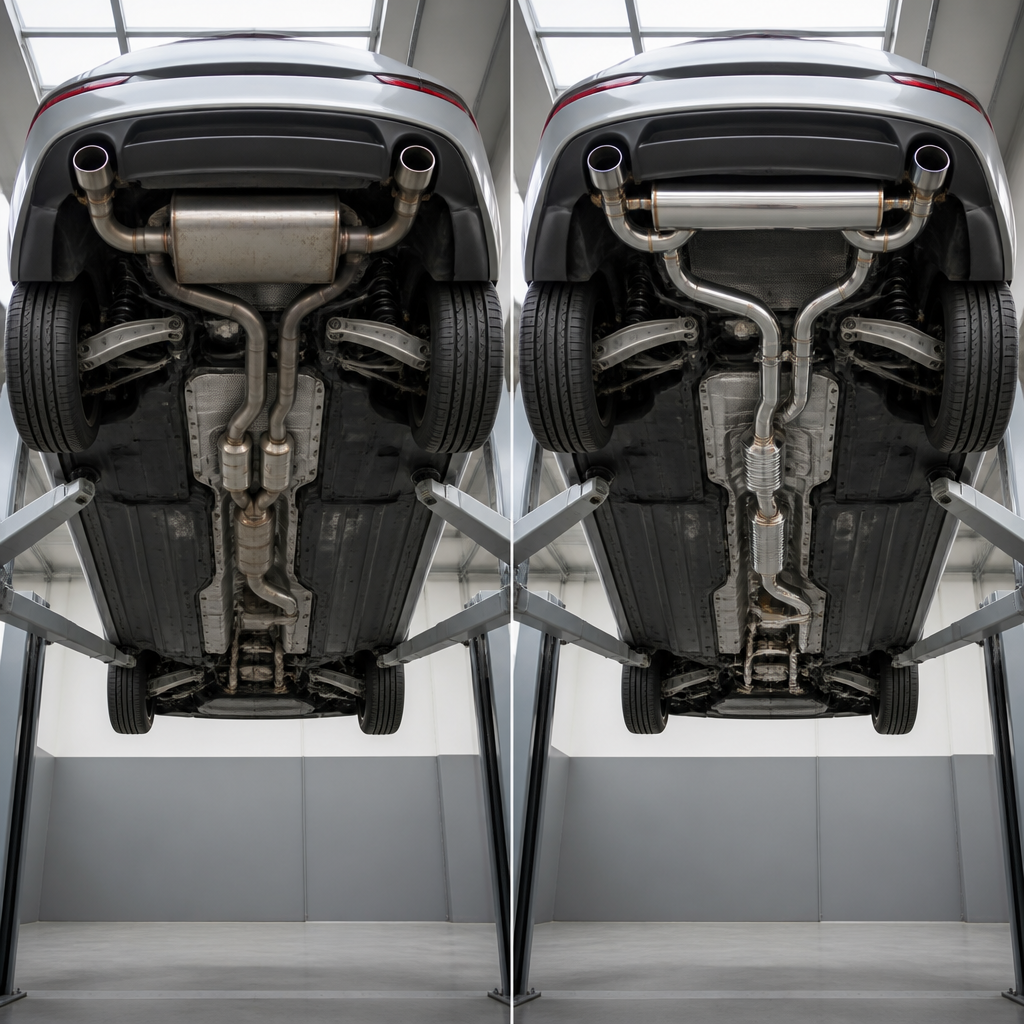
A performance exhaust system is any exhaust change designed to reduce restriction, manage heat, and sometimes tune pressure pulses. The goal is to help the engine push out exhaust gas with less work, so it can fill the cylinders better on the next intake stroke.
Common exhaust upgrade “zones” include:
- Axle-back: Rear muffler section. Mostly sound change, small flow change.
- Cat-back: From catalytic converter back. Moderate sound and flow change.
- Downpipe (turbo cars): Immediately after the turbo. Often the biggest restriction and the biggest performance change.
- Headers / manifolds (NA cars): Replace factory exhaust manifolds. Can change flow and pressure pulse timing.
- Catalytic converter changes: High-flow catalytic converter or cat delete (cat delete is illegal for street use in most places and creates major inspection and emissions issues).
How It Works (In Simple Engineering Terms)
Backpressure vs exhaust flow
People often say “backpressure is good.” What the engine actually wants is good flow with stable gas velocity and minimal restriction. Excess backpressure forces the engine to work harder to push exhaust out. That reduces efficiency and can reduce power.
But “less restriction” is not the same as “best design.” If pipe sizing is wrong, velocity drops too much at low and mid RPM. That can hurt torque and throttle response even if peak flow is higher.
Pulse tuning (why headers and mufflers can change torque shape)
Exhaust gas does not move as a smooth stream. It moves in pulses. Pipe length, collector design, and muffler design can help scavenging, which is how one cylinder’s exhaust pulse can help pull exhaust out of the next cylinder and even help start intake flow.
This is why two exhausts with similar diameter can feel different. One may build midrange torque better because the pressure waves line up better for the engine’s RPM range.
Turbo engines: Post-turbine restriction matters more
On a turbocharged engine, the turbine sits in the exhaust stream. Restriction after the turbo (downpipe, catalytic converter, cat-back) increases post-turbine pressure. That reduces the turbine’s expansion ratio and increases pumping losses. In simple terms: The turbo and engine have to fight harder to move exhaust out.
This is why turbo cars often respond more dramatically to exhaust changes than naturally aspirated cars.
Performance Impact: Realistic Power Gains and Where They Come From
It helps to separate “peak horsepower on a dyno” from “how the car feels on the road.” Exhaust changes often shift where power happens, not just how much.
Naturally aspirated (NA) engines: Usually small gains unless you support them
Peer-reviewed SAE research on exhaust design and engine breathing shows that reducing exhaust backpressure can improve volumetric efficiency, but gains depend heavily on operating point. On stock naturally aspirated engines, typical gains from reduced restriction are about 2 to 5% at the wheels. Bigger gains usually require matching changes like intake improvements, camshaft changes, or calibration changes.
What it means: A cat-back on a stock NA daily driver may add a small amount of peak power, but you should expect the main change to be sound and feel, not a transformation.
Why it matters: Many “seat of the pants” impressions come from a louder exhaust and different throttle sound. Those can feel faster even when the wheel horsepower change is small.
Practical implication: If your NA car is already well-designed from the factory, the exhaust may not be the main restriction. It can still be a good choice for sound and weight reduction, but it is not the best “power per dollar” change for most people.
If you want to compare expectations with intake changes, it helps to understand how small single-part gains usually are. Cold air intake dyno results show the same pattern: Most stock cars do not pick up large power from bolt-ons alone.
Turbocharged engines: Bigger gains, but tuning becomes more important
SAE research focused on turbocharged flow dynamics reports that reducing post-turbine backpressure improves performance by increasing turbine expansion ratio and reducing pumping losses. When a high-flow downpipe and freer-flowing exhaust are paired with ECU recalibration, documented gains can reach roughly 5 to 15% peak power on modified turbocharged engines.
What it means: Turbo cars often see meaningful gains because you are reducing resistance in the part of the system that most directly affects turbo efficiency and overall pumping work.
Why it matters: Without tuning, the ECU may not fully take advantage of the added flow. In some cases, it may even reduce boost or alter fueling to protect the engine if it detects conditions outside expected limits.
Practical implication: For many turbo platforms, the downpipe is the performance change, while the cat-back is more about sound and supporting flow at higher power levels.
Modern catalytic converters: Often not the big “power choke” people think
EPA testing and SAE research indicate that modern OEM three-way catalytic converters create measurable but often modest restriction on stock vehicles, commonly around 1 to 3 psi at wide-open throttle. That is not “free power,” but it explains why a cat-back alone may not produce big gains on many modern cars.
What it means: On a stock car, the catalytic converter may not be the main limit unless the converter is damaged, undersized for the engine output, or you are raising power significantly.
Why it matters: Many people chase power by removing emissions parts. That comes with legal problems, inspection failure risk, and can trigger warning lights and drivability issues.
Practical implication: A street-legal high-flow catalytic converter can be a reasonable middle ground for some builds, but it still needs to be chosen carefully and matched to tuning and emissions requirements in your area.
What Changes Most: Peak Power, Midrange Torque, Or Driving Feel?
Exhaust modifications often change where the engine makes its best power.
- Peak power: More likely to rise if the factory system was restrictive at higher RPM or higher boost.
- Midrange torque: Can improve, stay similar, or drop depending on pipe diameter and muffler design.
- Throttle response: Can feel sharper if pumping losses drop, but loudness can also create the illusion of quicker response.
- Consistency: Better flow can reduce heat buildup in some setups, but it can also raise thermal load elsewhere (especially on turbo cars).
Common Misconceptions
“Bigger pipes always make more power”
Oversized piping can reduce exhaust gas velocity. On many street NA engines, that can soften low-end and midrange torque. The best diameter depends on engine displacement, RPM range, and whether the engine is turbocharged.
“You need backpressure for torque”
The engine does not “need” backpressure. It needs a system that supports efficient scavenging and keeps pumping losses low. Poorly designed exhausts can lose torque, but that is usually a tuning and wave/velocity problem, not a backpressure benefit.
“A muffler delete is a performance mod”
On most modern cars, a muffler delete changes sound far more than power. It can also create drone and can draw unwanted attention. If performance is the goal, the restriction is often upstream, not at the rear muffler.
Potential Drawbacks and Trade-Offs
| Change | Possible Benefit | Common Trade-Off |
|---|---|---|
| Axle-back | Sound change, small weight change | Drone risk, minimal performance change |
| Cat-back | Sound, modest flow improvement | May gain little power on stock cars |
| Turbo downpipe | Often strong gains with tuning | Emissions legality concerns, higher heat and stress, CEL risk |
| Headers (NA) | Can reshape torque curve, improve top-end | Heat management needs, potential emissions/sensor issues |
| High-flow catalytic converter | Reduced restriction while keeping a cat | May still fail inspections if not certified; can trigger codes without proper calibration |
Noise fatigue and cabin drone
Many people like a deeper tone at light throttle but regret constant low-frequency drone at highway speeds. Drone is not just “loud.” It is a specific resonance that can make longer trips tiring.
Heat and underbody risk
Higher exhaust flow and different component placement can change underbody temperatures. On turbo cars in particular, a freer exhaust can lead to higher sustained boost and higher exhaust energy in some conditions. That can increase heat stress on nearby wiring, plastic shields, and rubber parts if heat shielding is not adequate.
Check engine lights and drivability
Exhaust changes can affect oxygen sensor readings, catalyst efficiency monitoring, and fuel trims. A check engine light explained often comes back to emissions monitors, especially after downpipe or catalyst changes.
Fuel economy: Often unchanged in real driving
In theory, reducing pumping losses can help efficiency at some operating points. In real life, fuel economy often stays the same because drivers use the sound and response to drive harder. Also, many cars operate far from wide-open throttle most of the time, where exhaust restriction is less relevant.
Safety Considerations
Legal and inspection risks are safety-adjacent
“Cat delete” setups and some loud exhaust configurations can create legal problems, failed inspections, and roadside attention. While that is not a crash safety issue, it can affect your ability to register and drive the car legally.
Carbon monoxide risk
Any exhaust leak under the car can allow fumes to enter the cabin, especially in traffic or when idling. After any exhaust work, watch for:
- Exhaust smell inside the cabin
- Headaches or nausea when driving with windows up
- Soot marks near joints
If you suspect a leak, treat it as urgent.
Burn risk around tips and underbody
Exhaust parts run extremely hot. Tip location changes and reduced muffler volume can raise temperatures in places passengers do not expect, especially near rear bumpers and diffuser areas.
Things to Consider Before Making Changes
Start by defining your goal: Sound, power, or both
If your main goal is sound, an axle-back or cat-back can make sense. If your main goal is measurable power, focus on where restriction actually is for your engine type.
Match the exhaust to the engine type
- Stock NA daily driver: Expect small power gains. Choose based on sound quality, drone control, and build quality.
- Turbo car with tuning plans: Exhaust flow changes can support meaningful gains. Plan for calibration and heat management.
- High-mileage car: Fix existing problems first. Misfires, oil burning, or clogged catalysts will distort results and can get worse with changes. If the car has drivability issues, it is smarter to address items like Common causes of engine misfires before modifications.
Know what “realistic gain” looks like for your setup
Use percentage thinking because it scales with the car:
- NA stock engines: Research-backed gains are commonly in the 2 to 5% range at the wheels when backpressure is reduced, with bigger gains needing supporting mods.
- Turbo engines with supporting parts and tuning: Research shows 5 to 15% peak power gains are possible when reducing post-turbine backpressure and recalibrating the ECU.
Plan for the “hidden” cost: Calibration and quality parts
The exhaust itself is only part of the system. Poor fitment can cause leaks and rattles. Poor catalyst choices can trigger codes. And on many turbo platforms, skipping tuning means leaving power on the table or creating unpredictable behavior.
Think about the whole car balance
If you add power, you may also need to think about traction, braking, and road noise comfort. For example, tire choices can change how “fast” the car feels and how stable it is when power comes in. grip with wider tires is a useful comparison when you are prioritizing real-world acceleration and control over peak dyno numbers.
Practical Guidance
If you want the most realistic outcome, choose the exhaust path based on how your engine makes power:
- If you drive a naturally aspirated car and it is stock: Buy an exhaust for sound quality, drone control, and durability first. Treat any horsepower gain as a bonus. Expect small, sometimes hard-to-feel gains unless you add supporting changes.
- If you drive a turbo car and you are open to tuning: A high-flow downpipe and a well-designed exhaust can produce meaningful gains, because reducing post-turbine restriction reduces pumping losses and helps the turbo operate more efficiently.
- If emissions compliance matters in your area: Keep emissions equipment intact and focus on systems designed for street use. The stress and cost of warning lights, inspection failures, and legal risk often outweighs the small extra performance from removing catalysts.
- If comfort matters: Prioritize a setup known for low drone. A car that sounds exciting for 10 minutes can be exhausting on a two-hour drive.
The most rewarding exhaust upgrades are the ones matched to the engine’s real restrictions and your real driving. When expectations are set by engineering reality, it is much easier to spend money once and end up happy with the result.


