


This post may contain affiliate links. Please read our disclosure and privacy policy for more information.
When your car will not start but the battery is good, the problem is often in the starter circuit: The starter motor itself, the starter solenoid, the starter relay, or the control wiring that tells the starter to engage. The good news is that you can do a few safe checks to narrow it down before you call for service.
What This Problem Feels Like
Most drivers notice one of these patterns when they turn the key or press the start button:
- One click (or a rapid clicking) and no crank: The engine does not turn over.
- Dash lights come on normally, but nothing happens: No crank, no click.
- Cranks sometimes, then suddenly won’t: It may act random, especially when hot.
- Starter spins but engine does not turn: You may hear a whirring sound.
- It starts if you try multiple times: Then it gets worse over days or weeks.
This problem is different from a weak battery situation. With a good battery, your headlights and dash lights look normal, the radio works, and the voltage is not collapsing when you try to start. If the engine cranks at normal speed but will not fire, that points to a different issue and should be diagnosed separately.
Is It Safe to Drive?
If the car will not crank, you are not driving it anywhere. The main safety concern is what you do while trying to get it started.
- Safe enough: Basic checks with the car in Park (or Neutral for a manual), parking brake set, and the key off.
- Not safe: Reaching near belts, fans, or the engine while someone turns the key. Also avoid bypassing electrical parts with improvised wires.
If the car is stuck in an unsafe location, like on a shoulder or in a travel lane, treat it as urgent. Use hazard lights, stay visible, and call for help rather than repeatedly cranking the engine.
Common Causes
These are the most common reasons a car will not start even though the battery is good, listed from most common to less common.
Starter motor worn out (or has a dead spot)
Starter motors wear with age. Brushes and internal contacts can fail, and sometimes the starter stops on a “dead spot” where it will not respond. You may get a single click, or nothing at all, even with a healthy battery.
Starter solenoid contacts burned
Many starters use a solenoid that acts like a heavy-duty switch. Over time, the high current load can burn the contacts. The result can be an audible click but no crank, or a start that only works after several tries.
Bad starter relay
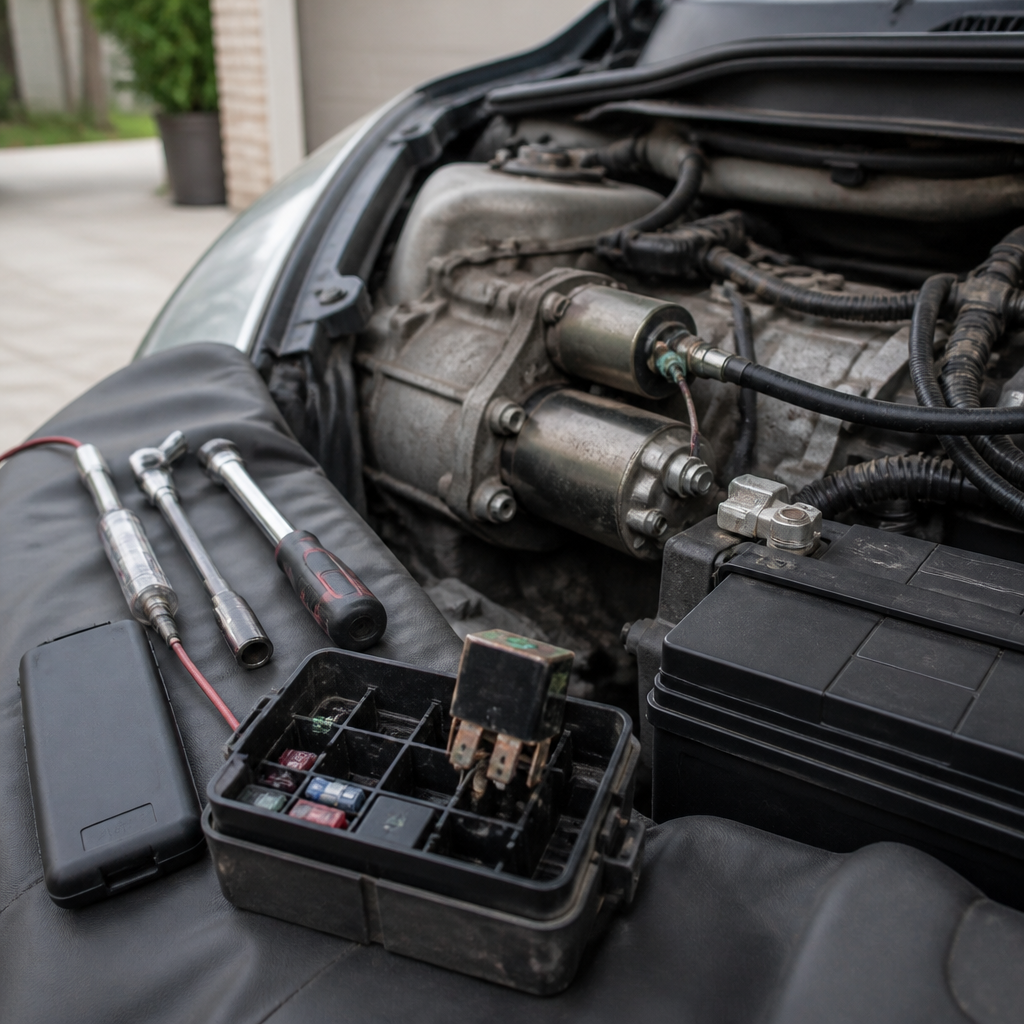
The relay is a smaller electrical switch that sends power to the starter solenoid. Relays can fail internally, develop high resistance, or have loose pins. This can cause an intermittent no-crank with normal dash lights.
Loose or corroded connections in the starter circuit
Even with a good battery, the starter needs very high current. A slightly loose battery terminal, corrosion at the battery posts, a weak ground connection, or a loose cable at the starter can stop cranking. This is common after battery replacement or recent under-hood work.
If you recently changed the battery and you are unsure about battery life facts and timing, Car battery replacement statistics can help set expectations, but a “good battery” still needs clean, tight connections to deliver starter current.
Neutral safety switch or clutch switch not allowing crank
Automatic transmissions have a park/neutral safety switch. Manuals typically have a clutch pedal switch. If the car does not “see” Park/Neutral or a fully pressed clutch, it may do nothing when you try to start. This can feel like a starter failure, but the starter is never being commanded on.
Ignition switch or start button circuit problem
If the ignition switch or the start request circuit has an internal fault, the starter relay may never get the signal to close. This is less common than starter or connection issues, but it happens, especially on higher-mileage vehicles.
Engine or starter mechanical issue (less common)
A seized starter drive, damaged flywheel teeth, or an engine that cannot rotate can mimic a starter electrical problem. This is less common, but important, because repeated attempts can cause more damage.
Quick Checks You Can Do at Home
These checks are meant to be safe and practical. They will not fix everything, but they can help you describe the problem clearly and avoid unnecessary parts replacement.
Check battery terminals and main connections
With the car off, open the hood and look closely at the battery terminals.
- Terminals should be tight and not rotate by hand.
- Look for heavy white or green corrosion.
- Follow the negative cable to where it bolts to the body or engine. That ground point should look clean and tight.
A battery can test “good” and still fail to deliver starter current through a poor connection. If you see obvious looseness, that alone can explain a no-crank.
Listen for relay and solenoid clues
Have a helper sit in the driver seat. Stand outside the car where you can hear the engine bay (not leaning into it). Ask them to turn the key to Start while you listen.
- Single click near the engine: Often the starter solenoid is trying, but the starter motor is not turning.
- Click from the fuse/relay box area: Relay may be working, but the starter may not be engaging.
- No click anywhere: Possible relay control issue, safety switch issue, or ignition/start request issue.
These are clues, not proof. But they help narrow the likely direction.
Try starting in Neutral (automatic) or with the clutch pressed firmly (manual)
For an automatic, keep your foot on the brake and try starting in Neutral. For a manual, press the clutch fully to the floor and try again.
If it suddenly cranks, the problem may be a misadjusted or failing safety switch or shifter position sensor. That does not rule out other issues, but it is a strong hint.
Check for a pattern when the engine is hot
If the car usually starts cold but will not start after driving and heat soaking, that points more toward a starter/solenoid that is failing under heat. Many worn starters act worse when hot because internal resistance increases.
Swap the starter relay only if it is an identical match
Some fuse boxes contain multiple identical relays (same part number). If you can find an identical relay for a non-critical circuit, sometimes you can swap them as a test. If the car starts after the swap, it supports a relay problem.
Do not force relays, do not mix different part numbers, and do not swap relays in a way that could affect safety systems.
Confirm the battery is truly healthy under load
A simple voltage reading can look fine until you try to crank. If you have a multimeter, a healthy system usually stays above about 10 volts during cranking. If it drops hard even though the battery tested “good” earlier, you may be dealing with a weak battery or poor connections.
If you want to rule out charging problems that may have led to repeated low-charge events, DIY car alternator test is useful later, but for this symptom the focus stays on starter and relay checks.
When This Becomes Serious
A starter circuit issue becomes more serious when it is consistent, when it makes unusual noises, or when it creates heat.
- Burning smell or smoke: Stop trying to start it. A cable or starter can overheat.
- Cables getting hot: Warm is one thing, hot to the touch is a warning. Stop and get it checked.
- Grinding noise during start attempts: This can damage the flywheel or flexplate teeth. Continued attempts can turn a starter job into a bigger repair.
- Starter spins but does not engage: Repeated spinning can damage the drive gear.
- Intermittent no-crank that is getting worse: Plan repair soon. It often fails completely with little warning.
If the car will crank sometimes, do not trust it for important trips until it is fixed. Getting stranded is common with failing starters and relays.
How a Mechanic Fixes It
A professional diagnosis usually focuses on voltage drop and command signals. The goal is to find out whether the starter is being told to work and whether it is receiving proper power and ground.
- Verify the complaint: Listen to the symptom and confirm whether it is no-crank, click-no-crank, or intermittent.
- Check for start command: Test whether the starter relay coil is getting the signal from the ignition switch, body control module, or start button system.
- Test relay function: Confirm the relay is closing and sending power out when commanded.
- Voltage drop testing: Measure voltage loss on the positive cable and the ground side while attempting to crank. This finds hidden resistance in cables, terminals, and grounds.
- Test at the starter: Confirm the solenoid is receiving proper voltage during crank request. If power and ground are good but the starter does not turn, the starter assembly is the likely fault.
Once the failed part is confirmed, the fix may be replacing the starter motor/solenoid assembly, replacing the relay, repairing terminals, or cleaning and securing ground points. After the repair, the shop should recheck starting performance and charging voltage.
Common Mistakes to Avoid
- Assuming the battery is “good” because the lights come on: Starting needs far more current than accessories.
- Replacing the starter without checking cable and ground condition: A bad connection can kill a new starter too.
- Cranking repeatedly for long periods: This can overheat cables and the starter, and it can drain a good battery quickly.
- Hammering the starter as a routine fix: It may work once if the starter has a dead spot, but it is not reliable and can crack housings or damage wiring.
- Swapping random relays: Using the wrong relay can cause electrical faults or disable other systems.
Related Problems to Watch For
These issues can show up around the same time, but they are not the same problem.
- Slow crank even with a “good” battery: Often points to high resistance in cables or a starter drawing too much current.
- Intermittent electrical glitches: Sometimes related to poor grounds that also affect starter performance.
- Rough running after it finally starts: That is a different symptom set, more like ignition or fuel issues. If you also notice shaking at idle later, engine shakes at idle covers that type of problem separately.
- Repeated dead battery episodes: Could involve charging problems. If that becomes the main symptom, focus on the charging system rather than the starter circuit.
Final Thoughts
If your car will not start but the battery is good, treat it as a starter circuit problem first: Connections, relay, solenoid, and starter motor. Start with simple checks you can do safely, like terminal tightness, ground condition, and whether it behaves differently in Neutral or with the clutch fully pressed.
If you get burning smell, grinding noises, hot cables, or repeated click-no-crank that is getting worse: Stop trying to start it and arrange a proper electrical diagnosis. A short test with the right tools can quickly confirm whether the relay is commanding the starter and whether the starter is getting full power and ground.


