




This post may contain affiliate links. Please read our disclosure and privacy policy for more information.
- The Origins
- Early Development: Licensed Cars and Commercial Work
- Setbacks, Resets, and the Return to Passenger Cars
- Major Turning Points: The Asian Financial Crisis and Hyundai Ownership
- Technology Evolution: From Simple Mechanical Packages to Global Platforms
- Design Evolution: Learning Identity, Then Building One
- Challenges and Competition: Moving Up Without Losing the Base
- Consumer Reception: From “Cheap” to “Considered”
- Modern Evolution: Performance Credibility and Electrification
- Influence on the Industry
- Legacy and Lasting Influence
Kia’s story is often told as a fast climb from cheap basic cars to confident global products. The real history is more complicated, shaped by South Korea’s industrial policy, oil shocks, changing safety and emissions rules, and a long learning process in engineering and design. Understanding how Kia changed helps explain why the brand looks and feels so different today compared with its early exports.
The Origins
Kia began in 1944 as Kyungsung Precision Industry, making steel tubing and bicycle parts in Japanese-occupied Korea. After World War II and the Korean War, the country needed basic transportation and manufacturing capacity more than it needed passenger cars. In 1952 the company adopted the name “Kia Industries,” and it built bicycles and later small motorcycles. That early focus mattered: Kia learned mass production, supplier management, and how to build durable mechanical products for rough conditions.
South Korea’s government also played a central role. In the 1960s and 1970s, industrial plans pushed companies to build export-ready manufacturing. Carmaking was not only a business but a national strategy. For Kia, that meant moving step by step, first through commercial vehicles, then into passenger cars under license.
Early Development: Licensed Cars and Commercial Work
Kia assembled trucks in the 1960s and expanded into three-wheeled vehicles and small commercial models, which were essential in a rapidly urbanizing economy. In 1973 it completed the Sohari plant, its first integrated automobile manufacturing facility. That plant was a turning point: It meant Kia could do stamping, welding, and assembly at scale rather than simply assembling kits.
In 1974 Kia produced the Brisa, often cited as Korea’s first domestically produced passenger car (depending on how “domestic” is defined). The Brisa used Mazda-based engineering and powertrains. Licensing was common in emerging auto industries because it reduced risk: Kia could sell proven mechanicals while building know-how inside its factories.
That arrangement solved a practical problem. Korean buyers needed affordable, repairable transport, and the domestic industry needed time to develop. The downside was dependency. When a brand’s core engineering comes from partners, it is difficult to build a unique identity or rapidly improve quality without the partner’s roadmap.
Setbacks, Resets, and the Return to Passenger Cars
Kia did not grow in a straight line. In the early 1980s, the South Korean government reorganized the auto industry, and Kia was pushed away from passenger cars for a time, focusing more on trucks and light commercial vehicles. It was a reminder that policy could shape product decisions as much as customer demand did.
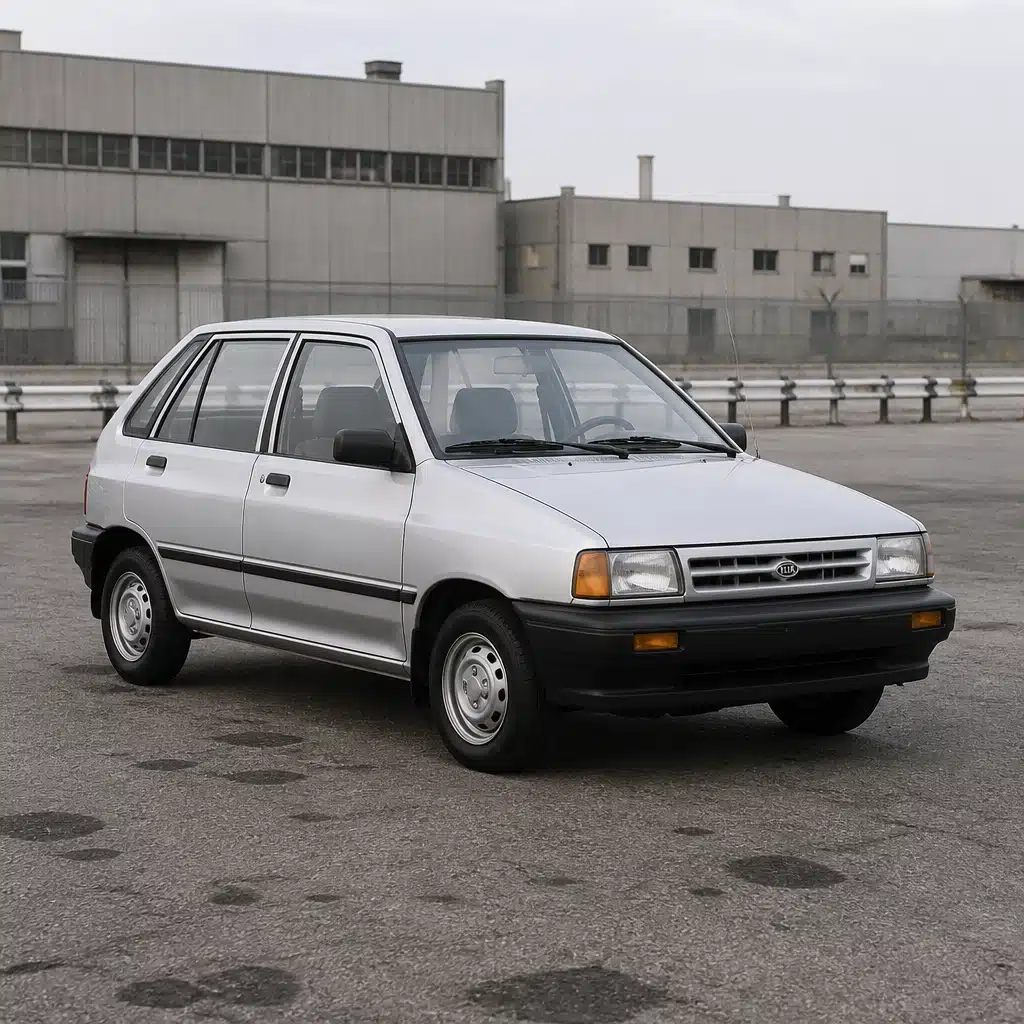
By the mid-1980s Kia was back in small cars, and it leaned heavily on partnerships again, most notably with Ford and Mazda. The 1986 Kia Pride, related to the Mazda 121 and sold in some markets under Ford badges, became a key export product. It reached the United States as the Kia Sephia and later the Pride-based Kia models in small numbers at first. The formula was clear: Keep prices low, keep the mechanical package simple, and use established designs to enter markets that were already competitive.
Consumers responded to the price, but the broader market story was tougher. In the late 1980s and early 1990s, Japanese brands had already defined what “reliable small car” meant in many export markets, while American and European brands were moving upmarket. Kia entered as a budget alternative, but a budget position can quickly become a quality stereotype that is hard to break.
Major Turning Points: The Asian Financial Crisis and Hyundai Ownership
The most important business event in modern Kia history came from outside the product lineup. The 1997 Asian financial crisis hit South Korea hard, tightening credit and cutting demand. Kia fell into bankruptcy in 1997, and Hyundai acquired a controlling interest in 1998, creating the Hyundai Motor Group structure that still exists.
This change happened because survival required scale, capital, and shared development costs. Modern cars were getting more expensive to engineer as safety regulations tightened and consumer expectations rose. Under one group, Hyundai and Kia could share platforms, engines, transmissions, and suppliers while keeping separate brand identities.
For Kia, the immediate problem was credibility. In export markets, early impressions of inconsistent build quality and thin dealer networks were difficult to overcome. The long-term solution was not advertising, but engineering investment, manufacturing process control, and a warranty strategy that lowered perceived risk for buyers. In the United States, Kia’s 10-year/100,000-mile powertrain warranty (introduced in 1999 for many buyers) became part of that trust-building effort, though the company still had to earn its reputation in real-world ownership.
Technology Evolution: From Simple Mechanical Packages to Global Platforms
Through the 2000s, Kia’s products steadily moved from basic transportation to fully competitive mainstream cars. This was less about single inventions and more about systems: Better corrosion protection, improved paint quality, tighter panel gaps, more robust electrical architecture, and more consistent powertrain calibration. These are unglamorous changes, but they are what buyers feel after years of use.
Platform sharing inside Hyundai Motor Group made this possible. A shared platform reduces cost and development time, freeing resources to improve interiors, safety equipment, and refinement. It also helped Kia respond faster to shifts in demand, especially the global move toward crossovers.
Regulations mattered too. Crash standards, airbag requirements, and emissions rules steadily tightened across North America and Europe. Meeting them required stronger body structures, more sensors, and increasingly complex engine management. Kia’s growth into these markets pushed it into the same technological race as established competitors.
By the 2010s, Kia was offering advanced driver assistance features that had once been limited to premium brands, like radar-based cruise control and lane-keeping systems, depending on model and market. The key industry change was cost reduction in computing and sensors, which allowed mainstream vehicles to adopt technology earlier reserved for higher-price segments.
Design Evolution: Learning Identity, Then Building One
For many enthusiasts, Kia’s biggest visible change was design. In earlier decades, Kia products often looked anonymous, which was common for brands built around licensed platforms and cost control. Distinctive styling can be expensive: It requires in-house design leadership, long-range planning, and the confidence to take visual risks.
A major shift came in the mid-to-late 2000s, when Kia strengthened its global design capabilities and committed to a recognizable face. Peter Schreyer, hired in 2006 after a long career in the Volkswagen Group, is widely associated with defining Kia’s “tiger nose” grille and creating a more cohesive lineup. The point was not the grille itself but the signal it sent: Kia wanted to be recognized instantly, not just chosen for price.
This mattered in showrooms. When products are similar in size and features, style can be the deciding factor. Bold design also changed how the brand was covered by media and discussed by consumers. Instead of being framed only as “cheap,” Kia began appearing in comparisons where design and value could sit alongside each other.
As a side effect, customization culture grew around certain models. Buyers began treating some Kias less like disposable transportation and more like personal statements. Even small choices like wheels, ride height, and appearance parts became part of ownership. Practical questions followed, including how changes affect everyday driving comfort and costs, such as Lowering springs vs coilovers for people who wanted a sportier stance without losing usability.
Challenges and Competition: Moving Up Without Losing the Base
Kia’s climb created a balancing act. If the brand moved too far upmarket, it risked losing the buyers who came for affordability. If it stayed too budget-focused, it could not fund the engineering and design improvements needed to compete globally.
Competition also shifted. In the 1990s, Kia’s main fight in many markets was against entry-level Japanese compacts and used cars. By the 2010s, it was fighting a wider field: Resurgent American small cars (until the market moved away from them), strong European compacts, and later a wave of value-focused Chinese brands in many regions. Kia’s response was to push quality, feature content, and design, then back it with longer warranties in some markets to reduce buyer anxiety.
Quality perception was not only about assembly. It also involved how cars aged: Paint, interior wear, and the little issues that drive owners crazy. Modern buyers share experiences quickly online, so small problems can become big reputation hits. That is why seemingly minor upkeep topics, like restore faded plastic parts, became more common discussion points among owners trying to keep newer cars looking new for longer.
Consumer Reception: From “Cheap” to “Considered”
Consumer response changed in phases. First came curiosity: Cheap cars with long warranties attracted first-time buyers and people who needed dependable transport on a budget. Then came skepticism: Many shoppers assumed low price meant corners cut. Over time, as third-party reviews improved and real owners reported better durability, Kia products began to reach a different kind of buyer, one cross-shopping established brands.
This shift was helped by smart product placement. Models like the Sportage gained relevance as crossovers replaced sedans for many families. The Optima (K5 in later naming) moved the brand into more style-conscious midsize sedan territory. And the Soul, launched for the 2010 model year in many markets, showed that a quirky shape could create a loyal audience without premium pricing. These were not simply new models; they were experiments in who Kia could be.
Safety also became a stronger part of mainstream shopping decisions in the 2000s and 2010s. As SUVs and crossovers became default family vehicles, customers started comparing crash performance, driver assistance features, and long-term ownership costs more seriously than before. That broader context is why topics like Family SUV key ratings became central to purchase decisions, pushing automakers to compete on structure, sensors, and software rather than only horsepower and price.
Modern Evolution: Performance Credibility and Electrification
In the late 2010s, Kia began chasing a kind of credibility that budget brands rarely attempt: Performance identity. The Stinger, introduced for 2018 in the United States, used rear-wheel-drive architecture (and available all-wheel drive) and offered a twin-turbo V6 option. It did not exist to sell in huge numbers. It existed to change the conversation about what Kia could engineer and what kind of driver it could attract.
At the same time, electrification became unavoidable. Tougher global emissions targets, city restrictions on pollution, and rapid improvement in battery cost and energy density pushed every automaker toward hybrids and EVs. Kia’s early steps included hybrids and plug-in hybrids (often paired with Hyundai group components), but the more decisive break came with dedicated EV platforms.
The EV6, launched globally in 2021, represented that new era. Built on Hyundai Motor Group’s E-GMP architecture, it used an 800-volt electrical system in many versions for faster DC charging, and it brought packaging advantages that are hard to match with gasoline platforms. The goal was not just range numbers. It was to make EV ownership more convenient and to prove that the brand could deliver advanced tech with good usability.
EVs also changed what “performance” means. Instant torque made straight-line speed easier to deliver, while tire choice and chassis tuning became even more important because electric vehicles are often heavier. Owners quickly discover tradeoffs between grip, efficiency, and road noise, which is why everyday topics like wider tires fuel economy show up in EV discussions as much as in sports car circles.
Influence on the Industry
Kia’s transformation helped reshape expectations in the non-luxury market. In the 1990s, “value brand” often meant fewer features and simpler cabins. By the 2010s, value increasingly meant high feature content for the money, strong design, and long warranties. That pushed competitors to respond, either by improving base trims, adding longer warranties in some markets, or creating new sub-brands and trims to protect profit while matching equipment levels.
Design leadership was another ripple effect. When a brand once dismissed for bland styling becomes known for striking shapes, it forces the rest of the mainstream market to take design more seriously. Kia’s rise also showed the power of globalized talent. Hiring top designers and engineers across regions became an open strategy, not a quiet one.
Finally, Kia’s growth highlighted how much modern success depends on flexible manufacturing and shared architectures. The company’s shift from small, licensed products to global platforms mirrored the broader industry move toward modular design, where a single architecture can underpin multiple body styles and powertrains.
Legacy and Lasting Influence
Kia’s journey from budget cars to design-led global products was not a single reinvention. It was a series of responses to real pressures: National industrial policy, financial crisis, fast-rising regulatory demands, and intense international competition. The brand’s long-term impact is a reminder that reputation can change, but only when products change first.
Today, Kia’s history matters because it explains the company’s priorities. It invests in design identity to avoid being trapped in commodity pricing. It shares technology within a larger group to keep development realistic. And it treats electrification not as a side project but as a core way to stay competitive as the market and regulations keep moving. For buyers, the result is a brand that is no longer defined mainly by cost, but by how quickly it learned to compete on the same global standards as everyone else.


