


This post may contain affiliate links. Please read our disclosure and privacy policy for more information.
- What It Is: Lowering Springs vs Coilovers
- How Lowering Changes the Car: The Parts People Do Not See
- Ride Quality Compared: Comfort, Noise, and Daily Driving
- Handling Compared: Steering Response, Grip, and Balance
- Upkeep and Long-Term Ownership: What You Will Maintain
- Comparison Table: Ride, Handling, and Upkeep
- Safety Considerations: Where Lowering Can Backfire
- Common Misconceptions
- Things to Consider Before Making Changes
- Choosing Between Them: Practical Guidance
Lowering your car can change how it feels more than almost any other “bolt-on” mod. The car can look better, roll less in corners, and feel more tied down. But it can also ride worse, scrape more, and wear parts faster if the setup is not matched to how the car actually moves.
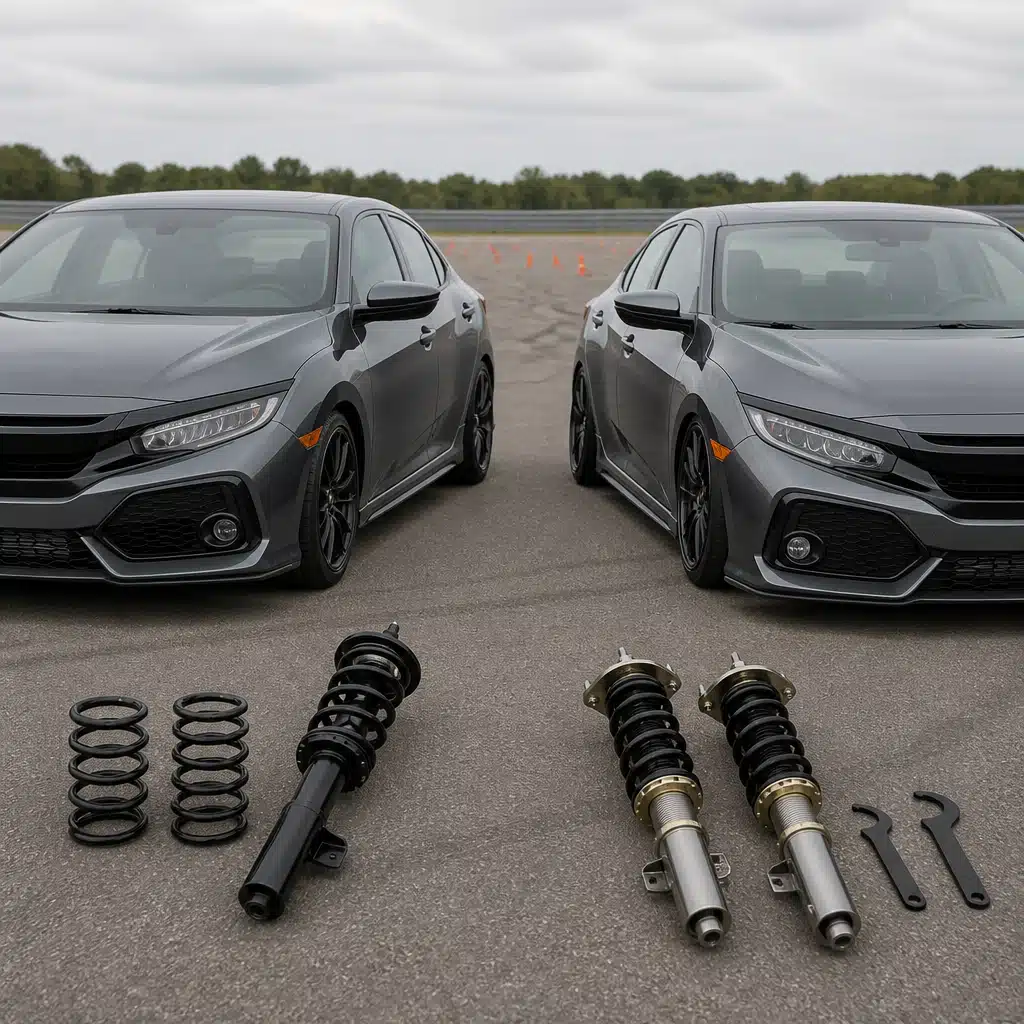
The big choice is usually between lowering springs on factory struts, or a full coilover kit. Both lower the ride height. The difference is how much control you get over spring rate, damping, ride height, and long-term upkeep.
What It Is: Lowering Springs vs Coilovers
Lowering springs
Lowering springs are shorter springs that replace the factory springs. They usually have a higher spring rate than stock. Most are designed to drop the car about 1 to 2 inches.
They reuse the factory struts or shocks. That is a major point: The spring is different, but the damper is often still tuned for the original spring and original ride height.
Coilovers
Coilovers are complete spring-and-damper assemblies built as a matched pair. Most aftermarket coilovers let you adjust ride height. Many also add damping adjustment (rebound, compression, or both). Some designs also allow corner balancing for track use.
Because the damper is part of the kit, a good coilover setup can be tuned closer to the spring rate and ride height you are actually running.
How Lowering Changes the Car: The Parts People Do Not See
Lowering is not only about making the car sit closer to the tire. It changes suspension geometry, available travel, and how the tire stays in contact with the road when the body moves.
Finding from safety research: Lowering can improve stability
NHTSA’s rollover research uses a measurement called Static Stability Factor (SSF). SSF is based on track width and the height of the vehicle’s center of gravity. When CG height goes down, SSF goes up. In simple terms: A lower center of gravity improves rollover resistance and reduces the amount of weight that shifts side-to-side during cornering.
What it means: A lower car generally has less lateral load transfer in a turn. That can improve “planted” feel and reduce body roll.
Why it matters: The main performance benefit most drivers feel from lowering is not raw grip. It is consistency and calmness: Less waiting for the body to settle during quick steering inputs.
Practical implications: Both lowering springs and coilovers can deliver this benefit. The bigger difference between them is whether the suspension still has enough travel and the right damping to control that lower ride height.
Finding from engineering research: Less ride height also means less travel
SAE-published vehicle dynamics research explains a key trade-off: Lowering reduces CG and can reduce body roll, but it also reduces jounce travel (upward suspension travel). If damper stroke and bump-stop strategy are not redesigned to match, the car can hit the bump stops more often. That feels like a sudden spike in stiffness, because at that point you are no longer riding mainly on the spring and damper.
What it means: You can end up with a car that feels “sporty” on smooth pavement but harsh and bouncy on real roads.
Why it matters: Bottoming out does not only hurt comfort. It can reduce grip on broken pavement because the tire struggles to follow the road.
Practical implications: A mild drop with well-matched components often drives better than an aggressive drop with unmatched dampers, even if the aggressive setup looks better.
Ride Quality Compared: Comfort, Noise, and Daily Driving
Ride quality is mainly the result of three things working together: Spring rate, damper valving, and remaining suspension travel. Lowering usually increases spring rate and reduces travel, so the damper has to do more work in less space.
Lowering springs on factory dampers
- Typical feel: Firmer, sometimes busy over small bumps.
- Common issue: The stock damper may not control the stiffer spring well, especially as the damper wears. This can show up as extra bounce, “float,” or a choppy ride.
- Best case: A modest drop, spring rates close to what the factory damper can handle, and good bump stop tuning. This can feel close to OEM sport suspension.
Coilovers
- Typical feel: Wider range. Some are comfortable; many are stiff. Damping adjustment can help, but only within the kit’s design window.
- Big advantage: The damper is designed for the spring rate and ride height range of the kit. That usually improves body control compared to springs on tired stock dampers.
- Trade-off: More parts and adjusters can add noise over time if bushings, mounts, or threads wear or loosen.
If comfort is the top priority, neither option is automatically “better.” The winning setup is the one that keeps enough travel and uses damping that matches the spring rate. Aggressive drops tend to lose this battle on normal roads.
Handling Compared: Steering Response, Grip, and Balance
Handling is more than body roll. The real goal is keeping the tire contact patch stable under braking, turning, and accelerating.
What lowering can improve
- Less body roll: Lower CG and often higher spring rate reduce roll angle.
- Faster response: The car can feel sharper because it takes less time for the body to settle.
- More confidence in transitions: Quick lane changes and sweeping turns often feel calmer.
What lowering can make worse
- Mid-corner grip on rough pavement: If you run out of travel, the tire can skip or lose load consistency.
- Bump steer and geometry side effects: On some cars, lowering changes control arm angles enough to alter toe change through travel. That can make the steering feel nervous over bumps.
- Alignment sensitivity: Lower cars often gain negative camber. A little can help cornering. Too much can reduce braking traction and eat tires.
Where coilovers usually pull ahead
Coilovers often offer better control of pitch and roll because damping and spring are designed together. If the kit allows damping changes, you can tune for your tires and roads. That said, not all coilovers are well engineered, and some low-cost kits use stiff springs to hide insufficient damper control.
For wheel and tire fitment, suspension changes often push owners to rethink offset and clearance. If you are also changing wheels, it helps to understand Offset and Backspacing Basics, because lowering reduces fender and inner clearance at the exact moments the suspension compresses.
Upkeep and Long-Term Ownership: What You Will Maintain
Suspension mods are not “set and forget,” especially in climates with salt, dirt roads, or big temperature swings.
Lowering springs upkeep
- Damper wear: Stock struts can wear faster when they are asked to control a stiffer spring with less travel. This is one of the most common long-term costs.
- Bump stops and mounts: Bottoming events can beat up bump stops and top mounts.
- Simplicity: Fewer moving parts means fewer things to clean, seize, or rattle.
Coilover upkeep
- Threaded bodies: Height adjustment depends on threads that can seize if not kept clean and protected. This is a frequent real-world issue in wet or salty areas.
- More wear points: Depending on design, you may have adjustable perches, locking collars, camber plates, spherical bearings, and more potential noise sources.
- Service intervals: Many performance dampers work best with periodic inspection and sometimes rebuilding. How often depends on use and quality.
Cost is not only purchase price. It is also the cost of keeping the parts working as intended. If you tend to “set it once” and never clean or re-check adjustments, springs usually fit that ownership style better.
Comparison Table: Ride, Handling, and Upkeep
| Category | Lowering Springs (On Stock Dampers) | Coilovers |
|---|---|---|
| Ride height control | Fixed drop (typical 1 to 2 inches) | Usually adjustable height; some allow corner balancing |
| Damping match | Depends on how well stock dampers tolerate the new spring rate | Typically better matched since damper and spring are designed together |
| Comfort on rough roads | Can be good with mild drop; can get bouncy if dampers are overwhelmed | Wide range; can be tuned, but many kits feel stiff and noisy over time |
| Handling response | Noticeable improvement vs stock; limited by damping and travel | Often stronger body control and sharper response when set up well |
| Risk of bottoming | Moderate to high if drop is aggressive or bump stops are not matched | Can be lower if designed with proper stroke; still rises with aggressive lowering |
| Maintenance burden | Low; main long-term cost is strut/shock wear | Medium to high; threads, collars, mounts, and possible damper service |
| Best fit for | Daily drivers wanting a cleaner stance and moderate performance gain | Drivers who want adjustability, track tuning, or a specific handling target |
Safety Considerations: Where Lowering Can Backfire
Lowering can improve stability by reducing CG height, but safety is not only about roll resistance. Real-world safety depends on predictable handling and consistent tire grip.
Bottoming and loss of control on rough roads
SAE’s ride-height and travel trade-off matters here. If you frequently hit bump stops, the car can “jack” weight off a tire in a corner, especially mid-turn on broken pavement. That can reduce grip and increase the chance of a slide.
Headlight aim and driver visibility
Lowering changes headlight aim. A small change can be annoying. A bigger drop can reduce your own visibility at night or glare other drivers if the beam pattern shifts upward.
Alignment and braking stability
After lowering, alignment can move out of spec. Too much toe or uneven camber can make the car dart under braking, especially on crowned or grooved roads.
Tire condition becomes more important
A lower, stiffer suspension tends to load tires harder over sharp impacts. If your tires are older or already wearing unevenly, the car can feel worse after lowering. If you are shopping for tires for a performance-oriented daily driver, reasons tires are expensive often comes down to construction and compounds that affect impact resistance, grip, and noise.
Common Misconceptions
“Lower is always better for handling.”
Lowering helps up to the point where you still have enough travel and healthy geometry. Past that, you can gain harshness and lose grip on real roads. The best handling street cars are often not the lowest cars.
“Coilovers always ride worse than springs.”
Some coilovers ride badly because they are stiff and underdamped, not because they are coilovers. A well-designed kit with sensible spring rates can ride better than mismatched springs on tired stock dampers.
“Springs are cheaper, so they are cheaper in the long run.”
Sometimes. If the stock struts wear out early, the total cost can climb. The long-run cost depends on how aggressive the springs are, the condition of the existing dampers, and how long you plan to keep the car.
Things to Consider Before Making Changes
Your real roads and real use
If your daily drive includes potholes, steep driveways, speed bumps, or rough highway joints, prioritize travel and damping control over maximum drop. A comfortable car that maintains grip is usually faster and safer on imperfect pavement.
How much adjustability you will actually use
Coilovers make the most sense when you will use the adjustment: Seasonal height changes, track days, different tire setups, or a specific handling balance you are chasing. If you will set the height once and never touch it, the extra complexity may not pay back.
Alignment budget and tire wear tolerance
Plan for alignment work after lowering. Also decide how much tire wear you can live with if the car ends up with more negative camber than stock. Extra camber can help cornering, but it can shorten tire life in normal commuting.
Related costs people forget
- Shorter bump stops or revised bump stop strategy (varies by platform and setup)
- New struts/shocks sooner than you expected (springs on stock dampers)
- Top mounts or camber plates (common on coilovers)
- Sway bar end links or geometry corrections on some vehicles
And if your modification plans extend beyond suspension, total spending can add up quickly. For a reality check on budgeting, DIY vs pro customization costs can help frame what people typically end up paying once a build moves past a single part.
Choosing Between Them: Practical Guidance
Pick lowering springs if:
- You want a modest drop and a simple setup.
- You mainly drive on the street and value low maintenance.
- You want improved stance and a small handling gain without chasing adjustability.
Pick coilovers if:
- You want adjustable ride height or damping to match specific tires and roads.
- You do track days, autocross, or spirited mountain driving and want more tuning range.
- You are willing to keep threads clean, re-check settings, and treat the suspension like a serviceable system.
A smart baseline for most daily drivers: Keep the drop reasonable. The research-backed benefit of lowering comes from reducing CG height, but SAE’s suspension travel warning is what decides whether the car still rides and grips well. In real traffic, a slightly higher car with more usable travel often feels more stable and predictable than a very low car that hits bump stops.
If you are torn, decide based on your tolerance for upkeep. Springs usually ask for less attention. Coilovers reward attention with more control. The best choice is the one you will maintain and align correctly, not the one with the biggest drop.


