




This post may contain affiliate links. Please read our disclosure and privacy policy for more information.
Changing tire size sounds simple: Bigger tires look tougher, and wider tires look sportier. But tire size upgrades change how your car uses fuel, how it brakes, and how your speedometer reads. If you want to plus-size, it helps to know what is really changing so you can pick a size that fits your goals without creating new problems.
What the modification or concept is
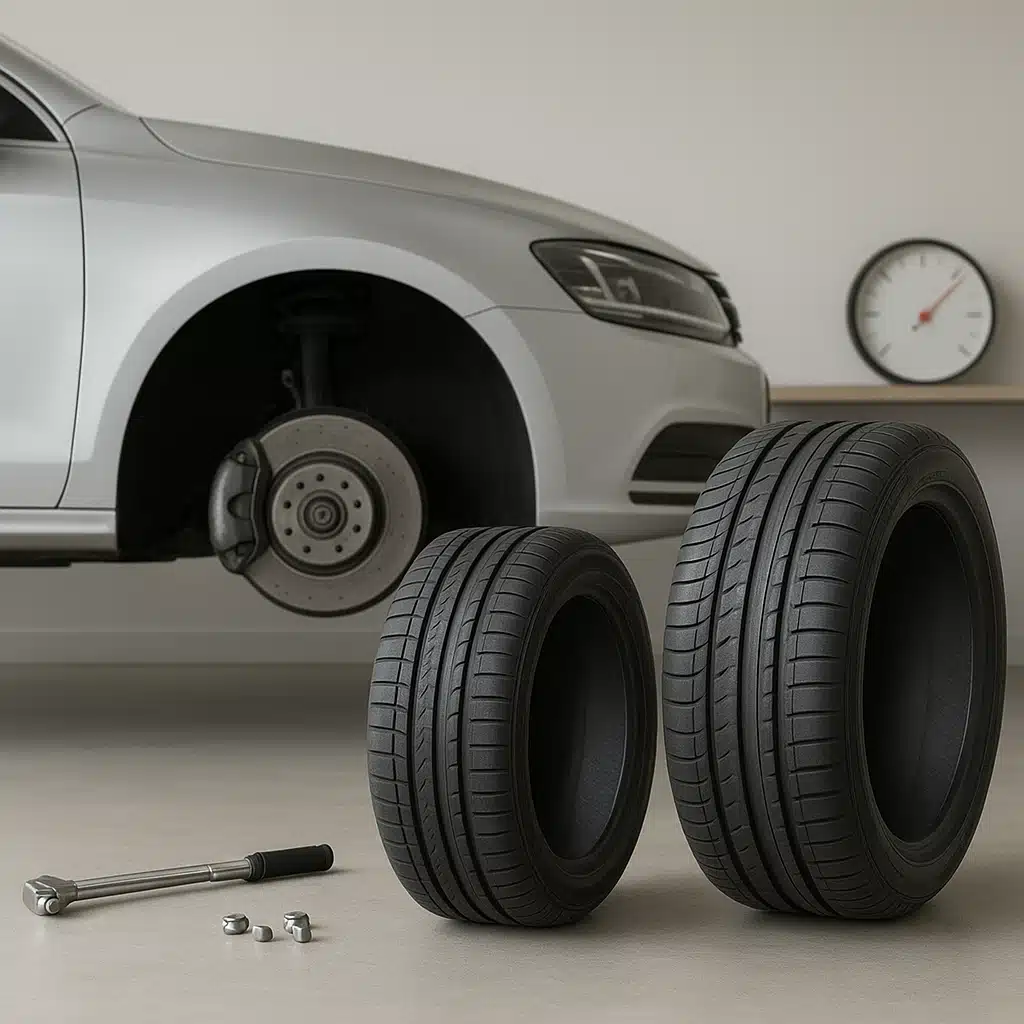
A tire size upgrade means changing your tire dimensions from the factory size. People often call this “plus-sizing.” Most of the time, plus-sizing means:
- A larger wheel diameter, like 16-inch wheels to 18-inch wheels
- A lower-profile tire sidewall, so the overall tire height stays close to stock
- Sometimes a wider tire for more grip or a different look
A tire size is usually written like 225/45R17:
- 225: The tire width in mm
- 45: The sidewall height as a percent of width
- R17: Wheel diameter in inches
The most important number for fuel economy, braking feel, and speedometer accuracy is the tire’s overall diameter (the full height of the mounted tire). The second big factor is weight: Heavier wheel and tire setups take more energy to spin and more force to slow down.
Why people do it
Drivers upgrade tire sizes for a few common reasons:
- Looks: Larger wheels and a lower sidewall can make a car look more modern.
- Handling feel: A shorter sidewall can feel sharper in turns because the tire flexes less.
- More grip: A wider tire can add traction, depending on the tire model and compound.
- Brake clearance: Bigger wheels can create room for larger brake parts on some setups.
But every change has trade-offs. Bigger and wider is not automatically better for daily driving.
Things to know before starting
Before you pick a new size, focus on four areas: Fitment, fuel economy, braking, and speedometer accuracy.
Fitment basics: Diameter, width, offset, and clearance
Your new tires must clear the suspension, brakes, and fenders at full steering lock and full suspension travel. A tire that fits while parked can still rub while turning or hitting bumps.
Wheel width and offset also matter. If you are not comfortable with offset math, start with Wheel offset explained so you know why some wheels poke out and some sit too far in.
Fuel economy: Rolling resistance and rotating mass
Tires affect MPG in two main ways:
- Rolling resistance: The energy needed to keep the tire rolling on the road.
- Rotating mass: The energy needed to spin the wheel and tire up to speed.
Authoritative research on tire efficiency shows rolling resistance is responsible for about 4–7% of fuel consumption in passenger cars. That means tires are not the only MPG factor, but they are a real one. Wider tires, aggressive tread, and heavier setups often raise rolling resistance and lower MPG.
NHTSA also notes that a 10% reduction in rolling resistance can improve fuel economy by about 1–2%. The same idea works in reverse: If your upgrade raises rolling resistance, MPG can drop.
Braking: Grip can help, weight can hurt
Braking performance depends on tire grip, tire contact patch, brake system condition, and road surface. A wider tire can add grip, but it is not a guarantee. Tire compound and tread design matter as much as width.
Also remember the weight issue: A heavier wheel and tire has more rotational energy. Your brakes must work harder to slow it down. That can raise stopping distance in some cases, and it can increase brake heat on long downhill driving.
Speedometer and odometer accuracy
Your car measures speed using wheel speed sensors and a programmed tire circumference. If you change overall tire diameter, your speedometer and odometer can become inaccurate.
- Larger overall diameter: Speedometer reads slower than your real speed.
- Smaller overall diameter: Speedometer reads faster than your real speed.
This also affects automatic transmission shift timing on some cars, and it can affect driver-assist systems that use wheel speed data.
Ride comfort and durability
Lower-profile tires usually ride harsher because there is less sidewall to absorb bumps. They are also easier to damage on potholes. If your roads are rough, a big wheel upgrade can be frustrating.
If you want a better tire without dramatic size changes, start with how to choose car tires and prioritize the right category, load rating, and construction for your driving.
Step-by-step explanation
1) Decide what you want to improve
Pick one main goal:
- Sharper steering feel
- More dry grip
- Better ride comfort
- Better winter traction
- Keep MPG as close to stock as possible
This matters because the “best” size is different for each goal.
2) Keep the overall diameter close to stock
For most daily drivers, try to keep the overall tire diameter close to factory. As a simple rule, smaller diameter changes keep the speedometer closer to correct and reduce rubbing risk.
If you go much taller, you also change gearing: The car may feel slower off the line because the tire travels farther per rotation.
3) Choose wheel diameter changes carefully
Going up 1 inch in wheel diameter is often easier to live with than jumping 2 or 3 inches. Larger jumps usually force a very short sidewall, which can hurt ride comfort and pothole protection.
4) Match tire width to wheel width
Do not stretch a tire too far or pinch it too much. A badly matched width can cause poor handling, uneven wear, and sidewall damage. Use the tire maker’s approved rim width range for the tire size you want.
5) Check load rating and speed rating
Your new tire must meet the vehicle’s required load capacity. If you choose a lower load rating, you can overload the tire during passengers, cargo, or high heat driving. Keep the speed rating appropriate for the car and your driving.
6) Confirm clearance at full lock and full compression
Clearance checks should include:
- Inside clearance to strut and control arms
- Outer clearance to fender lip
- Front wheels turned fully left and right
- Suspension compressed, especially if the car is lowered
If your car has been lowered, wheel and tire changes get harder. Start with Car suspension basics so you understand how ride height and alignment affect rubbing.
7) Plan for alignment
After changing wheels and tires, get an alignment if anything about ride height, suspension parts, or wheel specs changed. Even a small change in offset can shift how the tire sits under the car.
8) Verify speedometer with a GPS check
After installation, compare indicated speed to a GPS speed reading at steady speeds. If the difference is large, you may need recalibration options depending on the vehicle. Some cars can be programmed for tire size changes, and some cannot.
Common mistakes to avoid
- Going wider without a reason: Wider tires can hydroplane more easily in heavy rain, and they can be louder.
- Ignoring weight: A heavier wheel and tire combo can hurt MPG and acceleration and can make the car feel less playful.
- Chasing wheel diameter instead of tire quality: A great tire in the right category usually beats a bigger wheel with an average tire.
- Not checking offset: Wrong offset can cause rubbing, heavy steering feel, and faster wheel bearing wear.
- Forgetting the spare tire problem: A mismatched spare can be unsafe on AWD systems and can confuse traction control.
If cost is pushing you toward low-quality options, it helps to understand reasons tires are expensive so you know what parts of tire design actually matter for safety and performance.
Safety and legal considerations
Tires are safety parts. Stay within safe limits for load rating, speed rating, and clearance. A tire that rubs can cut into the sidewall, and sidewall damage can lead to sudden air loss.
Speedometer accuracy is also a safety issue. If your speedometer reads low, you can drive faster than you think. Laws vary by location, but a speedometer that is far off can create problems during inspections or traffic stops.
If you live in an area with strict inspections, keep documentation of your tire size and confirm it does not interfere with lights, fender coverage rules, or steering lock.
Final practical advice
For most street cars, the safest approach is a mild size change: Keep overall diameter close to stock, avoid big jumps in wheel diameter, and focus on tire quality and correct load rating. If you want better braking, choose a tire known for strong wet and dry grip and keep your brakes in good shape. If you want better MPG, avoid heavy wheels and overly wide tires, and look for tires built with lower rolling resistance.
When in doubt, change one thing at a time. A small, well-matched upgrade is easier to fit, easier to align, and easier to live with every day.


