


This post may contain affiliate links. Please read our disclosure and privacy policy for more information.
When a car hesitates only when you press the gas going uphill, it usually means the engine cannot make enough power under load. The good news is that many causes are common and fixable. The key is to take the symptom seriously, because a small hesitation can turn into a stall or a safety problem on a steep grade.
What This Problem Feels Like
Most drivers describe uphill hesitation as a delay when they press the accelerator, followed by a sudden surge. It often feels like the engine is trying to catch up.
You may notice it more on on-ramps, mountain roads, or even short steep hills in town. The car may be fine on flat roads, which can make the problem confusing.
Common ways it shows up:
- A brief stumble right as you ask for more power
- RPM rises slowly, then jumps
- The car feels like it is “holding back” for a moment
- It may downshift more than usual (automatic) or require more throttle (manual)
- The check engine light may be on or may flash during the hesitation
If the hesitation comes with shaking, that can point more toward a misfire. If it comes with a loud pinging sound, that can point toward knock. But the main symptom here is hesitation specifically under uphill load.
Is It Safe to Drive?
Light hesitation that happens once in a while, with no warning lights and no other symptoms, is usually not an immediate emergency. Still, it can be unsafe in certain situations because you need dependable power uphill.
Do not keep driving if any of these happen:
- The check engine light flashes
- The car loses speed fast and will not respond to throttle
- The engine runs rough and feels like it will stall
- You smell raw fuel, or you see smoke
- The hesitation is getting worse on every trip
If you need to drive to a safe place or to a shop, avoid steep routes, keep extra following distance, and do not attempt risky merges where you need strong acceleration.
Common Causes
Going uphill puts the engine under heavier load. That demands more fuel, more air, strong spark, and correct sensor signals. A weakness in any of those can show up first on hills.
Weak ignition parts causing a misfire under load
Worn spark plugs, weak ignition coils, or damaged plug wires can fire well enough at idle and cruising, but struggle when cylinder pressure rises uphill. The result can be hesitation, a stumble, or a brief shake.
Why it happens: Spark has a harder job under load. If spark is weak, it can misfire for a split second right when you ask for power.
If you also hear pinging or feel a hard rattle when accelerating, that is a different warning sign. For comparison symptoms, see Engine knocking when accelerating.
Fuel delivery that cannot keep up
An engine climbing a hill needs more fuel right now, not a second later. Common fuel-related causes include a partially clogged fuel filter (if your vehicle has a serviceable one), a weak fuel pump, a restricted fuel line, or fuel injectors that are dirty enough to reduce flow.
Why it happens: On flat ground, fuel demand is lower and a tired pump or restriction can still “get by.” Uphill load exposes the problem.
If this started soon after refueling, contamination or the wrong fuel can be part of the story. Similar patterns are covered in Car weak after refueling.
Air intake problems and unmetered air leaks
If the engine cannot measure air correctly, it cannot match fuel correctly. A dirty air filter, a failing mass air flow (MAF) sensor, or a vacuum leak can cause a lean condition that shows up as hesitation on hills.
Why it happens: Under load, the engine needs a stable air and fuel mix. Extra air entering after the sensor, or a sensor reading wrong, can make the mixture too lean and power drops.
Related clue: A rough idle or high idle often points more to an air leak, but uphill hesitation can still be the main symptom.
Throttle body and pedal control issues (drive-by-wire)
Many modern cars use an electronic throttle body. Carbon buildup around the throttle plate can affect airflow changes. A throttle actuator or throttle position sensor issue can also cause a delay between your foot and engine response.
Why it happens: The system has to react quickly when you add throttle uphill. If the throttle plate sticks slightly or the signal is unstable, you feel hesitation.
Transmission behavior that feels like engine hesitation
Sometimes the engine is fine, but the transmission hesitates to downshift on a hill, which makes the car feel like it bogs before it finally “wakes up.” This is more common if the transmission fluid is old, low, or overheated, or if the vehicle is hunting between gears.
Why it happens: If the transmission stays in too high a gear for too long, the engine lugs and responds slowly.
This can be tricky because it feels similar to engine power loss. If the RPM does not rise much when you press the gas and speed drops, think transmission decision or slip. If RPM rises but the car does not respond, think slip. If RPM and speed both lag together, think engine output.
Exhaust restriction (less common, but important)
A restricted catalytic converter or crushed exhaust can choke the engine, especially when it needs to breathe more uphill.
Why it happens: Exhaust pressure builds and the engine cannot push out gases fast enough. Power falls off and the car may hesitate, then struggle at higher speeds.
Related clue: You may notice a gradual loss of power over days or weeks, and the engine may feel “plugged up” at higher RPM.
Quick Checks You Can Do at Home
These checks are meant to be safe and basic. They can help you decide whether the issue is simple or if the car needs professional diagnosis soon.
Look for a warning light and note when it happens
If the check engine light is on, the stored codes can point the diagnosis in the right direction. If the light flashes during uphill acceleration, stop pushing the car hard and schedule service soon. A flashing light often means an active misfire that can damage the catalytic converter.
Write down exactly when it hesitates: Engine warm or cold, only on steep hills, only with passengers, only when the AC is on, and whether it happens at a certain RPM range.
Check the air filter
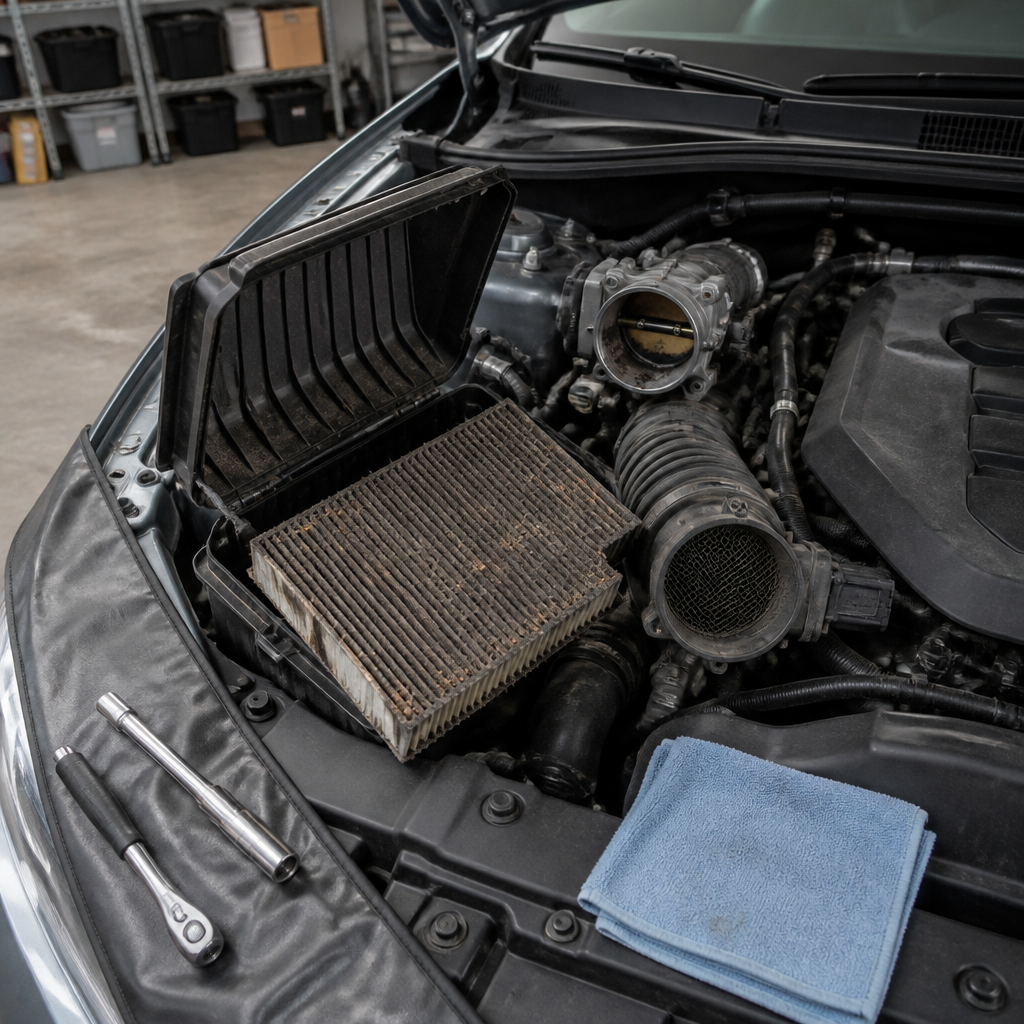
A clogged air filter can reduce airflow and make the engine feel weak under load. If it is dark, packed with debris, or wet, replace it. Make sure the air box is closed properly afterward.
Quick visual check for loose intake hoses
With the engine off and cool, inspect the main intake tube between the air box and the engine. Look for cracks, loose clamps, or a hose that has slipped off. Also look for any obvious broken vacuum hoses.
Do not spray cleaners or flammables around the engine bay. A visual check is enough here.
Check battery voltage and charging health if symptoms are intermittent
Low system voltage can cause odd behavior from coils, sensors, and the electronic throttle. If the hesitation comes and goes with other electrical weirdness, it is worth doing a basic charging check. You can use test your car alternator methods with a meter, or have it checked quickly at a shop.
Pay attention to fueling patterns
If hesitation started right after a fill-up, avoid heavy acceleration and steep hills until the issue is checked. If it improves as you burn fuel, that supports a fuel-related cause. If it stays the same, it can still be fuel delivery, but it is less tied to that one event.
When This Becomes Serious
Hesitation uphill stops being “minor” when it starts to affect safe traffic flow or points to damage risk.
Take it seriously right away if:
- The car hesitates so badly that you cannot maintain speed on a hill
- The engine shakes noticeably during the hesitation
- The check engine light flashes, even if it stops later
- You hear popping in the intake or exhaust
- The problem gets worse quickly over a few days
If your car feels generally weak even on flat roads, that is a broader symptom set than hill-only hesitation. For a wider look at that pattern, see Car feels slow to accelerate.
How a Mechanic Fixes It
A shop will usually confirm the symptom with a road test, then focus on the systems that fail under load.
- Scan for codes and misfire data: Even if the light is off, many cars store history codes and misfire counts. This helps narrow down ignition vs fuel vs air metering.
- Check ignition performance: The mechanic may inspect plug condition, test coils, and verify correct plug type and gap. Worn plugs and weak coils are common fixes for hesitation under load.
- Measure fuel pressure and volume: This confirms whether the pump and regulator can supply fuel during acceleration. If pressure drops under load, the fix may involve the pump, filter, wiring, or a restricted line.
- Verify sensor readings: MAF readings, oxygen sensor behavior, fuel trims, and throttle position are reviewed on a scan tool during a loaded test. Bad data leads to hesitation because fueling is wrong.
- Inspect for vacuum and intake leaks: Smoke testing is common. Small leaks can cause big drivability issues.
- Check for exhaust restriction: If power falls off sharply at higher RPM, they may test backpressure or compare sensor readings to confirm a restricted catalytic converter.
The actual repair depends on what fails the test. A good shop will show you the test result that proves the cause, not just guess and swap parts.
Common Mistakes to Avoid
- Ignoring a flashing check engine light: That can mean a misfire severe enough to overheat and damage the catalytic converter.
- Replacing parts based only on a guess: Uphill hesitation has several common causes. Testing is cheaper than repeated wrong parts.
- Cleaning sensors the wrong way: Some sensors are easy to damage. If you are not sure, leave it to a shop.
- Driving it hard to “clear it out”: If the engine is running lean or misfiring, hard driving can make damage more likely.
- Mixing up transmission lag with engine hesitation: Pay attention to RPM behavior. It helps the diagnosis.
Related Problems to Watch For
Hesitation uphill often overlaps with a few other symptoms. Noticing them can speed up diagnosis.
- Power loss on grades without obvious hesitation: This is the same family of problems, just less of a “stumble” and more of a steady lack of pull. See power loss climbing hills.
- Shaking during acceleration: Often points more strongly to a misfire or mount issue. If the hesitation includes vibration, shaking when accelerating fixes may match what you feel.
- Hard starts or rough idle: Can suggest air leaks, ignition wear, or fuel delivery issues getting worse.
Final Thoughts
If your engine hesitates when accelerating uphill, treat it as a load-related power problem: The engine is being asked to work harder and something cannot keep up. Start with safe basics like checking the air filter, looking for loose intake tubing, and watching for a warning light.
If the hesitation is repeatable on hills, happens during merges, or comes with a flashing check engine light or shaking, book a diagnosis soon and avoid steep routes until it is fixed. Reliable uphill power is not just about performance. It is about being able to move with traffic when you need to.


